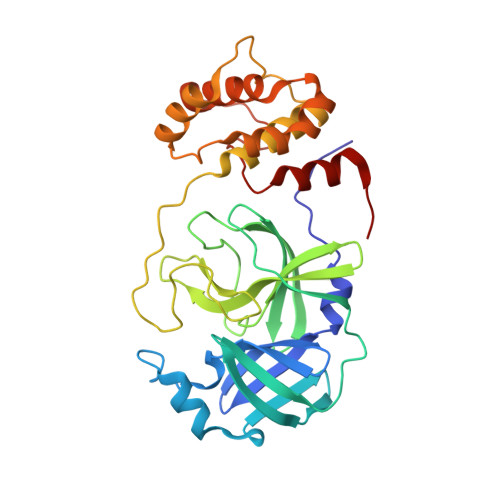
7P2G | pdb_00007p2g

Identification of low micromolar SARS-CoV-2 Mpro inhibitors from hits identified by in silico screens


Experimental Data Snapshot

  • Method: X-RAY DIFFRACTION
  • Resolution: 2.50 Å
  • R-Value Free: 
    0.277 (Depositor), 0.273 (DCC) 
  • R-Value Work: 
    0.224 (Depositor), 0.229 (DCC) 
  • R-Value Observed: 
    0.227 (Depositor) 

Starting Model: experimental
View more details

wwPDB Validation 3D Report Full Report

Validation slider image for 7P2G

Ligand Structure Quality Assessment 


This is version 1.2 of the entry. See complete history

Literature

Non-covalent SARS-CoV-2 M pro inhibitors developed from in silico screen hits.

Rossetti, G.G.Ossorio, M.A.Rempel, S.Kratzel, A.Dionellis, V.S.Barriot, S.Tropia, L.Gorgulla, C.Arthanari, H.Thiel, V.Mohr, P.Gamboni, R.Halazonetis, T.D.

(2022) Sci Rep 12: 2505-2505

  • DOI: https://doi.org/10.1038/s41598-022-06306-4
  • Primary Citation Related Structures: 
    7P2G

  • PubMed Abstract: 

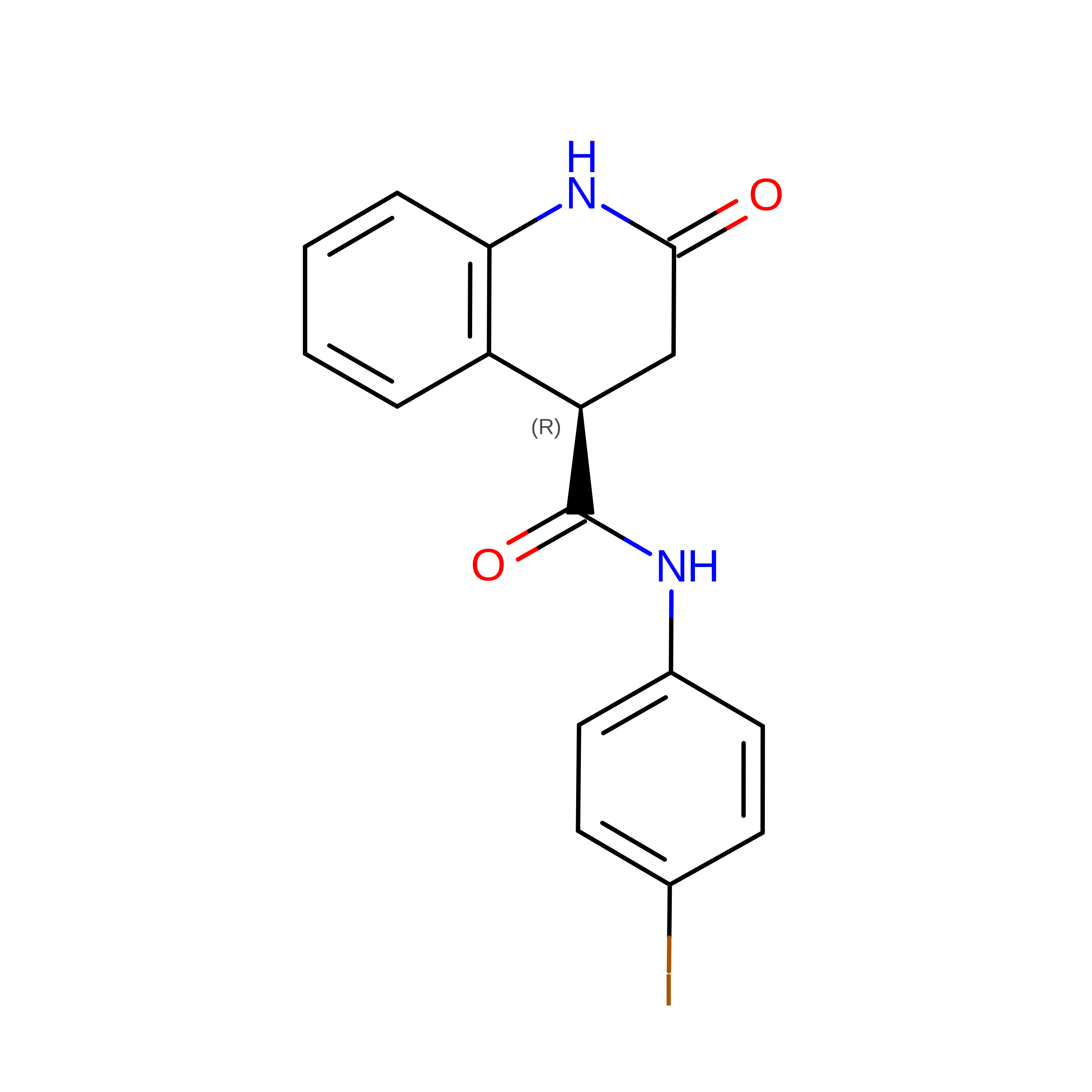
    M pro , the main protease of the severe acute respiratory syndrome coronavirus 2 (SARS-CoV-2), is essential for the viral life cycle. Accordingly, several groups have performed in silico screens to identify M pro inhibitors that might be used to treat SARS-CoV-2 infections. We selected more than five hundred compounds from the top-ranking hits of two very large in silico screens for on-demand synthesis. We then examined whether these compounds could bind to M pro and inhibit its protease activity. Two interesting chemotypes were identified, which were further evaluated by characterizing an additional five hundred synthesis on-demand analogues. The compounds of the first chemotype denatured M pro and were considered not useful for further development. The compounds of the second chemotype bound to and enhanced the melting temperature of M pro . The most active compound from this chemotype inhibited M pro in vitro with an IC 50 value of 1 μM and suppressed replication of the SARS-CoV-2 virus in tissue culture cells. Its mode of binding to M pro was determined by X-ray crystallography, revealing that it is a non-covalent inhibitor. We propose that the inhibitors described here could form the basis for medicinal chemistry efforts that could lead to the development of clinically relevant inhibitors.


  • Organizational Affiliation
    • Department of Molecular Biology, University of Geneva, 1205, Geneva, Switzerland.

Macromolecule Content 

  • Total Structure Weight: 34.22 kDa 
  • Atom Count: 2,383 
  • Modeled Residue Count: 305 
  • Deposited Residue Count: 306 
  • Unique protein chains: 1

Macromolecules

Find similar proteins by:|  3D Structure
Entity ID: 1
MoleculeChains  Sequence LengthOrganismDetailsImage
3C-like proteinase306Severe acute respiratory syndrome coronavirus 2Mutation(s): 0 
Gene Names: ORF1ab
EC: 2.7.7.48 (PDB Primary Data), 3.4.19.12 (PDB Primary Data), 3.4.22.69 (PDB Primary Data), 3.6.4.12 (PDB Primary Data), 3.6.4.13 (PDB Primary Data)
UniProt
Find proteins for P0DTD1 (Severe acute respiratory syndrome coronavirus 2)
Explore P0DTD1 
Go to UniProtKB:  P0DTD1
Entity Groups
Sequence Clusters30% Identity50% Identity70% Identity90% Identity95% Identity100% Identity
UniProt GroupP0DTD1
Sequence Annotations
Expand
Reference Sequence

Small Molecules

Ligands 1 Unique
IDChains Name / Formula / InChI Key2D Diagram3D Interactions
4N0
(Subject of Investigation/LOI)

Query on 4N0


Download:Ideal Coordinates CCD File
B [auth A](4~{R})-~{N}-(4-iodophenyl)-2-oxidanylidene-3,4-dihydro-1~{H}-quinoline-4-carboxamide
C16 H13 I N2 O2
DDBKMCQLKKZOJH-CYBMUJFWSA-N

Experimental Data & Validation

Experimental Data

  • Method: X-RAY DIFFRACTION
  • Resolution: 2.50 Å
  • R-Value Free:  0.277 (Depositor), 0.273 (DCC) 
  • R-Value Work:  0.224 (Depositor), 0.229 (DCC) 
  • R-Value Observed: 0.227 (Depositor) 
Space Group: C 1 2 1
Unit Cell:
Length ( Å )Angle ( ˚ )
a = 114.61α = 90
b = 53.79β = 100.976
c = 45.44γ = 90
Software Package:
Software NamePurpose
PHENIXrefinement
XDSdata reduction
XSCALEdata scaling
PHASERphasing

Structure Validation

View Full Validation Report


Ligand Structure Quality Assessment 


Entry History 

Deposition Data

Revision History  (Full details and data files)

  • Version 1.0: 2022-05-04
    Type: Initial release
  • Version 1.1: 2022-05-11
    Changes: Database references
  • Version 1.2: 2024-01-31
    Changes: Data collection, Refinement description