7ORJ | pdb_00007orj

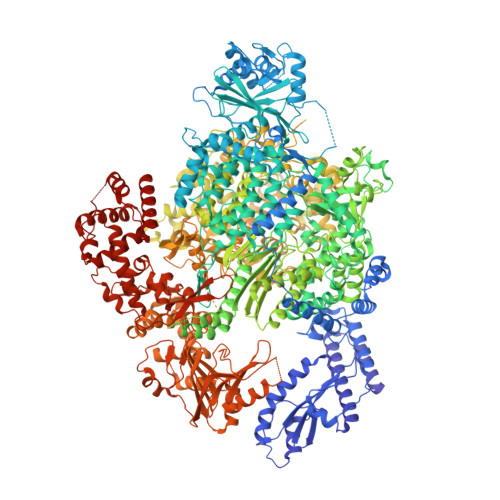
La Crosse virus polymerase at transcription capped RNA cleavage stage


Experimental Data Snapshot

  • Method: ELECTRON MICROSCOPY
  • Resolution: 3.90 Å
  • Aggregation State: PARTICLE 
  • Reconstruction Method: SINGLE PARTICLE 

Starting Model: experimental
View more details

wwPDB Validation 3D Report Full Report

Validation slider image for 7ORJ

This is version 1.2 of the entry. See complete history

Literature

Structural snapshots of La Crosse virus polymerase reveal the mechanisms underlying Peribunyaviridae replication and transcription.

Arragain, B.Durieux Trouilleton, Q.Baudin, F.Provaznik, J.Azevedo, N.Cusack, S.Schoehn, G.Malet, H.

(2022) Nat Commun 13: 902-902

  • DOI: https://doi.org/10.1038/s41467-022-28428-z
  • Primary Citation Related Structures: 
    7ORI, 7ORJ, 7ORK, 7ORL, 7ORM, 7ORN, 7ORO

  • PubMed Abstract: 

    Segmented negative-strand RNA bunyaviruses encode a multi-functional polymerase that performs genome replication and transcription. Here, we establish conditions for in vitro activity of La Crosse virus polymerase and visualize its conformational dynamics by cryo-electron microscopy, unveiling the precise molecular mechanics underlying its essential activities. We find that replication initiation is coupled to distal duplex promoter formation, endonuclease movement, prime-and-realign loop extension and closure of the polymerase core that direct the template towards the active site. Transcription initiation depends on C-terminal region closure and endonuclease movements that prompt primer cleavage prior to primer entry in the active site. Product realignment after priming, observed in replication and transcription, is triggered by the prime-and-realign loop. Switch to elongation results in polymerase reorganization and core region opening to facilitate template-product duplex formation in the active site cavity. The uncovered detailed mechanics should be helpful for the future design of antivirals counteracting bunyaviral life threatening pathogens.


  • Organizational Affiliation
    • Univ. Grenoble Alpes, CNRS, CEA, IBS, F-38000, Grenoble, France.

Macromolecule Content 

  • Total Structure Weight: 283.61 kDa 
  • Atom Count: 18,197 
  • Modeled Residue Count: 2,165 
  • Deposited Residue Count: 2,332 
  • Unique protein chains: 1
  • Unique nucleic acid chains: 3

Macromolecules


Find similar proteins by:|  3D Structure
Entity ID: 1
MoleculeChains  Sequence LengthOrganismDetailsImage
RNA-directed RNA polymerase L2,276La Crosse virusMutation(s): 1 
EC: 2.7.7.48 (PDB Primary Data), 3.1 (PDB Primary Data)
UniProt
Find proteins for A5HC98 (Bunyavirus La Crosse)
Explore A5HC98 
Go to UniProtKB:  A5HC98
Entity Groups
Sequence Clusters30% Identity50% Identity70% Identity90% Identity95% Identity100% Identity
UniProt GroupA5HC98
Sequence Annotations
Expand
Reference Sequence
Find similar nucleic acids by:  Sequence
Entity ID: 2
MoleculeChains LengthOrganismImage
RNA (5'-R(P*AP*CP*GP*AP*GP*UP*GP*UP*CP*GP*UP*AP*CP*CP*AP*AP*G)-3')B [auth H]17Orthobunyavirus lacrosseense
Sequence Annotations
Expand
Reference Sequence
Find similar nucleic acids by:  Sequence
Entity ID: 3
MoleculeChains LengthOrganismImage
RNA (5'-R(P*CP*UP*UP*GP*GP*UP*AP*GP*UP*AP*CP*AP*CP*UP*AP*CP*U)-3')C [auth T]25Orthobunyavirus lacrosseense
Sequence Annotations
Expand
Reference Sequence
Find similar nucleic acids by:  Sequence
Entity ID: 4
MoleculeChains LengthOrganismImage
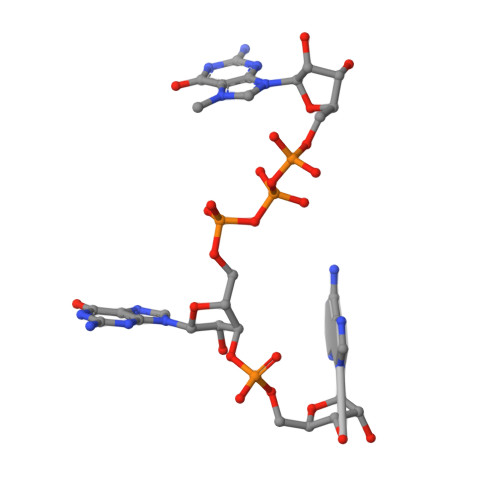
5' capped RNAD [auth P]14Orthobunyavirus lacrosseense
Sequence Annotations
Expand
Reference Sequence

Experimental Data & Validation

Experimental Data

  • Method: ELECTRON MICROSCOPY
  • Resolution: 3.90 Å
  • Aggregation State: PARTICLE 
  • Reconstruction Method: SINGLE PARTICLE 
EM Software:
TaskSoftware PackageVersion
RECONSTRUCTIONRELION3.1
MODEL REFINEMENTPHENIX1.19.2

Structure Validation

View Full Validation Report


Entry History 

& Funding Information

Deposition Data


Funding OrganizationLocationGrant Number
Agence Nationale de la Recherche (ANR)FranceANR-19-CE11-0024-02

Revision History  (Full details and data files)

  • Version 1.0: 2022-02-16
    Type: Initial release
  • Version 1.1: 2022-03-02
    Changes: Database references
  • Version 1.2: 2024-07-17
    Changes: Data collection, Refinement description