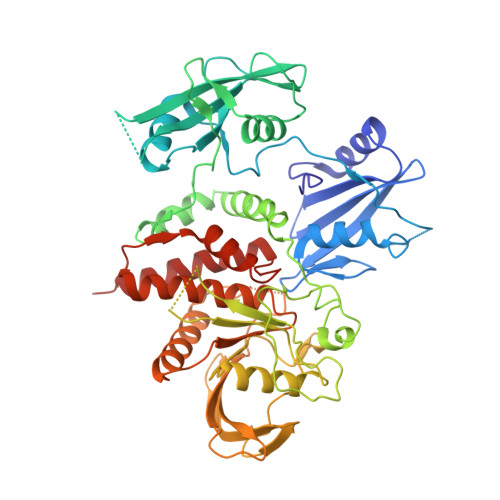
7EMN | pdb_00007emn

The atomic structure of SHP2 E76A mutant


Experimental Data Snapshot

  • Method: X-RAY DIFFRACTION
  • Resolution: 3.00 Å
  • R-Value Free: 
    0.271 (Depositor), 0.272 (DCC) 
  • R-Value Work: 
    0.223 (Depositor), 0.223 (DCC) 
  • R-Value Observed: 
    0.226 (Depositor) 

Starting Model: experimental
View more details

wwPDB Validation 3D Report Full Report

Validation slider image for 7EMN

This is version 1.2 of the entry. See complete history

Literature

A novel partially open state of SHP2 points to a "multiple gear" regulation mechanism.

Tao, Y.Xie, J.Zhong, Q.Wang, Y.Zhang, S.Luo, F.Wen, F.Xie, J.Zhao, J.Sun, X.Long, H.Ma, J.Zhang, Q.Long, J.Fang, X.Lu, Y.Li, D.Li, M.Zhu, J.Sun, B.Li, G.Diao, J.Liu, C.

(2021) J Biological Chem 296: 100538-100538

  • DOI: https://doi.org/10.1016/j.jbc.2021.100538
  • Primary Citation Related Structures: 
    7EMN

  • PubMed Abstract: 

    The protein tyrosine phosphatase SHP2 mediates multiple signal transductions in various cellular pathways, controlled by a variety of upstream inputs. SHP2 dysregulation is causative of different types of cancers and developmental disorders, making it a promising drug target. However, how SHP2 is modulated by its different regulators remains largely unknown. Here, we use single-molecule fluorescence resonance energy transfer and molecular dynamics simulations to investigate this question. We identify a partially open, semiactive conformation of SHP2 that is intermediate between the known open and closed states. We further demonstrate a "multiple gear" regulatory mechanism, in which different activators (e.g., insulin receptor substrate-1 and CagA), oncogenic mutations (e.g., E76A), and allosteric inhibitors (e.g., SHP099) can shift the equilibrium of the three conformational states and regulate SHP2 activity to different levels. Our work reveals the essential role of the intermediate state in fine-tuning the activity of SHP2, which may provide new opportunities for drug development for relevant cancers.


  • Organizational Affiliation
    • Bio-X Institutes, Key Laboratory for the Genetics of Developmental and Neuropsychiatric Disorders, Ministry of Education, Shanghai Jiao Tong University, Shanghai, China.

Macromolecule Content 

  • Total Structure Weight: 122.78 kDa 
  • Atom Count: 7,956 
  • Modeled Residue Count: 992 
  • Deposited Residue Count: 1,068 
  • Unique protein chains: 1

Macromolecules

Find similar proteins by:|  3D Structure
Entity ID: 1
MoleculeChains  Sequence LengthOrganismDetailsImage
Tyrosine-protein phosphatase non-receptor type 11
A, B
534Homo sapiensMutation(s): 1 
Gene Names: PTPN11PTP2CSHPTP2
EC: 3.1.3.48
UniProt & NIH Common Fund Data Resources
Find proteins for Q06124 (Homo sapiens)
Explore Q06124 
Go to UniProtKB:  Q06124
PHAROS:  Q06124
GTEx:  ENSG00000179295 
Entity Groups
Sequence Clusters30% Identity50% Identity70% Identity90% Identity95% Identity100% Identity
UniProt GroupQ06124
Sequence Annotations
Expand
Reference Sequence

Experimental Data & Validation

Experimental Data

  • Method: X-RAY DIFFRACTION
  • Resolution: 3.00 Å
  • R-Value Free:  0.271 (Depositor), 0.272 (DCC) 
  • R-Value Work:  0.223 (Depositor), 0.223 (DCC) 
  • R-Value Observed: 0.226 (Depositor) 
Space Group: P 1 21 1
Unit Cell:
Length ( Å )Angle ( ˚ )
a = 46.2α = 90
b = 211.45β = 96.96
c = 56.1γ = 90
Software Package:
Software NamePurpose
SCALEPACKdata scaling
PHENIXrefinement
PDB_EXTRACTdata extraction
XDSdata reduction
PHENIXphasing

Structure Validation

View Full Validation Report


Entry History 

Deposition Data

Revision History  (Full details and data files)

  • Version 1.0: 2021-05-05
    Type: Initial release
  • Version 1.1: 2021-07-21
    Changes: Database references
  • Version 1.2: 2023-11-29
    Changes: Data collection, Database references, Refinement description