Download Mendeley
Aha1 Exhibits Distinctive Dynamics Behavior and Chaperone-Like Activity.
Hu, H., Wang, Q., Du, J., Liu, Z., Ding, Y., Xue, H., Zhou, C., Feng, L., Zhang, N.(2021) Molecules 26
- PubMed: 33808352 Search on PubMedSearch on PubMed Central
- DOI: https://doi.org/10.3390/molecules26071943
- Primary Citation Related Structures:
7DMD, 7DME - PubMed Abstract:
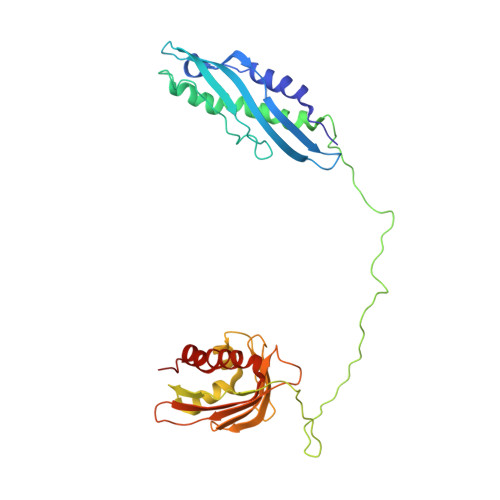
Aha1 is the only co-chaperone known to strongly stimulate the ATPase activity of Hsp90. Meanwhile, besides the well-studied co-chaperone function, human Aha1 has also been demonstrated to exhibit chaperoning activity against stress-denatured proteins. To provide structural insights for a better understanding of Aha1's co-chaperone and chaperone-like activities, nuclear magnetic resonance (NMR) techniques were used to reveal the unique structure and internal dynamics features of full-length human Aha1. We then found that, in solution, both the two domains of Aha1 presented distinctive thermal stabilities and dynamics behaviors defined by their primary sequences and three-dimensional structures. The low thermal stability (melting temperature of Aha1 28-162 : 54.45 °C) and the internal dynamics featured with slow motions on the µs-ms time scale were detected for Aha1's N-terminal domain (Aha1N). The aforementioned experimental results suggest that Aha1N is in an energy-unfavorable state, which would therefore thermostatically favor the interaction of Aha1N with its partner proteins such as Hsp90's middle domain. Differently from Aha1N, Aha1C (Aha1's C-terminal domain) exhibited enhanced thermal stability (melting temperature of Aha1 204-335 : 72.41 °C) and the internal dynamics featured with intermediate motions on the ps-ns time scale. Aha1C's thermal and structural stabilities make it competent for the stabilization of the exposed hydrophobic groove of dimerized Hsp90's N-terminal domain. Of note, according to the NMR data and the thermal shift results, although the very N-terminal region (M1-W27) and the C-terminal relaxin-like factor (RLF) motif showed no tight contacts with the remaining parts of human Aha1, they were identified to play important roles in the recognition of intrinsically disordered pathological α-synuclein.
- Analytical Research Center for Organic and Biological Molecules, Shanghai Institute of Materia Medica, Chinese Academy of Sciences, 555 Zu Chong Zhi Road, Shanghai 201203, China.
Organizational Affiliation: