7DBS | pdb_00007dbs

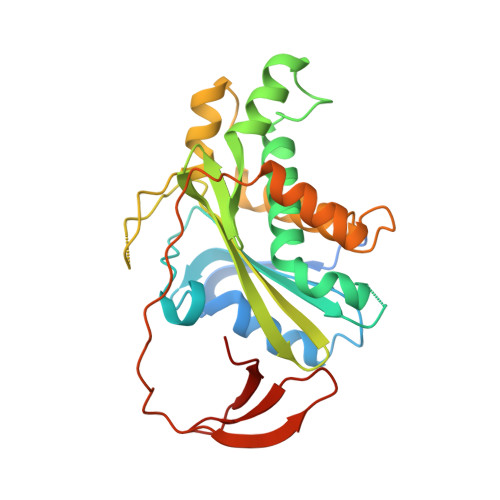
Crystal Structure Of Biotin Protein Ligase From Leishmania Major in complex with Biotin


Experimental Data Snapshot

  • Method: X-RAY DIFFRACTION
  • Resolution: 2.33 Å
  • R-Value Free: 
    0.242 (Depositor), 0.247 (DCC) 
  • R-Value Work: 
    0.217 (Depositor), 0.219 (DCC) 
  • R-Value Observed: 
    0.218 (Depositor) 

Starting Model: experimental
View more details

wwPDB Validation 3D Report Full Report

Validation slider image for 7DBS

Ligand Structure Quality Assessment 


This is version 1.2 of the entry. See complete history

Literature

Leishmania major biotin protein ligase forms a unique cross-handshake dimer.

Rajak, M.K.Bhatnagar, S.Pandey, S.Kumar, S.Verma, S.Patel, A.K.Sundd, M.

(2021) Acta Crystallogr D Struct Biol 77: 510-521

  • DOI: https://doi.org/10.1107/S2059798321001418
  • Primary Citation Related Structures: 
    7DBS

  • PubMed Abstract: 

    Biotin protein ligase catalyses the post-translational modification of biotin carboxyl carrier protein (BCCP) domains, a modification that is crucial for the function of several carboxylases. It is a two-step process that results in the covalent attachment of biotin to the ϵ-amino group of a conserved lysine of the BCCP domain of a carboxylase in an ATP-dependent manner. In Leishmania, three mitochondrial enzymes, acetyl-CoA carboxylase, methylcrotonyl-CoA carboxylase and propionyl-CoA carboxylase, depend on biotinylation for activity. In view of the indispensable role of the biotinylating enzyme in the activation of these carboxylases, crystal structures of L. major biotin protein ligase complexed with biotin and with biotinyl-5'-AMP have been solved. L. major biotin protein ligase crystallizes as a unique dimer formed by cross-handshake interactions of the hinge region of the two monomers formed by partial unfolding of the C-terminal domain. Interestingly, the substrate (BCCP domain)-binding site of each monomer is occupied by its own C-terminal domain in the dimer structure. This was observed in all of the crystals that were obtained, suggesting a closed/inactive conformation of the enzyme. Size-exclusion chromatography studies carried out using high protein concentrations (0.5 mM) suggest the formation of a concentration-dependent dimer that exists in equilibrium with the monomer.


  • Organizational Affiliation
    • National Institute of Immunology, Aruna Asaf Ali Marg, New Delhi 110 067, India.

Macromolecule Content 

  • Total Structure Weight: 30.8 kDa 
  • Atom Count: 1,883 
  • Modeled Residue Count: 252 
  • Deposited Residue Count: 283 
  • Unique protein chains: 1

Macromolecules

Find similar proteins by:|  3D Structure
Entity ID: 1
MoleculeChains  Sequence LengthOrganismDetailsImage
Biotin/lipoate protein ligase-like protein283Leishmania majorMutation(s): 0 
Gene Names: LMJF_31_1070
EC: 6.3.4.15
UniProt
Find proteins for Q4Q6F6 (Leishmania major)
Explore Q4Q6F6 
Go to UniProtKB:  Q4Q6F6
Entity Groups
Sequence Clusters30% Identity50% Identity70% Identity90% Identity95% Identity100% Identity
UniProt GroupQ4Q6F6
Sequence Annotations
Expand
Reference Sequence

Small Molecules

Ligands 1 Unique
IDChains Name / Formula / InChI Key2D Diagram3D Interactions
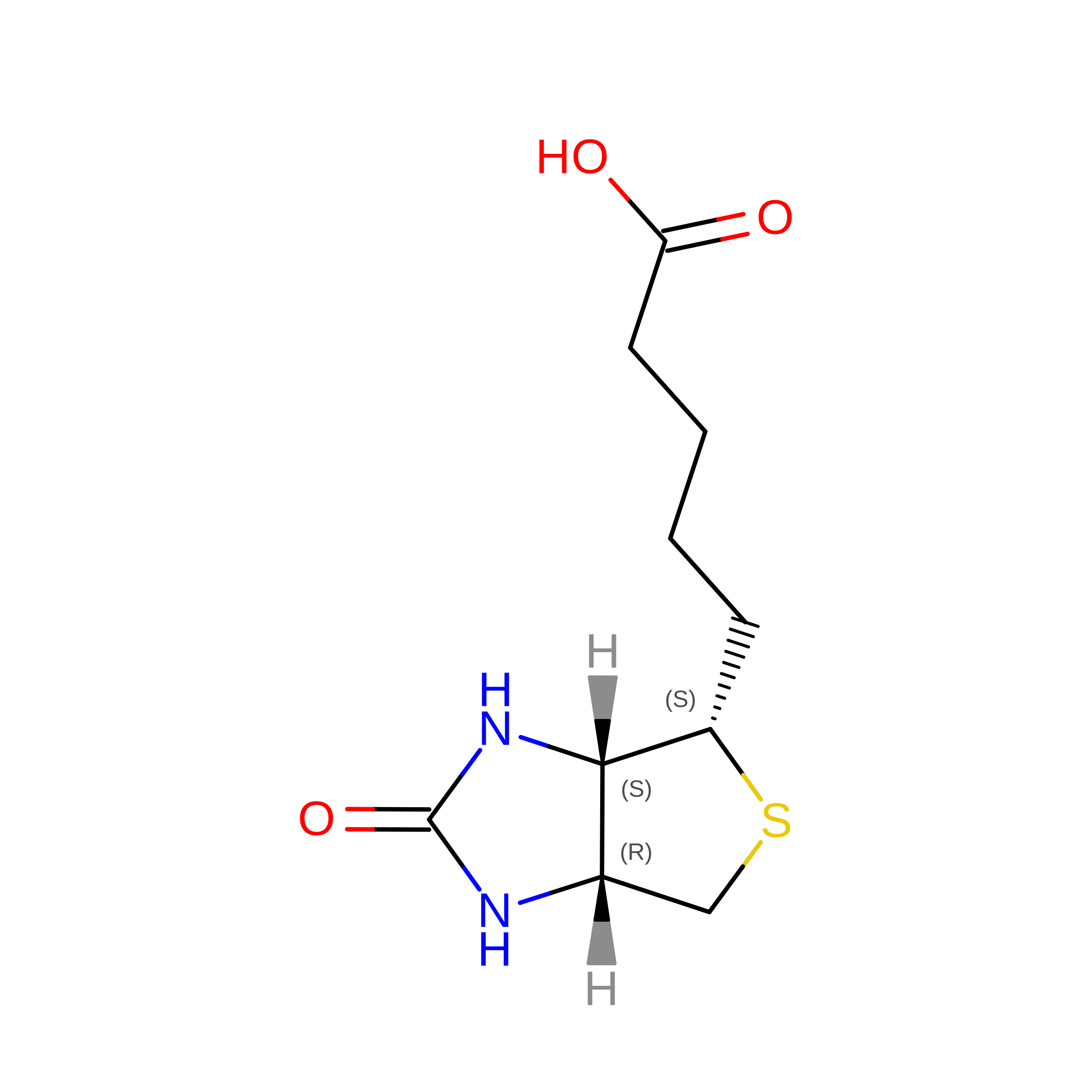
BTN
(Subject of Investigation/LOI)

Query on BTN


Download:Ideal Coordinates CCD File
B [auth A]BIOTIN
C10 H16 N2 O3 S
YBJHBAHKTGYVGT-ZKWXMUAHSA-N

Experimental Data & Validation

Experimental Data

  • Method: X-RAY DIFFRACTION
  • Resolution: 2.33 Å
  • R-Value Free:  0.242 (Depositor), 0.247 (DCC) 
  • R-Value Work:  0.217 (Depositor), 0.219 (DCC) 
  • R-Value Observed: 0.218 (Depositor) 
Space Group: C 1 2 1
Unit Cell:
Length ( Å )Angle ( ˚ )
a = 115.918α = 90
b = 44.7β = 104.072
c = 54.472γ = 90
Software Package:
Software NamePurpose
PHENIXrefinement
Aimlessdata scaling
PHENIXphasing
PHENIXmodel building

Structure Validation

View Full Validation Report


Ligand Structure Quality Assessment 


Entry History 

Deposition Data

Revision History  (Full details and data files)

  • Version 1.0: 2021-04-14
    Type: Initial release
  • Version 1.1: 2021-04-21
    Changes: Database references
  • Version 1.2: 2023-11-29
    Changes: Data collection, Database references, Refinement description