6ZW0 | pdb_00006zw0

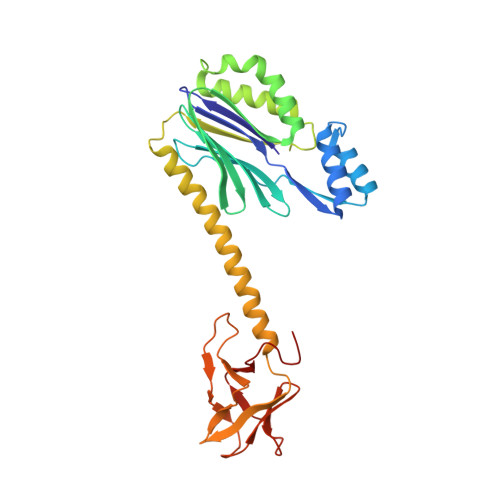
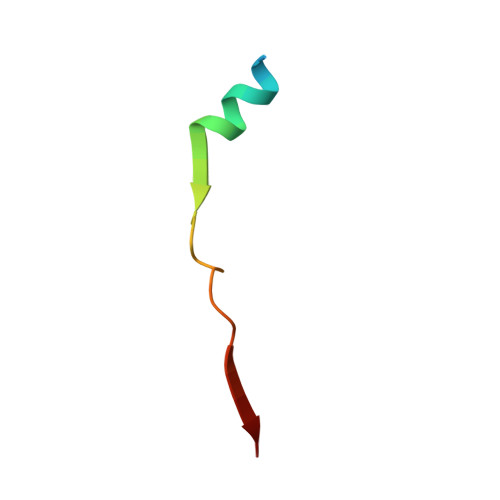
Connectase MJ0548 from Methanocaldococcus jannaschii in complex with an MtrA-derived peptide


Experimental Data Snapshot

  • Method: X-RAY DIFFRACTION
  • Resolution: 3.05 Å
  • R-Value Free: 
    0.294 (Depositor), 0.291 (DCC) 
  • R-Value Work: 
    0.254 (Depositor), 0.254 (DCC) 
  • R-Value Observed: 
    0.256 (Depositor) 

Starting Model: experimental
View more details

wwPDB Validation 3D Report Full Report

Validation slider image for 6ZW0

Ligand Structure Quality Assessment 


This is version 1.2 of the entry. See complete history

Literature

Archaeal Connectase is a specific and efficient protein ligase related to proteasome beta subunits.

Fuchs, A.C.D.Ammelburg, M.Martin, J.Schmitz, R.A.Hartmann, M.D.Lupas, A.N.

(2021) Proc Natl Acad Sci U S A 118

  • DOI: https://doi.org/10.1073/pnas.2017871118
  • Primary Citation Related Structures: 
    6ZVZ, 6ZW0

  • PubMed Abstract: 

    Sequence-specific protein ligations are widely used to produce customized proteins "on demand." Such chimeric, immobilized, fluorophore-conjugated or segmentally labeled proteins are generated using a range of chemical, (split) intein, split domain, or enzymatic methods. Where short ligation motifs and good chemoselectivity are required, ligase enzymes are often chosen, although they have a number of disadvantages, for example poor catalytic efficiency, low substrate specificity, and side reactions. Here, we describe a sequence-specific protein ligase with more favorable characteristics. This ligase, Connectase, is a monomeric homolog of 20S proteasome subunits in methanogenic archaea. In pulldown experiments with Methanosarcina mazei cell extract, we identify a physiological substrate in methyltransferase A (MtrA), a key enzyme of archaeal methanogenesis. Using microscale thermophoresis and X-ray crystallography, we show that only a short sequence of about 20 residues derived from MtrA and containing a highly conserved KDPGA motif is required for this high-affinity interaction. Finally, in quantitative activity assays, we demonstrate that this recognition tag can be repurposed to allow the ligation of two unrelated proteins. Connectase catalyzes such ligations at substantially higher rates, with higher yields, but without detectable side reactions when compared with a reference enzyme. It thus presents an attractive tool for the development of new methods, for example in the preparation of selectively labeled proteins for NMR, the covalent and geometrically defined attachment of proteins on surfaces for cryo-electron microscopy, or the generation of multispecific antibodies.


  • Organizational Affiliation
    • Department of Protein Evolution, Max Planck Institute for Developmental Biology, 72076 Tübingen, Germany.

Macromolecule Content 

  • Total Structure Weight: 77.18 kDa 
  • Atom Count: 5,322 
  • Modeled Residue Count: 650 
  • Deposited Residue Count: 660 
  • Unique protein chains: 2

Macromolecules

Find similar proteins by:|  3D Structure
Entity ID: 1
MoleculeChains  Sequence LengthOrganismDetailsImage
Connectase MJ0548
A, B
300Methanocaldococcus jannaschiiMutation(s): 1 
Gene Names: MJ0548
UniProt
Find proteins for Q57968 (Methanocaldococcus jannaschii (strain ATCC 43067 / DSM 2661 / JAL-1 / JCM 10045 / NBRC 100440))
Explore Q57968 
Go to UniProtKB:  Q57968
Entity Groups
Sequence Clusters30% Identity50% Identity70% Identity90% Identity95% Identity100% Identity
UniProt GroupQ57968
Sequence Annotations
Expand
Reference Sequence
Find similar proteins by:|  3D Structure
Entity ID: 2
MoleculeChains  Sequence LengthOrganismDetailsImage
Tetrahydromethanopterin S-methyltransferase subunit A
C, D
30Methanocaldococcus jannaschiiMutation(s): 0 
EC: 2.1.1.86 (PDB Primary Data), 7.2.1.4 (UniProt)
UniProt
Find proteins for Q58261 (Methanocaldococcus jannaschii (strain ATCC 43067 / DSM 2661 / JAL-1 / JCM 10045 / NBRC 100440))
Explore Q58261 
Go to UniProtKB:  Q58261
Entity Groups
Sequence Clusters30% Identity50% Identity70% Identity90% Identity95% Identity100% Identity
UniProt GroupQ58261
Sequence Annotations
Expand
Reference Sequence

Small Molecules

Ligands 1 Unique
IDChains Name / Formula / InChI Key2D Diagram3D Interactions
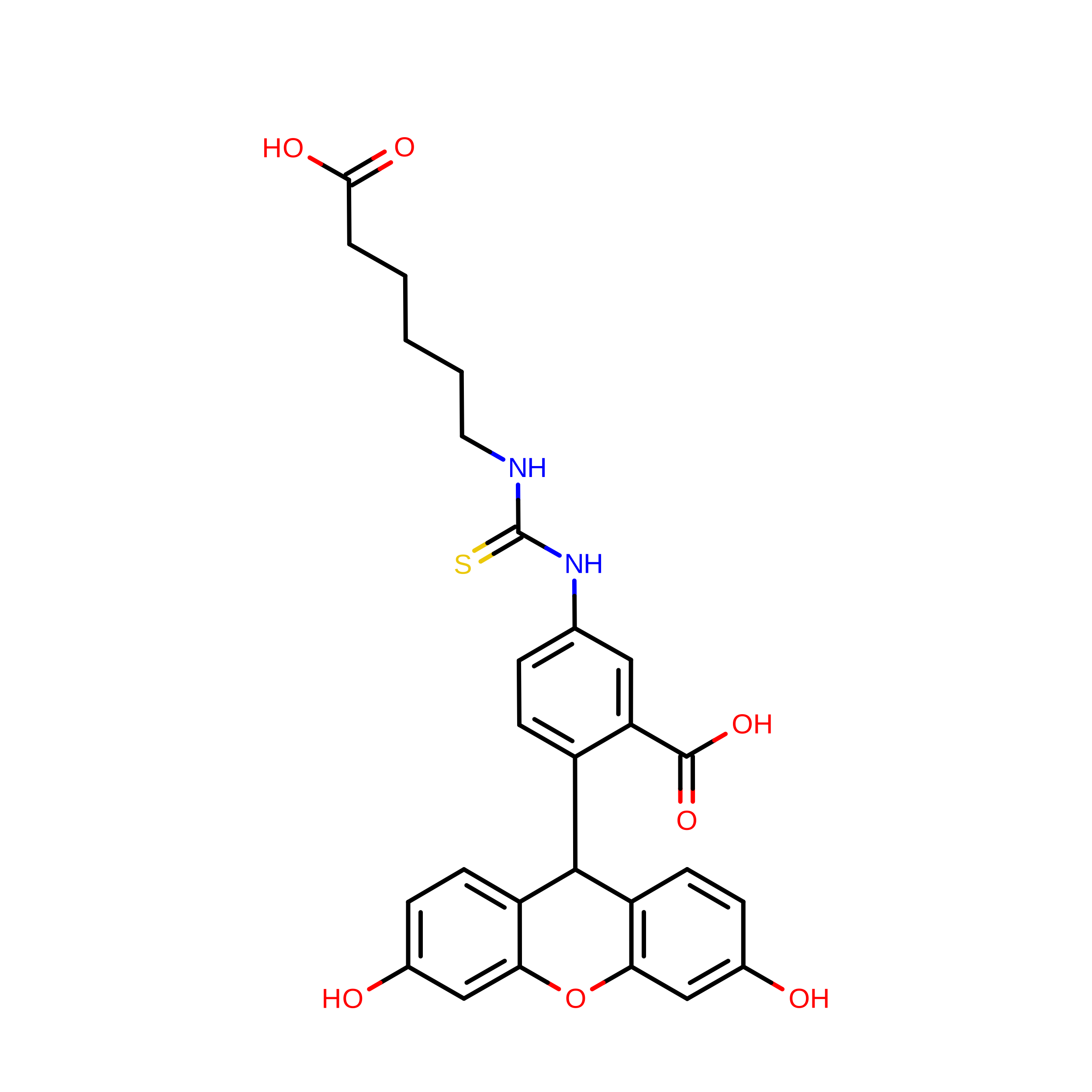
QRE

Query on QRE


Download:Ideal Coordinates CCD File
E [auth A],
F [auth B]
2-[3,6-bis(oxidanyl)-9~{H}-xanthen-9-yl]-5-[(6-oxidanyl-6-oxidanylidene-hexyl)carbamothioylamino]benzoic acid
C27 H26 N2 O7 S
RDYFZBSVNLLBMW-UHFFFAOYSA-N

Experimental Data & Validation

Experimental Data

  • Method: X-RAY DIFFRACTION
  • Resolution: 3.05 Å
  • R-Value Free:  0.294 (Depositor), 0.291 (DCC) 
  • R-Value Work:  0.254 (Depositor), 0.254 (DCC) 
  • R-Value Observed: 0.256 (Depositor) 
Space Group: P 21 21 21
Unit Cell:
Length ( Å )Angle ( ˚ )
a = 72.242α = 90
b = 98.5β = 90
c = 109.528γ = 90
Software Package:
Software NamePurpose
REFMACrefinement
XDSdata reduction
XDSdata scaling
MOLREPphasing
PDB_EXTRACTdata extraction

Structure Validation

View Full Validation Report


Ligand Structure Quality Assessment 


Entry History 

Deposition Data

Revision History  (Full details and data files)

  • Version 1.0: 2021-06-09
    Type: Initial release
  • Version 1.1: 2024-01-31
    Changes: Data collection, Database references, Refinement description
  • Version 1.2: 2024-10-16
    Changes: Structure summary