Download Mendeley
A ubiquitous disordered protein interaction module orchestrates transcription elongation.
Cermakova, K., Demeulemeester, J., Lux, V., Nedomova, M., Goldman, S.R., Smith, E.A., Srb, P., Hexnerova, R., Fabry, M., Madlikova, M., Horejsi, M., De Rijck, J., Debyser, Z., Adelman, K., Hodges, H.C., Veverka, V.(2021) Science 374: 1113-1121
- PubMed: 34822292 Search on PubMedSearch on PubMed Central
- DOI: https://doi.org/10.1126/science.abe2913
- Primary Citation Related Structures:
6ZUY, 6ZUZ, 6ZV0, 6ZV1, 6ZV2, 6ZV3, 6ZV4 - PubMed Abstract:
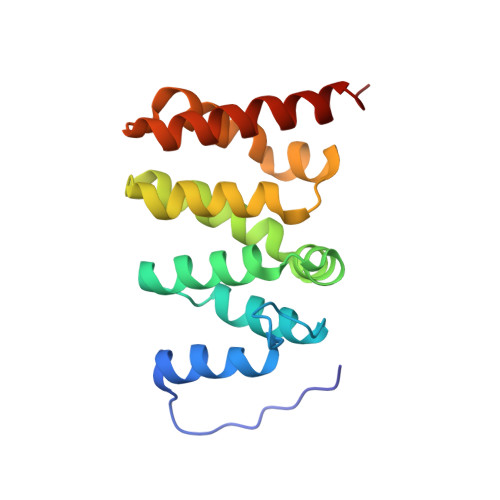
During eukaryotic transcription elongation, RNA polymerase II (RNAP2) is regulated by a chorus of factors. Here, we identified a common binary interaction module consisting of TFIIS N-terminal domains (TNDs) and natively unstructured TND-interacting motifs (TIMs). This module was conserved among the elongation machinery and linked complexes including transcription factor TFIIS, Mediator, super elongation complex, elongin, IWS1, SPT6, PP1-PNUTS phosphatase, H3K36me3 readers, and other factors. Using nuclear magnetic resonance, live-cell microscopy, and mass spectrometry, we revealed the structural basis for these interactions and found that TND-TIM sequences were necessary and sufficient to induce strong and specific colocalization in the crowded nuclear environment. Disruption of a single TIM in IWS1 induced robust changes in gene expression and RNAP2 elongation dynamics, which underscores the functional importance of TND-TIM surfaces for transcription elongation.
- Center for Precision Environmental Health, Department of Molecular and Cellular Biology, and Dan L Duncan Comprehensive Cancer Center, Baylor College of Medicine, Houston, TX, USA.
Organizational Affiliation: