6Y8P | pdb_00006y8p

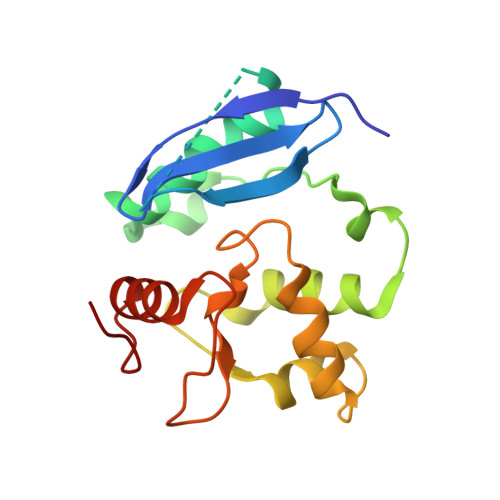
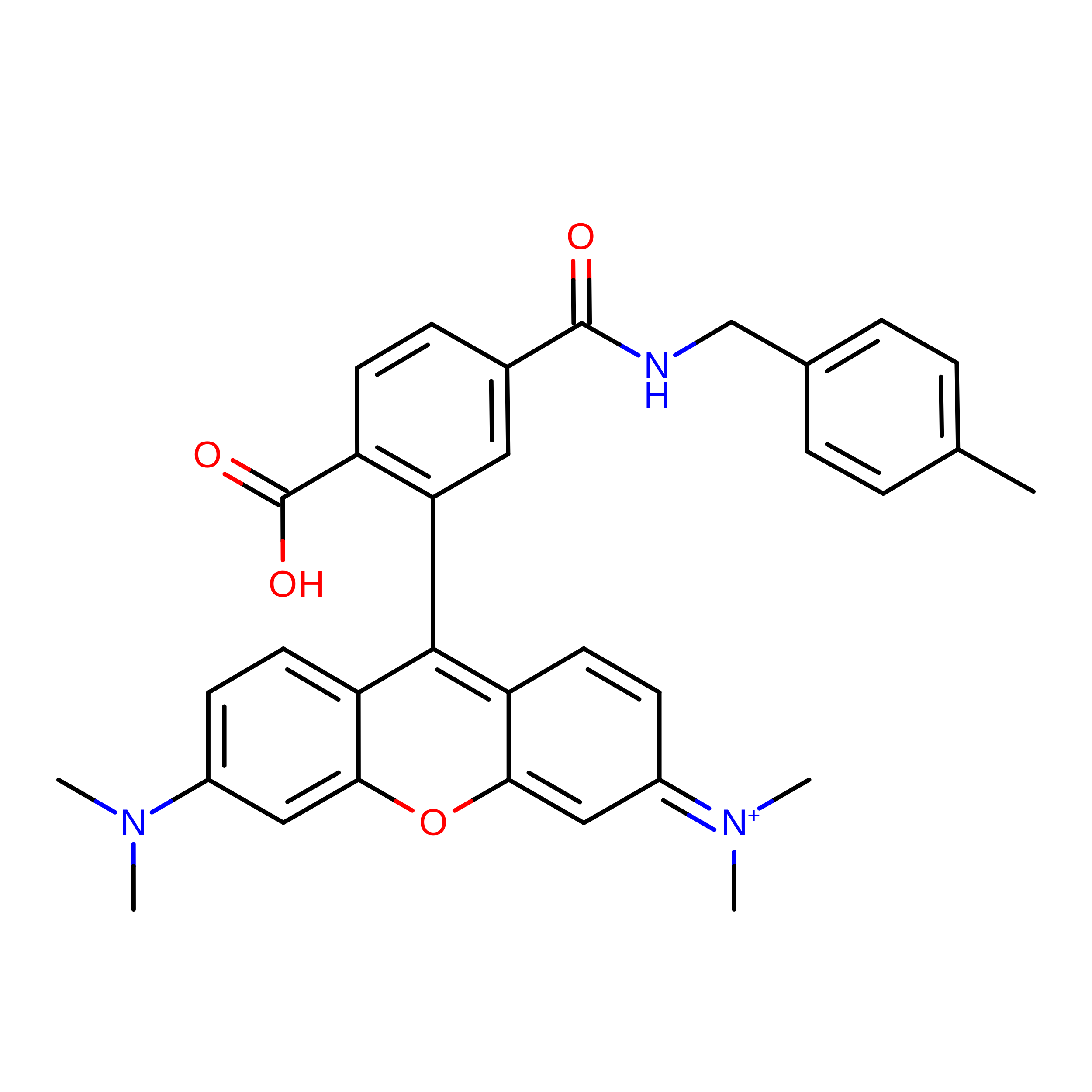
Crystal structure of SNAP-tag labeled with a benzyl-tetramethylrhodamine fluorophore


Experimental Data Snapshot

  • Method: X-RAY DIFFRACTION
  • Resolution: 2.30 Å
  • R-Value Free: 
    0.277 (Depositor), 0.273 (DCC) 
  • R-Value Work: 
    0.236 (Depositor), 0.241 (DCC) 
  • R-Value Observed: 
    0.237 (Depositor) 

Starting Model: experimental
View more details

wwPDB Validation   3D Report Full Report


Ligand Structure Quality Assessment 


This is version 1.4 of the entry. See complete history


Literature

Kinetic and Structural Characterization of the Self-Labeling Protein Tags HaloTag7, SNAP-tag, and CLIP-tag.

Wilhelm, J.Kuhn, S.Tarnawski, M.Gotthard, G.Tunnermann, J.Tanzer, T.Karpenko, J.Mertes, N.Xue, L.Uhrig, U.Reinstein, J.Hiblot, J.Johnsson, K.

(2021) Biochemistry 60: 2560-2575

  • DOI: https://doi.org/10.1021/acs.biochem.1c00258
  • Primary Citation Related Structures: 
    6Y7A, 6Y7B, 6Y8P, 6ZCC

  • PubMed Abstract: 

    The self-labeling protein tags (SLPs) HaloTag7, SNAP-tag, and CLIP-tag allow the covalent labeling of fusion proteins with synthetic molecules for applications in bioimaging and biotechnology. To guide the selection of an SLP-substrate pair and provide guidelines for the design of substrates, we report a systematic and comparative study of the labeling kinetics and substrate specificities of HaloTag7, SNAP-tag, and CLIP-tag. HaloTag7 reaches almost diffusion-limited labeling rate constants with certain rhodamine substrates, which are more than 2 orders of magnitude higher than those of SNAP-tag for the corresponding substrates. SNAP-tag labeling rate constants, however, are less affected by the structure of the label than those of HaloTag7, which vary over 6 orders of magnitude for commonly employed substrates. Determining the crystal structures of HaloTag7 and SNAP-tag labeled with fluorescent substrates allowed us to rationalize their substrate preferences. We also demonstrate how these insights can be exploited to design substrates with improved labeling kinetics.


  • Organizational Affiliation
    • Department of Chemical Biology, Max Planck Institute for Medical Research, 69120 Heidelberg, Germany.

Macromolecules
Find similar proteins by:  (by identity cutoff)  |  3D Structure
Entity ID: 1
MoleculeChains Sequence LengthOrganismDetailsImage
O6-alkylguanine-DNA alkyltransferase mutant177Homo sapiensMutation(s): 0 
EC: 2.1.1.63
UniProt
Find proteins for E5BBQ0 (Homo sapiens)
Explore E5BBQ0 
Go to UniProtKB:  E5BBQ0
Entity Groups  
Sequence Clusters30% Identity50% Identity70% Identity90% Identity95% Identity100% Identity
UniProt GroupE5BBQ0
Sequence Annotations
Expand
  • Reference Sequence
Experimental Data & Validation

Experimental Data

  • Method: X-RAY DIFFRACTION
  • Resolution: 2.30 Å
  • R-Value Free:  0.277 (Depositor), 0.273 (DCC) 
  • R-Value Work:  0.236 (Depositor), 0.241 (DCC) 
  • R-Value Observed: 0.237 (Depositor) 
Space Group: P 32 2 1
Unit Cell:
Length ( Å )Angle ( ˚ )
a = 65.515α = 90
b = 65.515β = 90
c = 97.067γ = 120
Software Package:
Software NamePurpose
PHENIXrefinement
PDB_EXTRACTdata extraction
XDSdata reduction
XSCALEdata scaling
PHASERphasing

Structure Validation

View Full Validation Report


Ligand Structure Quality Assessment 


Entry History 

Deposition Data

Revision History  (Full details and data files)

  • Version 1.0: 2021-03-31
    Type: Initial release
  • Version 1.1: 2021-10-27
    Changes: Data collection, Database references
  • Version 1.2: 2021-11-10
    Changes: Data collection, Database references
  • Version 1.3: 2024-01-24
    Changes: Data collection, Database references, Refinement description
  • Version 1.4: 2024-10-23
    Changes: Structure summary