Download Mendeley
A F 420 -dependent single domain chemogenetic tool for protein de-dimerization.
Antoney, J., Kainrath, S., Dubowsky, J.G., Ahmed, F.H., Kang, S.W., Mackie, E.R.R., Granado, G.B., Soares da Costa, T.P., Jackson, C.J., Janovjak, H.(2025) J Mol Biol : 169184-169184
- PubMed: 40324743 Search on PubMed
- DOI: https://doi.org/10.1016/j.jmb.2025.169184
- Primary Citation Related Structures:
6WTA, 6XRI - PubMed Abstract:
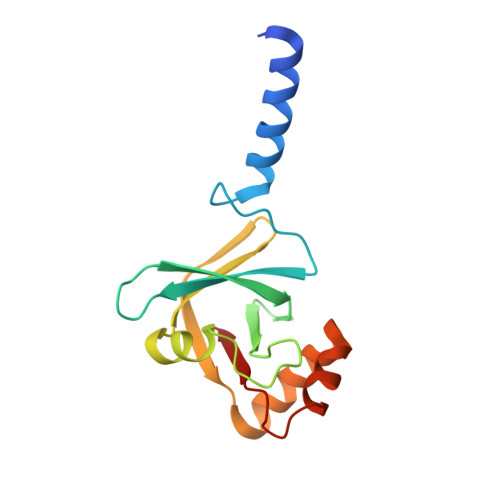
Protein-protein interactions (PPIs) mediate many fundamental cellular processes. Control of PPIs through optically or chemically responsive protein domains has had a profound impact on basic research and some clinical applications. Most chemogenetic methods induce the association, i.e., dimerization or oligomerization, of target proteins, whilst the few available dissociation approaches either break large oligomeric protein clusters or heteromeric complexes. Here, we have exploited the controlled dissociation of a homodimeric oxidoreductase from mycobacteria (MSMEG_2027) by its native cofactor, F 420 , which is not present in mammals, as a bioorthogonal monomerization switch. Using X-ray crystallography, we found that in the absence of F 420 , MSMEG_2027 forms a unique domain-swapped dimer that occludes the cofactor binding site. Rearrangement of the N-terminal helix upon F 420 binding results in the dissolution of the dimer. We then showed that MSMEG_2027 can be fused to proteins of interest in human cells and applied it as a tool to induce and release MAPK/ERK signalling downstream of a chimeric fibroblast growth factor receptor 1 (FGFR1) tyrosine kinase. This F 420 -dependent chemogenetic de-homodimerization tool is stoichiometric and based on a single domain and thus represents a novel mechanism to investigate protein complexes in situ.
- Research School of Chemistry, Australian National University, 137 Sullivans Creek Road, Canberra 2601 ACT, Australia; ARC Centre of Excellence in Synthetic Biology, Research School of Chemistry, Australian National University, 137 Sullivans Creek Road, Canberra 2601 ACT, Australia; ARC Centre of Excellence in Synthetic Biology, Centre for Agriculture and the Bioeconomy, School of Biology and Environmental Science, Queensland University of Technology, 2 George Street, Brisbane 4000 QLD, Australia.
Organizational Affiliation: