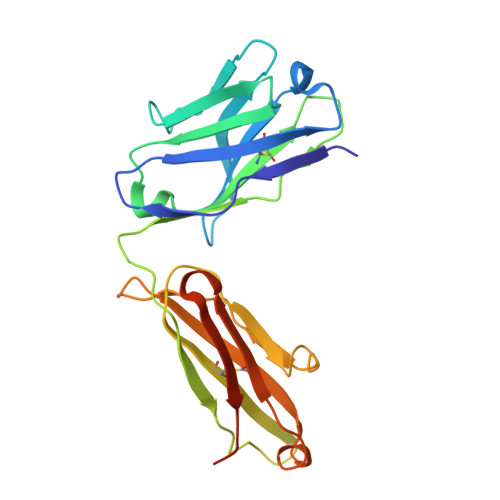
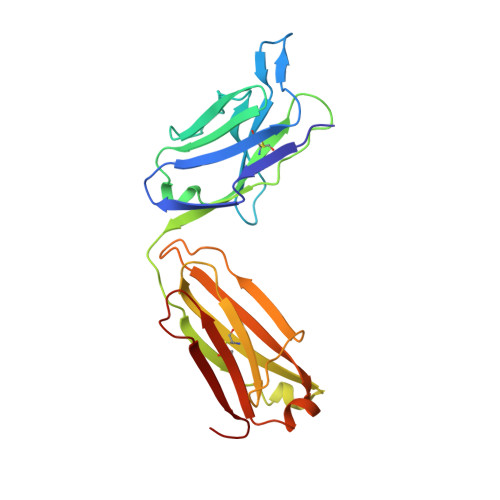
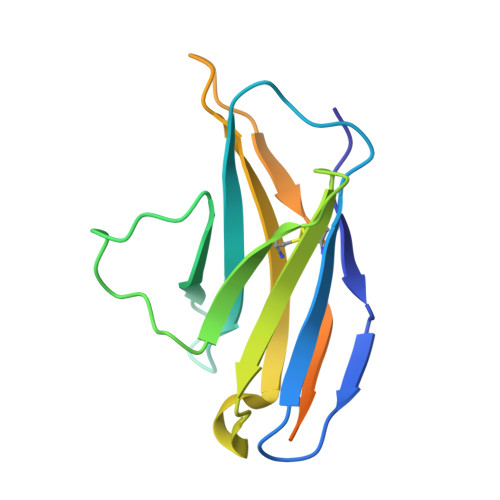
6XKR | pdb_00006xkr

Structure of Sasanlimab Fab in complex with PD-1


Experimental Data Snapshot

  • Method: X-RAY DIFFRACTION
  • Resolution: 2.59 Å
  • R-Value Free: 
    0.271 (Depositor), 0.212 (DCC) 
  • R-Value Work: 
    0.218 (Depositor) 
  • R-Value Observed: 
    0.221 (Depositor) 

Starting Model: experimental
View more details

wwPDB Validation 3D Report Full Report

Validation slider image for 6XKR

This is version 1.3 of the entry. See complete history

Literature

Pharmacologic Properties and Preclinical Activity of Sasanlimab, A High-affinity Engineered Anti-Human PD-1 Antibody.

Al-Khami, A.A.Youssef, S.Abdiche, Y.Nguyen, H.Chou, J.Kimberlin, C.R.Chin, S.M.Kamperschroer, C.Jessen, B.Kern, B.Budimir, N.Dillon, C.P.Xu, A.Clark, J.D.Chou, J.Kraynov, E.Rajpal, A.Lin, J.C.Salek-Ardakani, S.

(2020) Mol Cancer Ther 19: 2105-2116

  • DOI: https://doi.org/10.1158/1535-7163.MCT-20-0093
  • Primary Citation Related Structures: 
    6XKR

  • PubMed Abstract: 

    Development of antagonistic mAbs that specifically target the immune checkpoint receptor, programmed cell death protein-1 (PD-1), is of great interest for cancer immunotherapy. Here, we report the biophysical characteristics and nonclinical antagonistic activities of sasanlimab (PF-06801591), a humanized anti-PD-1 antibody of IgG4 isotype. We show that sasanlimab binds selectively and with similar high potency to human and cynomolgus monkey PD-1 receptor and blocks its interaction with PD-L1 and PD-L2, with no detectable Fc-dependent effector function. The binding of sasanlimab to human and cynomolgus PD-1 is associated with the formation of a stable complex, which is likely to be the main driver of this high-affinity interaction. In vitro , sasanlimab significantly augmented T-cell proliferation and cytokine production in mixed lymphocyte reaction and superantigen stimulation assays. In vivo , sasanlimab accelerated the incidence of GvHD by enhancing T-cell proliferation and cytokine secretion in a xenogeneic model of acute GvHD and halted the growth of MC-38 colon adenocarcinoma tumors in human PD-1 knock-in mice. Pharmacokinetic and toxicokinetic findings from cynomolgus monkey showed that sasanlimab was active and well-tolerated. Taken together, the data presented here support the clinical development of sasanlimab for the treatment of patients with advanced cancers as a single agent or in combination with other immunotherapies.


  • Organizational Affiliation
    • Cancer Immunology Discovery, Pfizer Inc., San Diego, California.

Macromolecule Content 

  • Total Structure Weight: 65.49 kDa 
  • Atom Count: 4,257 
  • Modeled Residue Count: 548 
  • Deposited Residue Count: 592 
  • Unique protein chains: 3

Macromolecules

Find similar proteins by:|  3D Structure
Entity ID: 1
MoleculeChains  Sequence LengthOrganismDetailsImage
Sasanlimab Fab Heavy chainA [auth H]231Homo sapiensMutation(s): 0 
Find similar proteins by:|  3D Structure
Entity ID: 2
MoleculeChains  Sequence LengthOrganismDetailsImage
Sasanlimab Fab Light chainB [auth L]220Homo sapiensMutation(s): 0 
Find similar proteins by:|  3D Structure
Entity ID: 3
MoleculeChains  Sequence LengthOrganismDetailsImage
Programmed cell death protein 1C [auth P]141Homo sapiensMutation(s): 0 
Gene Names: PDCD1PD1
UniProt & NIH Common Fund Data Resources
Find proteins for Q15116 (Homo sapiens)
Explore Q15116 
Go to UniProtKB:  Q15116
PHAROS:  Q15116
GTEx:  ENSG00000188389 
Entity Groups
Sequence Clusters30% Identity50% Identity70% Identity90% Identity95% Identity100% Identity
UniProt GroupQ15116
Sequence Annotations
Expand
Reference Sequence

Experimental Data & Validation

Experimental Data

  • Method: X-RAY DIFFRACTION
  • Resolution: 2.59 Å
  • R-Value Free:  0.271 (Depositor), 0.212 (DCC) 
  • R-Value Work:  0.218 (Depositor) 
  • R-Value Observed: 0.221 (Depositor) 
Space Group: P 2 21 21
Unit Cell:
Length ( Å )Angle ( ˚ )
a = 41.453α = 90
b = 90.622β = 90
c = 176.322γ = 90
Software Package:
Software NamePurpose
XDSdata reduction
Aimlessdata scaling
PHENIXrefinement
PDB_EXTRACTdata extraction
PHASERphasing

Structure Validation

View Full Validation Report


Entry History 

Deposition Data

Revision History  (Full details and data files)

  • Version 1.0: 2020-09-09
    Type: Initial release
  • Version 1.1: 2020-10-14
    Changes: Database references
  • Version 1.2: 2023-10-18
    Changes: Data collection, Database references, Refinement description
  • Version 1.3: 2024-10-30
    Changes: Structure summary