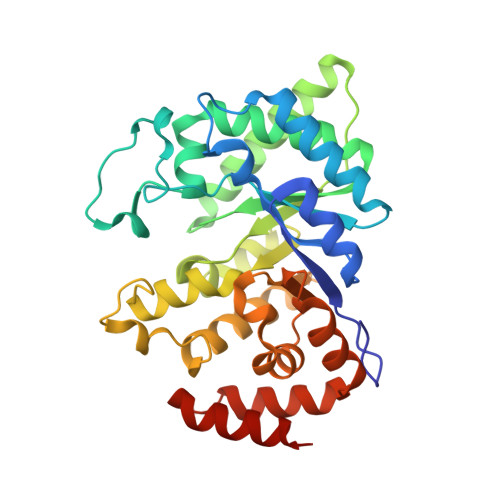
6VU0 | pdb_00006vu0

CRYSTAL STRUCTURE OF THE C-TERMINAL DOMAIN OF ENZYME I OF THE BACTERIAL PHOSPHOTRANSFERASE SYSTEM FROM THE ESCHERICHIA COLI ENZYME

  • Classification: TRANSFERASE
  • Organism(s): Escherichia coli
  • Expression System: Escherichia coli
  • Mutation(s): No 

  • Deposited: 2020-02-14 Released: 2020-06-17 
  • Deposition Author(s): Stewart Jr., C.E.
  • Funding Organization(s): National Institutes of Health/National Institute of General Medical Sciences (NIH/NIGMS)

Experimental Data Snapshot

  • Method: X-RAY DIFFRACTION
  • Resolution: 3.50 Å
  • R-Value Free: 
    0.260 (Depositor), 0.265 (DCC) 
  • R-Value Work: 
    0.226 (Depositor), 0.228 (DCC) 
  • R-Value Observed: 
    0.228 (Depositor) 

Starting Model: experimental
View more details

wwPDB Validation 3D Report Full Report

Validation slider image for 6VU0

Ligand Structure Quality Assessment 


This is version 1.2 of the entry. See complete history

Literature

Hybrid Thermophilic/Mesophilic Enzymes Reveal a Role for Conformational Disorder in Regulation of Bacterial Enzyme I.

Dotas, R.R.Nguyen, T.T.Stewart Jr., C.E.Ghirlando, R.Potoyan, D.A.Venditti, V.

(2020) J Mol Biology 432: 4481-4498

  • DOI: https://doi.org/10.1016/j.jmb.2020.05.024
  • Primary Citation Related Structures: 
    6V9K, 6VBJ, 6VU0

  • PubMed Abstract: 

    Conformational disorder is emerging as an important feature of biopolymers, regulating a vast array of cellular functions, including signaling, phase separation, and enzyme catalysis. Here we combine NMR, crystallography, computer simulations, protein engineering, and functional assays to investigate the role played by conformational heterogeneity in determining the activity of the C-terminal domain of bacterial Enzyme I (EIC). In particular, we design chimeric proteins by hybridizing EIC from thermophilic and mesophilic organisms, and we characterize the resulting constructs for structure, dynamics, and biological function. We show that EIC exists as a mixture of active and inactive conformations and that functional regulation is achieved by tuning the thermodynamic balance between active and inactive states. Interestingly, we also present a hybrid thermophilic/mesophilic enzyme that is thermostable and more active than the wild-type thermophilic enzyme, suggesting that hybridizing thermophilic and mesophilic proteins is a valid strategy to engineer thermostable enzymes with significant low-temperature activity.


  • Organizational Affiliation
    • Department of Chemistry, Iowa State University, Ames, IA 50011, USA.

Macromolecule Content 

  • Total Structure Weight: 70.89 kDa 
  • Atom Count: 4,858 
  • Modeled Residue Count: 620 
  • Deposited Residue Count: 632 
  • Unique protein chains: 1

Macromolecules

Find similar proteins by:|  3D Structure
Entity ID: 1
MoleculeChains  Sequence LengthOrganismDetailsImage
PEP-protein phosphotransferase system enzyme I
A, B
316Escherichia coliMutation(s): 0 
Gene Names: ptsI_2NCTC9962_06426
EC: 2.7.3.9
UniProt
Find proteins for P08839 (Escherichia coli (strain K12))
Explore P08839 
Go to UniProtKB:  P08839
Entity Groups
Sequence Clusters30% Identity50% Identity70% Identity90% Identity95% Identity100% Identity
UniProt GroupP08839
Sequence Annotations
Expand
Reference Sequence

Experimental Data & Validation

Experimental Data

  • Method: X-RAY DIFFRACTION
  • Resolution: 3.50 Å
  • R-Value Free:  0.260 (Depositor), 0.265 (DCC) 
  • R-Value Work:  0.226 (Depositor), 0.228 (DCC) 
  • R-Value Observed: 0.228 (Depositor) 
Space Group: P 41 2 2
Unit Cell:
Length ( Å )Angle ( ˚ )
a = 136.46α = 90
b = 136.46β = 90
c = 183.58γ = 90
Software Package:
Software NamePurpose
PHENIXrefinement
MOSFLMdata reduction
Aimlessdata scaling
PHASERphasing

Structure Validation

View Full Validation Report


Ligand Structure Quality Assessment 


Entry History 

& Funding Information

Deposition Data


Funding OrganizationLocationGrant Number
National Institutes of Health/National Institute of General Medical Sciences (NIH/NIGMS)United StatesR35GM133488

Revision History  (Full details and data files)

  • Version 1.0: 2020-06-17
    Type: Initial release
  • Version 1.1: 2020-08-12
    Changes: Database references
  • Version 1.2: 2023-10-11
    Changes: Data collection, Database references, Refinement description