6U6K | pdb_00006u6k

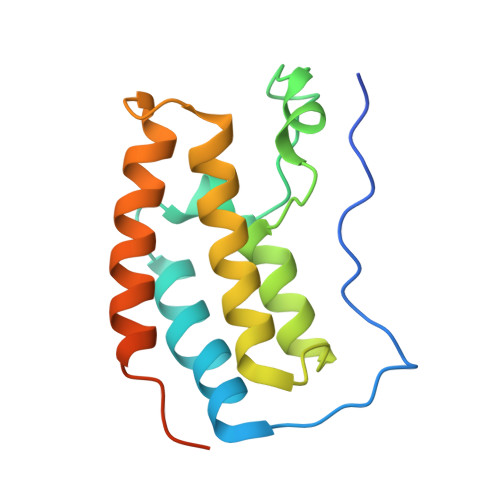
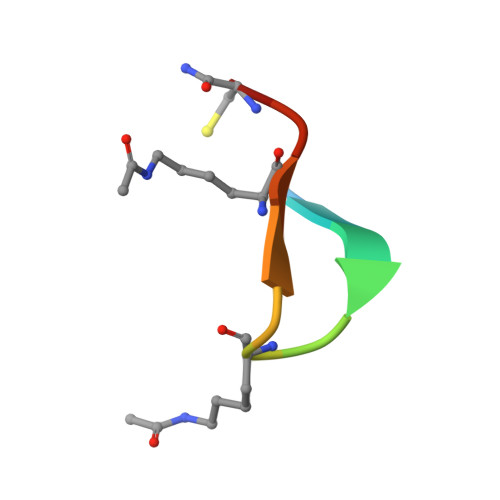
BRD4-BD1 in complex with the cyclic peptide 3.1_3


Experimental Data Snapshot

  • Method: X-RAY DIFFRACTION
  • Resolution: 1.70 Å
  • R-Value Free: 
    0.218 (Depositor), 0.220 (DCC) 
  • R-Value Work: 
    0.180 (Depositor), 0.181 (DCC) 
  • R-Value Observed: 
    0.182 (Depositor) 

Starting Model: experimental
View more details

wwPDB Validation 3D Report Full Report

Validation slider image for 6U6K

This is version 1.4 of the entry. See complete history

Literature

Cyclic peptides can engage a single binding pocket through highly divergent modes.

Patel, K.Walport, L.J.Walshe, J.L.Solomon, P.D.Low, J.K.K.Tran, D.H.Mouradian, K.S.Silva, A.P.G.Wilkinson-White, L.Norman, A.Franck, C.Matthews, J.M.Guss, J.M.Payne, R.J.Passioura, T.Suga, H.Mackay, J.P.

(2020) Proc Natl Acad Sci U S A 117: 26728-26738

  • DOI: https://doi.org/10.1073/pnas.2003086117
  • Primary Citation Related Structures: 
    6U4A, 6U61, 6U6K, 6U6L, 6U71, 6U72, 6U74, 6U8G, 6U8H, 6U8I, 6U8M, 6ULP, 6ULQ, 6ULT, 6ULV

  • PubMed Abstract: 

    Cyclic peptide library screening technologies show immense promise for identifying drug leads and chemical probes for challenging targets. However, the structural and functional diversity encoded within such libraries is largely undefined. We have systematically profiled the affinity, selectivity, and structural features of library-derived cyclic peptides selected to recognize three closely related targets: the acetyllysine-binding bromodomain proteins BRD2, -3, and -4. We report affinities as low as 100 pM and specificities of up to 10 6 -fold. Crystal structures of 13 peptide-bromodomain complexes reveal remarkable diversity in both structure and binding mode, including both α-helical and β-sheet structures as well as bivalent binding modes. The peptides can also exhibit a high degree of structural preorganization. Our data demonstrate the enormous potential within these libraries to provide diverse binding modes against a single target, which underpins their capacity to yield highly potent and selective ligands.


  • Organizational Affiliation
    • School of Life and Environmental Sciences, The University of Sydney, Sydney, NSW 2006, Australia.

Macromolecule Content 

  • Total Structure Weight: 18.67 kDa 
  • Atom Count: 1,266 
  • Modeled Residue Count: 139 
  • Deposited Residue Count: 159 
  • Unique protein chains: 2

Macromolecules

Find similar proteins by:|  3D Structure
Entity ID: 1
MoleculeChains  Sequence LengthOrganismDetailsImage
Bromodomain-containing protein 4146Homo sapiensMutation(s): 0 
Gene Names: BRD4HUNK1
UniProt & NIH Common Fund Data Resources
Find proteins for O60885 (Homo sapiens)
Explore O60885 
Go to UniProtKB:  O60885
PHAROS:  O60885
GTEx:  ENSG00000141867 
Entity Groups
Sequence Clusters30% Identity50% Identity70% Identity90% Identity95% Identity100% Identity
UniProt GroupO60885
Sequence Annotations
Expand
Reference Sequence
Find similar proteins by:  Sequence   |   3D Structure  
Entity ID: 2
MoleculeChains  Sequence LengthOrganismDetailsImage
cyclic peptide 3.1_3B [auth C]13synthetic constructMutation(s): 0 

Small Molecules

Modified Residues  1 Unique
IDChains TypeFormula2D DiagramParent
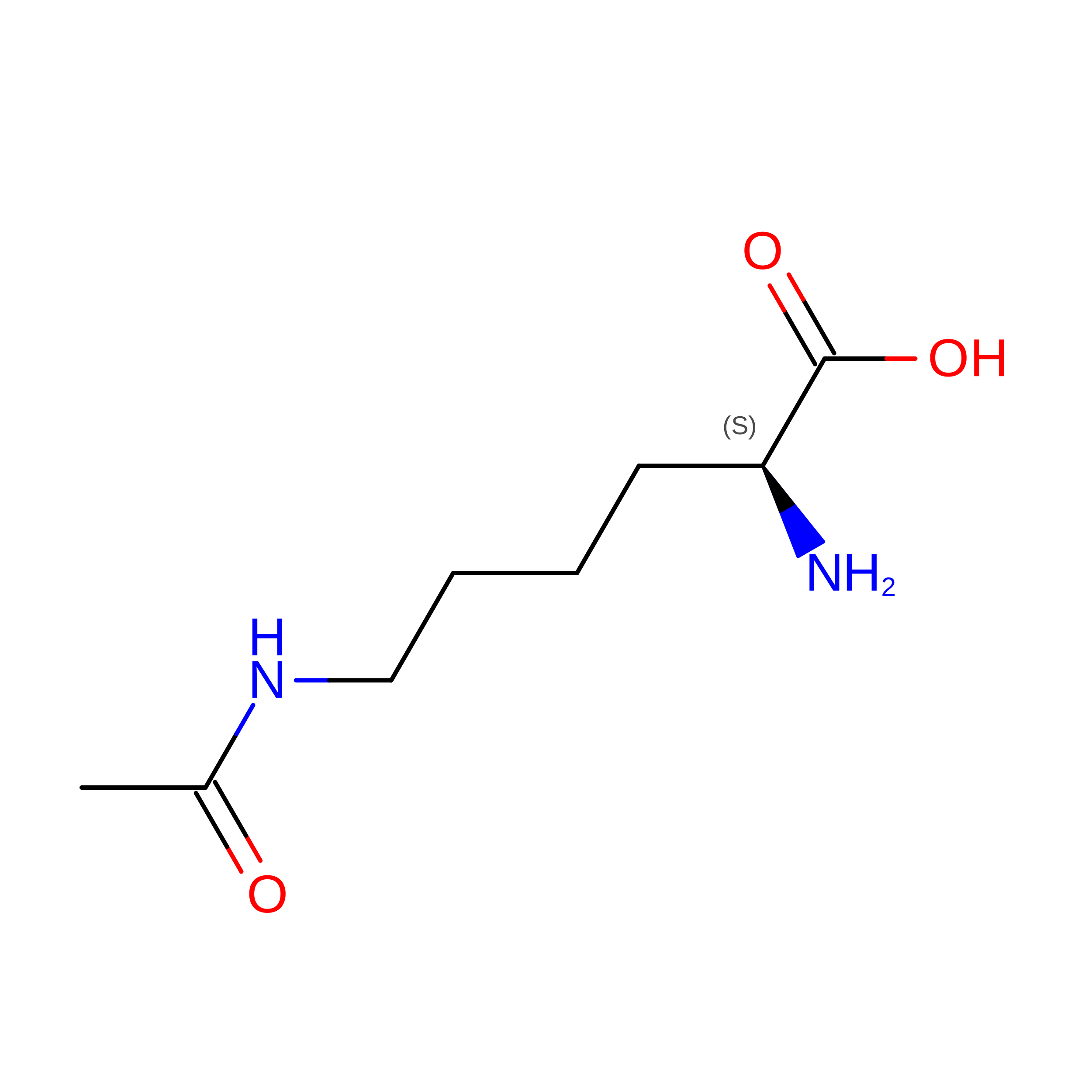
ALY
Query on ALY
B [auth C]L-PEPTIDE LINKINGC8 H16 N2 O3LYS

Experimental Data & Validation

Experimental Data

  • Method: X-RAY DIFFRACTION
  • Resolution: 1.70 Å
  • R-Value Free:  0.218 (Depositor), 0.220 (DCC) 
  • R-Value Work:  0.180 (Depositor), 0.181 (DCC) 
  • R-Value Observed: 0.182 (Depositor) 
Space Group: C 1 2 1
Unit Cell:
Length ( Å )Angle ( ˚ )
a = 121.957α = 90
b = 41.903β = 94.204
c = 29.538γ = 90
Software Package:
Software NamePurpose
PHENIXrefinement
XDSdata reduction
Aimlessdata scaling
PHASERphasing

Structure Validation

View Full Validation Report


Entry History 

& Funding Information

Deposition Data


Funding OrganizationLocationGrant Number
National Health and Medical Research Council (NHMRC, Australia)AustraliaAPP1161623

Revision History  (Full details and data files)

  • Version 1.0: 2020-08-19
    Type: Initial release
  • Version 1.1: 2021-03-03
    Changes: Database references
  • Version 1.2: 2023-10-11
    Changes: Advisory, Data collection, Database references, Refinement description
  • Version 1.3: 2023-11-15
    Changes: Data collection
  • Version 1.4: 2024-10-09
    Changes: Structure summary