Download Mendeley
Concerted dynamics of metallo-base pairs in an A/B-form helical transition.
Schmidt, O.P., Jurt, S., Johannsen, S., Karimi, A., Sigel, R.K.O., Luedtke, N.W.(2019) Nat Commun 10: 4818-4818
- PubMed: 31645548 Search on PubMedSearch on PubMed Central
- DOI: https://doi.org/10.1038/s41467-019-12440-x
- Primary Citation Related Structures:
6FY6, 6FY7, 6RLS - PubMed Abstract:
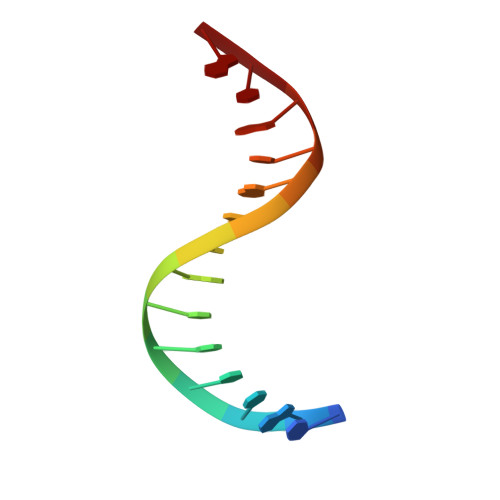
Metal-mediated base pairs expand the repertoire of nucleic acid structures and dynamics. Here we report solution structures and dynamics of duplex DNA containing two all-natural C-Hg II -T metallo base pairs separated by six canonical base pairs. NMR experiments reveal a 3:1 ratio of well-resolved structures in dynamic equilibrium. The major species contains two (N3)T-Hg II -(N3)C base pairs in a predominantly B-form helix. The minor species contains (N3)T-Hg II -(N4)C base pairs and greater A-form characteristics. Ten-fold different 1 J coupling constants ( 15 N, 199 Hg) are observed for (N3)C-Hg II (114 Hz) versus (N4)C-Hg II (1052 Hz) connectivities, reflecting differences in cytosine ionization and metal-bonding strengths. Dynamic interconversion between the two types of C-Hg II -T base pairs are coupled to a global conformational exchange between the helices. These observations inspired the design of a repetitive DNA sequence capable of undergoing a global B-to-A-form helical transition upon adding Hg II , demonstrating that C-Hg II -T has unique switching potential in DNA-based materials and devices.
- Department of Chemistry, University of Zurich, Zurich, Switzerland.
Organizational Affiliation: