6QP0 | pdb_00006qp0

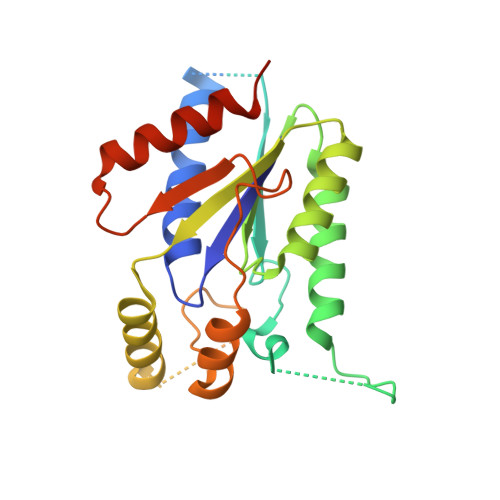
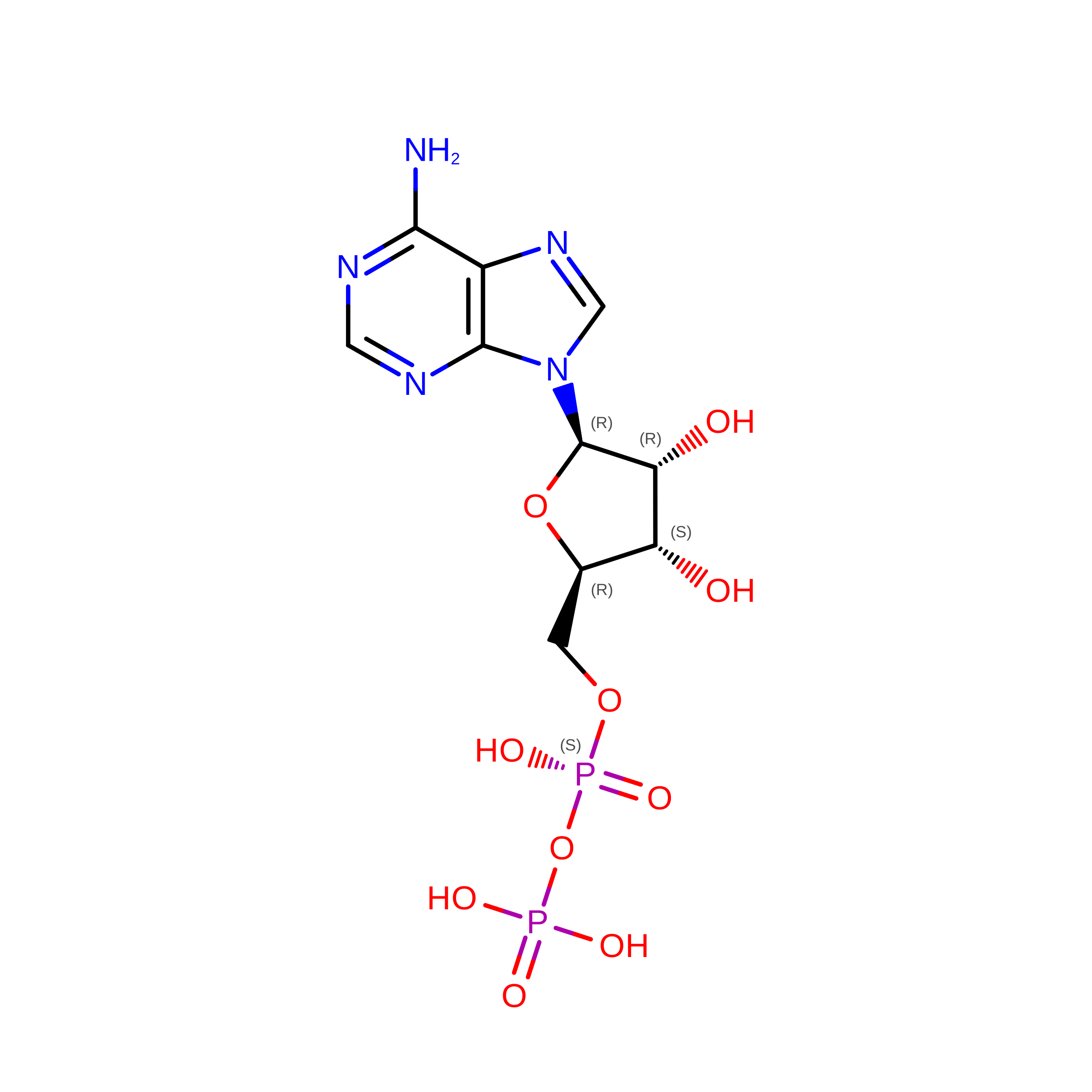
Crystal structure of Chaetomium thermophilum Kti12 in complex with ADP-AlF3


Experimental Data Snapshot

  • Method: X-RAY DIFFRACTION
  • Resolution: 2.41 Å
  • R-Value Free: 
    0.275 (Depositor), 0.274 (DCC) 
  • R-Value Work: 
    0.239 (Depositor), 0.240 (DCC) 
  • R-Value Observed: 
    0.240 (Depositor) 

wwPDB Validation 3D Report Full Report

Validation slider image for 6QP0

Ligand Structure Quality Assessment 


This is version 1.4 of the entry. See complete history

Literature

Kti12, a PSTK-like tRNA dependent ATPase essential for tRNA modification by Elongator.

Krutyholowa, R.Hammermeister, A.Zabel, R.Abdel-Fattah, W.Reinhardt-Tews, A.Helm, M.Stark, M.J.R.Breunig, K.D.Schaffrath, R.Glatt, S.

(2019) Nucleic Acids Res 47: 4814-4830

  • DOI: https://doi.org/10.1093/nar/gkz190
  • Primary Citation Related Structures: 
    6QP0

  • PubMed Abstract: 

    Posttranscriptional RNA modifications occur in all domains of life. Modifications of anticodon bases are of particular importance for ribosomal decoding and proteome homeostasis. The Elongator complex modifies uridines in the wobble position and is highly conserved in eukaryotes. Despite recent insights into Elongator's architecture, the structure and function of its regulatory factor Kti12 have remained elusive. Here, we present the crystal structure of Kti12's nucleotide hydrolase domain trapped in a transition state of ATP hydrolysis. The structure reveals striking similarities to an O-phosphoseryl-tRNA kinase involved in the selenocysteine pathway. Both proteins employ similar mechanisms of tRNA binding and show tRNASec-dependent ATPase activity. In addition, we demonstrate that Kti12 binds directly to Elongator and that ATP hydrolysis is crucial for Elongator to maintain proper tRNA anticodon modification levels in vivo. In summary, our data reveal a hitherto uncharacterized link between two translational control pathways that regulate selenocysteine incorporation and affect ribosomal tRNA selection via specific tRNA modifications.


  • Organizational Affiliation
    • Max Planck Research Group at the Malopolska Centre of Biotechnology, Jagiellonian University, Krakow, Poland.

Macromolecule Content 

  • Total Structure Weight: 30.8 kDa 
  • Atom Count: 1,590 
  • Modeled Residue Count: 188 
  • Deposited Residue Count: 263 
  • Unique protein chains: 1

Macromolecules

Find similar proteins by:|  3D Structure
Entity ID: 1
MoleculeChains  Sequence LengthOrganismDetailsImage
Putative chromatin binding protein263Thermochaetoides thermophilaMutation(s): 0 
Gene Names: CTHT_0070100
UniProt
Find proteins for G0SHI1 (Chaetomium thermophilum (strain DSM 1495 / CBS 144.50 / IMI 039719))
Explore G0SHI1 
Go to UniProtKB:  G0SHI1
Entity Groups
Sequence Clusters30% Identity50% Identity70% Identity90% Identity95% Identity100% Identity
UniProt GroupG0SHI1
Sequence Annotations
Expand
Reference Sequence

Experimental Data & Validation

Experimental Data

  • Method: X-RAY DIFFRACTION
  • Resolution: 2.41 Å
  • R-Value Free:  0.275 (Depositor), 0.274 (DCC) 
  • R-Value Work:  0.239 (Depositor), 0.240 (DCC) 
  • R-Value Observed: 0.240 (Depositor) 
Space Group: P 31 2 1
Unit Cell:
Length ( Å )Angle ( ˚ )
a = 71.02α = 90
b = 71.02β = 90
c = 88.57γ = 120
Software Package:
Software NamePurpose
PHENIXrefinement
XDSdata reduction
XDSdata scaling
PHASERphasing
SHELXSphasing
RESOLVEphasing

Structure Validation

View Full Validation Report


Ligand Structure Quality Assessment 


Entry History 

& Funding Information

Deposition Data


Funding OrganizationLocationGrant Number
Polish National Science CentrePolandUMO-2015/19/B/NZ1/00343

Revision History  (Full details and data files)

  • Version 1.0: 2019-03-13
    Type: Initial release
  • Version 1.1: 2019-03-20
    Changes: Data collection, Refinement description
  • Version 1.2: 2019-04-10
    Changes: Data collection, Database references
  • Version 1.3: 2019-05-22
    Changes: Data collection, Database references
  • Version 1.4: 2024-05-15
    Changes: Data collection, Database references