6PWH | pdb_00006pwh

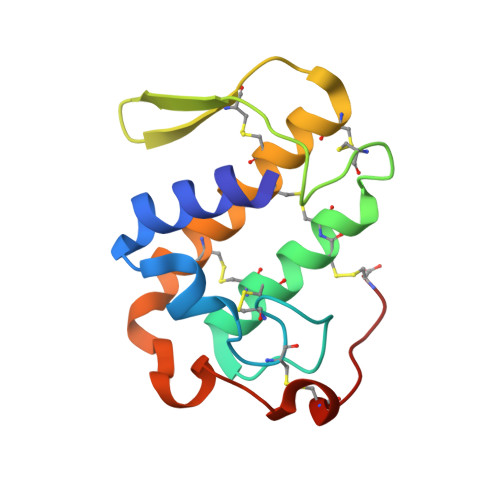
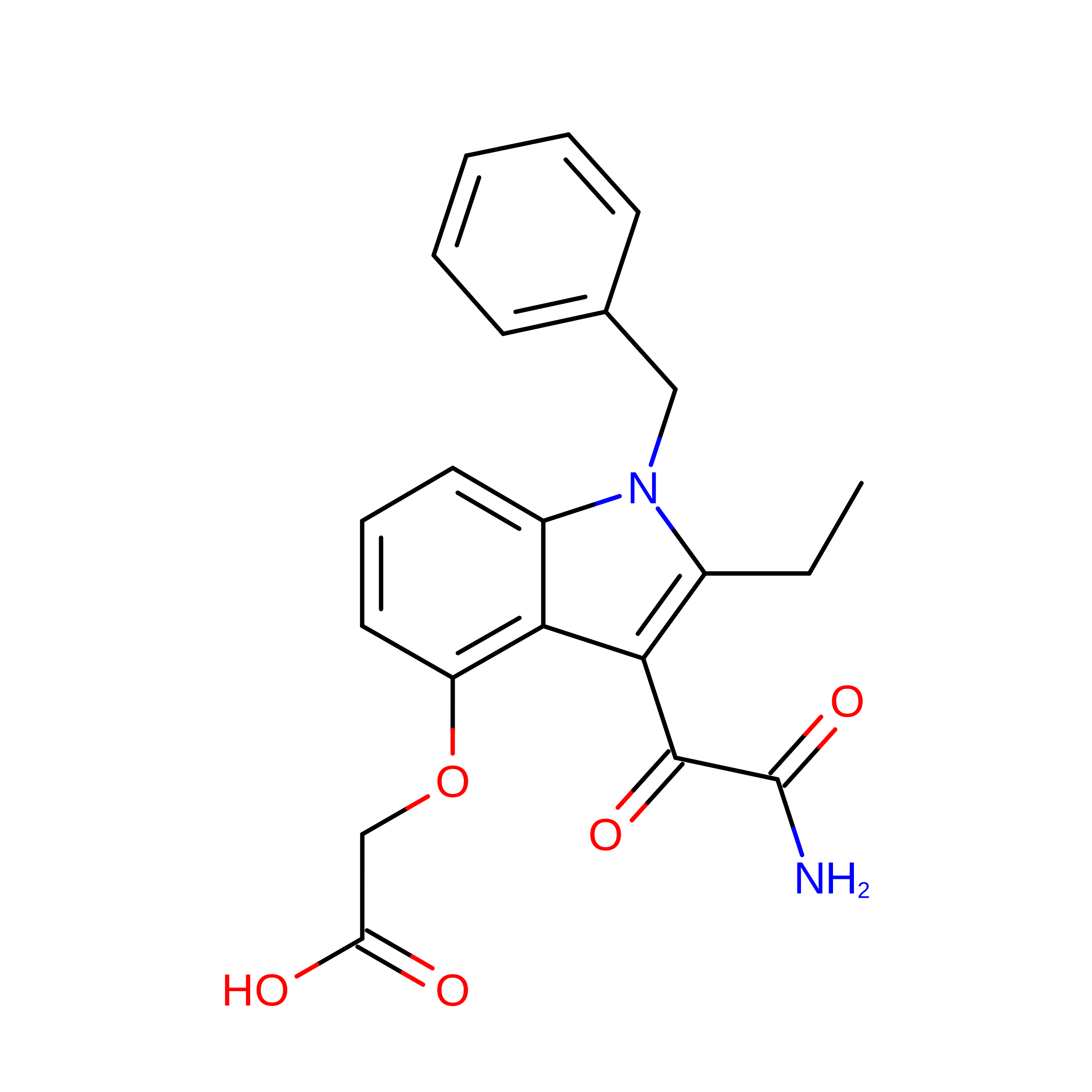
Cystal structure of Myotoxin II from Bothrops moojeni co-crystallized with Varespladib (LY315920)


Experimental Data Snapshot

  • Method: X-RAY DIFFRACTION
  • Resolution: 1.75 Å
  • R-Value Free: 
    0.232 (Depositor), 0.233 (DCC) 
  • R-Value Work: 
    0.212 (Depositor), 0.213 (DCC) 
  • R-Value Observed: 
    0.213 (Depositor) 

Starting Model: experimental
View more details

wwPDB Validation 3D Report Full Report

Validation slider image for 6PWH

Ligand Structure Quality Assessment 


This is version 1.3 of the entry. See complete history

Literature

Structural basis for phospholipase A2-like toxin inhibition by the synthetic compound Varespladib (LY315920).

Salvador, G.H.M.Gomes, A.A.S.Bryan-Quiros, W.Fernandez, J.Lewin, M.R.Gutierrez, J.M.Lomonte, B.Fontes, M.R.M.

(2019) Sci Rep 9: 17203-17203

  • DOI: https://doi.org/10.1038/s41598-019-53755-5
  • Primary Citation Related Structures: 
    6PWH

  • PubMed Abstract: 

    The World Health Organization recently listed snakebite envenoming as a Neglected Tropical Disease, proposing strategies to significantly reduce the global burden of this complex pathology by 2030. In this context, effective adjuvant treatments to complement conventional antivenom therapy based on inhibitory molecules for specific venom toxins have gained renewed interest. Varespladib (LY315920) is a synthetic molecule clinically tested to block inflammatory cascades of several diseases associated with elevated levels of secreted phospholipase A 2 (sPLA 2 ). Most recently, Varespladib was tested against several whole snake venoms and isolated PLA 2 toxins, demonstrating potent inhibitory activity. Herein, we describe the first structural and functional study of the complex between Varespladib and a PLA 2 -like snake venom toxin (MjTX-II). In vitro and in vivo experiments showed this compound's capacity to inhibit the cytotoxic and myotoxic effects of MjTX-II from the medically important South American snake, Bothrops moojeni. Crystallographic and bioinformatics analyses revealed interactions of Varespladib with two specific regions of the toxin, suggesting inhibition occurs by physical blockage of its allosteric activation, preventing the alignment of its functional sites and, consequently, impairing its ability to disrupt membranes. Furthermore, based on the analysis of several crystallographic structures, a distinction between toxin activators and inhibitors is proposed.


  • Organizational Affiliation
    • Departamento de Física e Biofísica, Instituto de Biociências, Universidade Estadual Paulista (UNESP), Botucatu, SP, Brazil.

Macromolecule Content 

  • Total Structure Weight: 28.74 kDa 
  • Atom Count: 2,044 
  • Modeled Residue Count: 244 
  • Deposited Residue Count: 244 
  • Unique protein chains: 1

Macromolecules

Find similar proteins by:|  3D Structure
Entity ID: 1
MoleculeChains  Sequence LengthOrganismDetailsImage
Basic phospholipase A2 homolog 2
A, B
122Bothrops moojeniMutation(s): 0 
UniProt
Find proteins for Q9I834 (Bothrops moojeni)
Explore Q9I834 
Go to UniProtKB:  Q9I834
Entity Groups
Sequence Clusters30% Identity50% Identity70% Identity90% Identity95% Identity100% Identity
UniProt GroupQ9I834
Sequence Annotations
Expand
Reference Sequence

Experimental Data & Validation

Experimental Data

  • Method: X-RAY DIFFRACTION
  • Resolution: 1.75 Å
  • R-Value Free:  0.232 (Depositor), 0.233 (DCC) 
  • R-Value Work:  0.212 (Depositor), 0.213 (DCC) 
  • R-Value Observed: 0.213 (Depositor) 
Space Group: P 1 21 1
Unit Cell:
Length ( Å )Angle ( ˚ )
a = 54.864α = 90
b = 37.189β = 114.39
c = 68.681γ = 90
Software Package:
Software NamePurpose
HKL-2000data reduction
SCALEPACKdata scaling
PHASERphasing
PHENIXrefinement
PDB_EXTRACTdata extraction

Structure Validation

View Full Validation Report


Ligand Structure Quality Assessment 


Entry History 

& Funding Information

Deposition Data


Funding OrganizationLocationGrant Number
Sao Paulo Research Foundation (FAPESP)Brazil2015/24167-7

Revision History  (Full details and data files)

  • Version 1.0: 2019-12-04
    Type: Initial release
  • Version 1.1: 2021-03-17
    Changes: Structure summary
  • Version 1.2: 2023-10-11
    Changes: Data collection, Database references, Refinement description
  • Version 1.3: 2024-11-06
    Changes: Structure summary