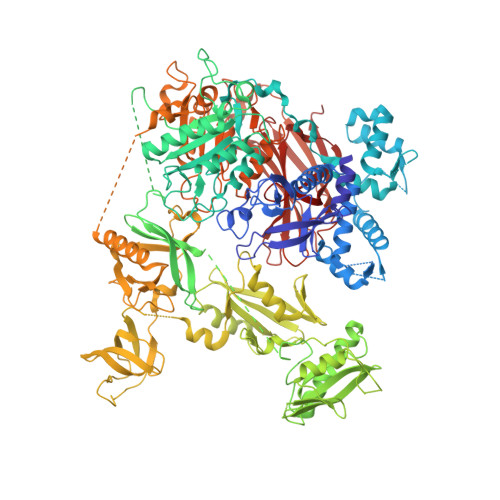
6PBC | pdb_00006pbc

Structural basis for the activation of PLC-gamma isozymes by phosphorylation and cancer-associated mutations

  • Classification: HYDROLASE
  • Organism(s): Rattus norvegicus
  • Expression System: Trichoplusia ni
  • Mutation(s): No 

  • Deposited: 2019-06-13 Released: 2020-01-08 
  • Deposition Author(s): Hajicek, N., Sondek, J.
  • Funding Organization(s): National Institutes of Health/National Institute of General Medical Sciences (NIH/NIGMS)

Experimental Data Snapshot

  • Method: X-RAY DIFFRACTION
  • Resolution: 2.46 Å
  • R-Value Free: 
    0.245 (Depositor), 0.246 (DCC) 
  • R-Value Work: 
    0.202 (Depositor), 0.204 (DCC) 
  • R-Value Observed: 
    0.205 (Depositor) 

wwPDB Validation 3D Report Full Report

Validation slider image for 6PBC

This is version 1.1 of the entry. See complete history

Literature

Structural basis for the activation of PLC-gamma isozymes by phosphorylation and cancer-associated mutations.

Hajicek, N.Keith, N.C.Siraliev-Perez, E.Temple, B.R.S.Huang, W.Zhang, Q.Harden, T.K.Sondek, J.

(2019) Elife 8

  • DOI: https://doi.org/10.7554/eLife.51700
  • Primary Citation Related Structures: 
    6PBC

  • PubMed Abstract: 

    Direct activation of the human phospholipase C-γ isozymes (PLC-γ1, -γ2) by tyrosine phosphorylation is fundamental to the control of diverse biological processes, including chemotaxis, platelet aggregation, and adaptive immunity. In turn, aberrant activation of PLC-γ1 and PLC-γ2 is implicated in inflammation, autoimmunity, and cancer. Although structures of isolated domains from PLC-γ isozymes are available, these structures are insufficient to define how release of basal autoinhibition is coupled to phosphorylation-dependent enzyme activation. Here, we describe the first high-resolution structure of a full-length PLC-γ isozyme and use it to underpin a detailed model of their membrane-dependent regulation. Notably, an interlinked set of regulatory domains integrates basal autoinhibition, tyrosine kinase engagement, and additional scaffolding functions with the phosphorylation-dependent, allosteric control of phospholipase activation. The model also explains why mutant forms of the PLC-γ isozymes found in several cancers have a wide spectrum of activities, and highlights how these activities are tuned during disease.


  • Organizational Affiliation
    • Department of Pharmacology, The University of North Carolina at Chapel Hill, Chapel Hill, United States.

Macromolecule Content 

  • Total Structure Weight: 136.02 kDa 
  • Atom Count: 8,846 
  • Modeled Residue Count: 1,070 
  • Deposited Residue Count: 1,176 
  • Unique protein chains: 1

Macromolecules

Find similar proteins by:|  3D Structure
Entity ID: 1
MoleculeChains  Sequence LengthOrganismDetailsImage
1-phosphatidylinositol 4,5-bisphosphate phosphodiesterase gamma,1-phosphatidylinositol 4,5-bisphosphate phosphodiesterase gamma-11,176Rattus norvegicusMutation(s): 0 
Gene Names: Plcg1rCG_32419
EC: 3.1.4.11
UniProt
Find proteins for G3V845 (Rattus norvegicus)
Explore G3V845 
Go to UniProtKB:  G3V845
Entity Groups
Sequence Clusters30% Identity50% Identity70% Identity90% Identity95% Identity100% Identity
UniProt GroupG3V845
Sequence Annotations
Expand
Reference Sequence

Experimental Data & Validation

Experimental Data

  • Method: X-RAY DIFFRACTION
  • Resolution: 2.46 Å
  • R-Value Free:  0.245 (Depositor), 0.246 (DCC) 
  • R-Value Work:  0.202 (Depositor), 0.204 (DCC) 
  • R-Value Observed: 0.205 (Depositor) 
Space Group: P 21 21 21
Unit Cell:
Length ( Å )Angle ( ˚ )
a = 70.766α = 90
b = 82.441β = 90
c = 228.318γ = 90
Software Package:
Software NamePurpose
HKL-2000data reduction
HKL-2000data scaling
PHASERphasing
SOLVEphasing
RESOLVEphasing
PHENIXrefinement
PDB_EXTRACTdata extraction

Structure Validation

View Full Validation Report


Entry History 

& Funding Information

Deposition Data


Funding OrganizationLocationGrant Number
National Institutes of Health/National Institute of General Medical Sciences (NIH/NIGMS)United StatesR01-GM057391

Revision History  (Full details and data files)

  • Version 1.0: 2020-01-08
    Type: Initial release
  • Version 1.1: 2024-03-13
    Changes: Data collection, Database references