6OMM | pdb_00006omm

Cryo-EM structure of formyl peptide receptor 2/lipoxin A4 receptor in complex with Gi


Experimental Data Snapshot

  • Method: ELECTRON MICROSCOPY
  • Resolution: 3.17 Å
  • Aggregation State: PARTICLE 
  • Reconstruction Method: SINGLE PARTICLE 

wwPDB Validation 3D Report Full Report

Validation slider image for 6OMM

This is version 1.2 of the entry. See complete history

Literature

Structure of formylpeptide receptor 2-Gicomplex reveals insights into ligand recognition and signaling.

Zhuang, Y.Liu, H.Edward Zhou, X.Kumar Verma, R.de Waal, P.W.Jang, W.Xu, T.H.Wang, L.Meng, X.Zhao, G.Kang, Y.Melcher, K.Fan, H.Lambert, N.A.Eric Xu, H.Zhang, C.

(2020) Nat Commun 11: 885-885

  • DOI: https://doi.org/10.1038/s41467-020-14728-9
  • Primary Citation Related Structures: 
    6OMM

  • PubMed Abstract: 

    Formylpeptide receptors (FPRs) as G protein-coupled receptors (GPCRs) can recognize formylpeptides derived from pathogens or host cells to function in host defense and cell clearance. In addition, FPRs, especially FPR2, can also recognize other ligands with a large chemical diversity generated at different stages of inflammation to either promote or resolve inflammation in order to maintain a balanced inflammatory response. The mechanism underlying promiscuous ligand recognition and activation of FPRs is not clear. Here we report a cryo-EM structure of FPR2-G i signaling complex with a peptide agonist. The structure reveals a widely open extracellular region with an amphiphilic environment for ligand binding. Together with computational docking and simulation, the structure suggests a molecular basis for the recognition of formylpeptides and a potential mechanism of receptor activation, and reveals conserved and divergent features in G i coupling. Our results provide a basis for understanding the molecular mechanism of the functional promiscuity of FPRs.


  • Organizational Affiliation
    • The CAS Key Laboratory of Receptor Research, Shanghai Institute of Materia Medica, Chinese Academy of Sciences, Shanghai, 201203, China.

Macromolecule Content 

  • Total Structure Weight: 156.99 kDa 
  • Atom Count: 9,134 
  • Modeled Residue Count: 1,142 
  • Deposited Residue Count: 1,389 
  • Unique protein chains: 6

Macromolecules

Find similar proteins by:|  3D Structure
Entity ID: 1
MoleculeChains  Sequence LengthOrganismDetailsImage
N-formyl peptide receptor 2A [auth R]363Homo sapiensMutation(s): 0 
Gene Names: FPR2FPRH1FPRL1LXA4R
Membrane Entity: Yes 
UniProt & NIH Common Fund Data Resources
Find proteins for P25090 (Homo sapiens)
Explore P25090 
Go to UniProtKB:  P25090
PHAROS:  P25090
GTEx:  ENSG00000171049 
Entity Groups
Sequence Clusters30% Identity50% Identity70% Identity90% Identity95% Identity100% Identity
UniProt GroupP25090
Sequence Annotations
Expand
Reference Sequence
Find similar proteins by:  Sequence   |   3D Structure  
Entity ID: 2
MoleculeChains  Sequence LengthOrganismDetailsImage
Peptide agonistB [auth L]6synthetic constructMutation(s): 0 
Find similar proteins by:|  3D Structure
Entity ID: 3
MoleculeChains  Sequence LengthOrganismDetailsImage
Guanine nucleotide-binding protein G(i) subunit alpha-1C [auth A]353Homo sapiensMutation(s): 3 
Gene Names: GNAI1
EC: 3.6.5
Membrane Entity: Yes 
UniProt & NIH Common Fund Data Resources
Find proteins for P63096 (Homo sapiens)
Explore P63096 
Go to UniProtKB:  P63096
PHAROS:  P63096
GTEx:  ENSG00000127955 
Entity Groups
Sequence Clusters30% Identity50% Identity70% Identity90% Identity95% Identity100% Identity
UniProt GroupP63096
Sequence Annotations
Expand
Reference Sequence
Find similar proteins by:|  3D Structure
Entity ID: 4
MoleculeChains  Sequence LengthOrganismDetailsImage
Guanine nucleotide-binding protein G(I)/G(S)/G(T) subunit beta-1D [auth B]353Homo sapiensMutation(s): 3 
Gene Names: GNB1
UniProt & NIH Common Fund Data Resources
Find proteins for P62873 (Homo sapiens)
Explore P62873 
Go to UniProtKB:  P62873
PHAROS:  P62873
GTEx:  ENSG00000078369 
Entity Groups
Sequence Clusters30% Identity50% Identity70% Identity90% Identity95% Identity100% Identity
UniProt GroupP62873
Sequence Annotations
Expand
Reference Sequence
Find similar proteins by:|  3D Structure
Entity ID: 5
MoleculeChains  Sequence LengthOrganismDetailsImage
Guanine nucleotide-binding protein G(I)/G(S)/G(O) subunit gamma-2E [auth C]67Homo sapiensMutation(s): 2 
Gene Names: GNG2
Membrane Entity: Yes 
UniProt & NIH Common Fund Data Resources
Find proteins for P59768 (Homo sapiens)
Explore P59768 
Go to UniProtKB:  P59768
PHAROS:  P59768
GTEx:  ENSG00000186469 
Entity Groups
Sequence Clusters30% Identity50% Identity70% Identity90% Identity95% Identity100% Identity
UniProt GroupP59768
Sequence Annotations
Expand
Reference Sequence
Find similar proteins by:|  3D Structure
Entity ID: 6
MoleculeChains  Sequence LengthOrganismDetailsImage
scFv16F [auth E]247synthetic constructMutation(s): 0 

Small Molecules

Ligands 2 Unique
IDChains Name / Formula / InChI Key2D Diagram3D Interactions
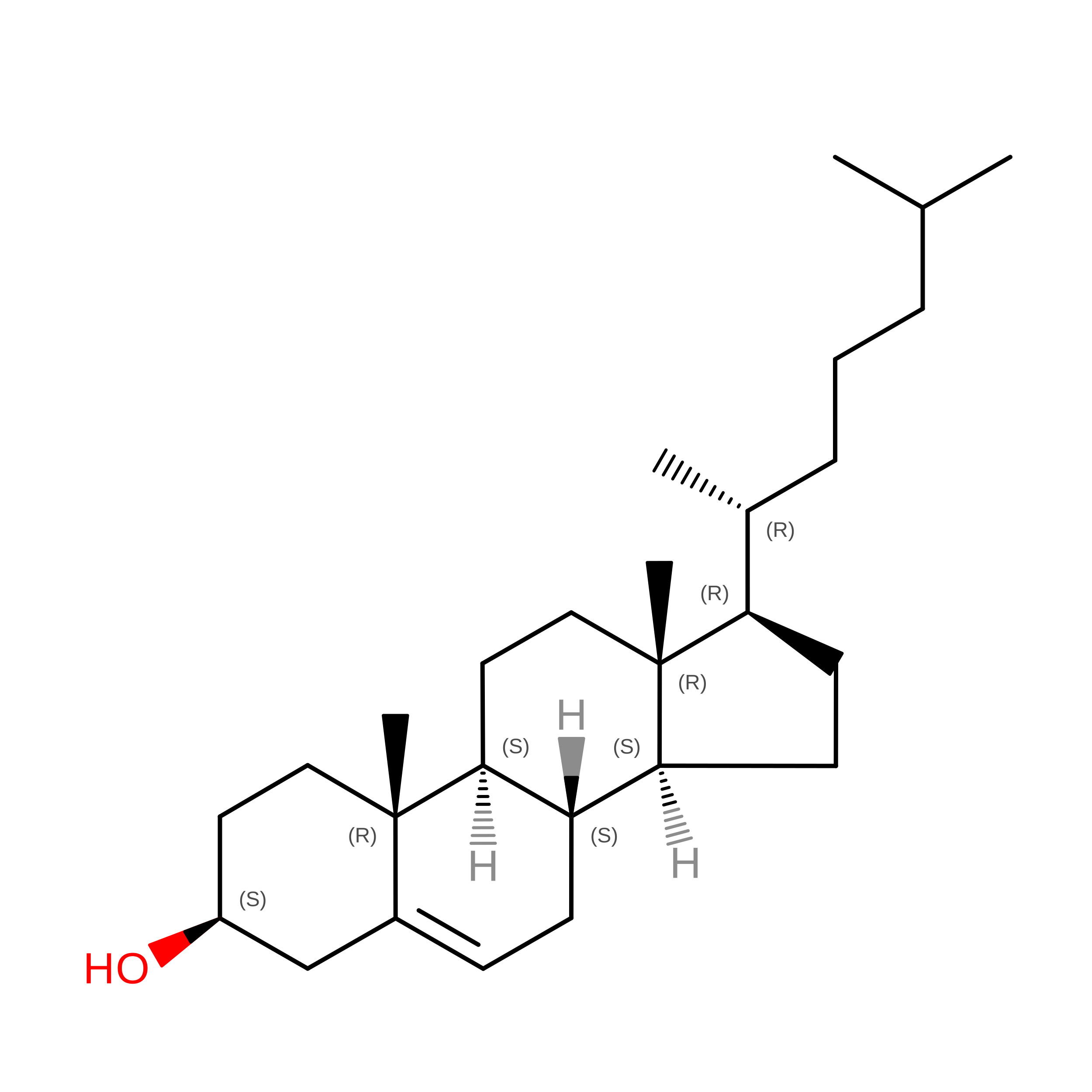
CLR

Query on CLR


Download:Ideal Coordinates CCD File
G [auth R],
H [auth R],
I [auth R],
J [auth R],
K [auth R]
CHOLESTEROL
C27 H46 O
HVYWMOMLDIMFJA-DPAQBDIFSA-N
PLM

Query on PLM


Download:Ideal Coordinates CCD File
L [auth R],
M [auth R],
N [auth R]
PALMITIC ACID
C16 H32 O2
IPCSVZSSVZVIGE-UHFFFAOYSA-N

Experimental Data & Validation

Experimental Data

  • Method: ELECTRON MICROSCOPY
  • Resolution: 3.17 Å
  • Aggregation State: PARTICLE 
  • Reconstruction Method: SINGLE PARTICLE 
EM Software:
TaskSoftware PackageVersion
MODEL REFINEMENTPHENIX

Structure Validation

View Full Validation Report


Entry History 

& Funding Information

Deposition Data


Funding OrganizationLocationGrant Number
National Institutes of Health/National Human Genome Research Institute (NIH/NHGRI)United States1R35GM128641
National Institutes of Health/National Human Genome Research Institute (NIH/NHGRI)United States1R01GM127710

Revision History  (Full details and data files)

  • Version 1.0: 2020-02-26
    Type: Initial release
  • Version 1.1: 2025-04-02
    Changes: Data collection, Database references, Structure summary
  • Version 1.2: 2025-05-14
    Changes: Data collection, Structure summary