6O0K | pdb_00006o0k

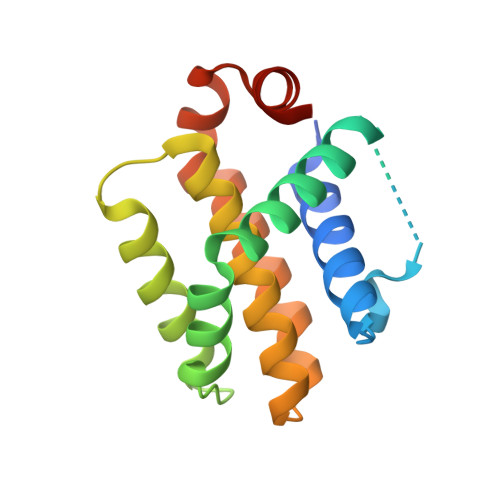
crystal structure of BCL-2 with venetoclax


Experimental Data Snapshot

  • Method: X-RAY DIFFRACTION
  • Resolution: 1.62 Å
  • R-Value Free: 
    0.202 (Depositor), 0.203 (DCC) 
  • R-Value Work: 
    0.161 (Depositor), 0.164 (DCC) 
  • R-Value Observed: 
    0.163 (Depositor) 

Starting Model: experimental
View more details

wwPDB Validation 3D Report Full Report

Validation slider image for 6O0K

Ligand Structure Quality Assessment 


This is version 2.2 of the entry. See complete history

Literature

Structures of BCL-2 in complex with venetoclax reveal the molecular basis of resistance mutations.

Birkinshaw, R.W.Gong, J.N.Luo, C.S.Lio, D.White, C.A.Anderson, M.A.Blombery, P.Lessene, G.Majewski, I.J.Thijssen, R.Roberts, A.W.Huang, D.C.S.Colman, P.M.Czabotar, P.E.

(2019) Nat Commun 10: 2385-2385

  • DOI: https://doi.org/10.1038/s41467-019-10363-1
  • Primary Citation Related Structures: 
    6O0K, 6O0L, 6O0M, 6O0O, 6O0P

  • PubMed Abstract: 

    Venetoclax is a first-in-class cancer therapy that interacts with the cellular apoptotic machinery promoting apoptosis. Treatment of patients suffering chronic lymphocytic leukaemia with this BCL-2 antagonist has revealed emergence of a drug-selected BCL-2 mutation (G101V) in some patients failing therapy. To understand the molecular basis of this acquired resistance we describe the crystal structures of venetoclax bound to both BCL-2 and the G101V mutant. The pose of venetoclax in its binding site on BCL-2 reveals small but unexpected differences as compared to published structures of complexes with venetoclax analogues. The G101V mutant complex structure and mutant binding assays reveal that resistance is acquired by a knock-on effect of V101 on an adjacent residue, E152, with venetoclax binding restored by a E152A mutation. This provides a framework for considering analogues of venetoclax that might be effective in combating this mutation.


  • Organizational Affiliation
    • Walter and Eliza Hall Institute of Medical Research, 1G Royal Parade, Parkville, VIC, 3052, Australia. birkinshaw.r@wehi.edu.au.

Macromolecule Content 

  • Total Structure Weight: 20.64 kDa 
  • Atom Count: 1,512 
  • Modeled Residue Count: 141 
  • Deposited Residue Count: 166 
  • Unique protein chains: 1

Macromolecules

Find similar proteins by:|  3D Structure
Entity ID: 1
MoleculeChains  Sequence LengthOrganismDetailsImage
Apoptosis regulator Bcl-2166Homo sapiensMutation(s): 0 
Gene Names: BCL2BCL2L1BCL2LBCLX
UniProt & NIH Common Fund Data Resources
Find proteins for P10415 (Homo sapiens)
Explore P10415 
Go to UniProtKB:  P10415
PHAROS:  P10415
GTEx:  ENSG00000171791 
Find proteins for Q07817 (Homo sapiens)
Explore Q07817 
Go to UniProtKB:  Q07817
PHAROS:  Q07817
GTEx:  ENSG00000171552 
Entity Groups
Sequence Clusters30% Identity50% Identity70% Identity90% Identity95% Identity100% Identity
UniProt GroupsQ07817P10415
Sequence Annotations
Expand
Reference Sequence

Small Molecules

Ligands 2 Unique
IDChains Name / Formula / InChI Key2D Diagram3D Interactions
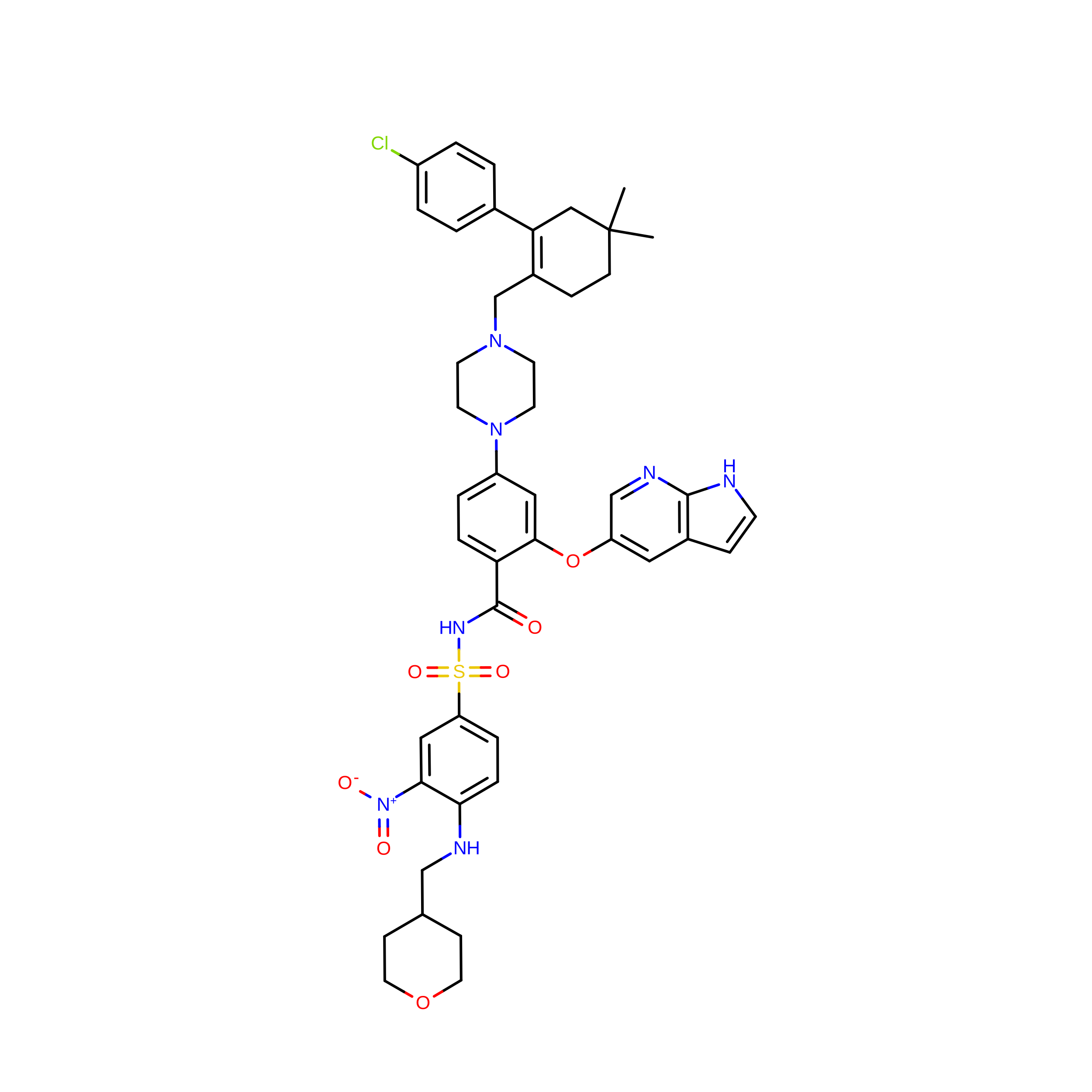
LBM

Query on LBM


Download:Ideal Coordinates CCD File
B [auth A]4-{4-[(4'-chloro-5,5-dimethyl[3,4,5,6-tetrahydro[1,1'-biphenyl]]-2-yl)methyl]piperazin-1-yl}-N-[(3-nitro-4-{[(oxan-4-yl )methyl]amino}phenyl)sulfonyl]-2-[(1H-pyrrolo[2,3-b]pyridin-5-yl)oxy]benzamide
C45 H50 Cl N7 O7 S
LQBVNQSMGBZMKD-UHFFFAOYSA-N
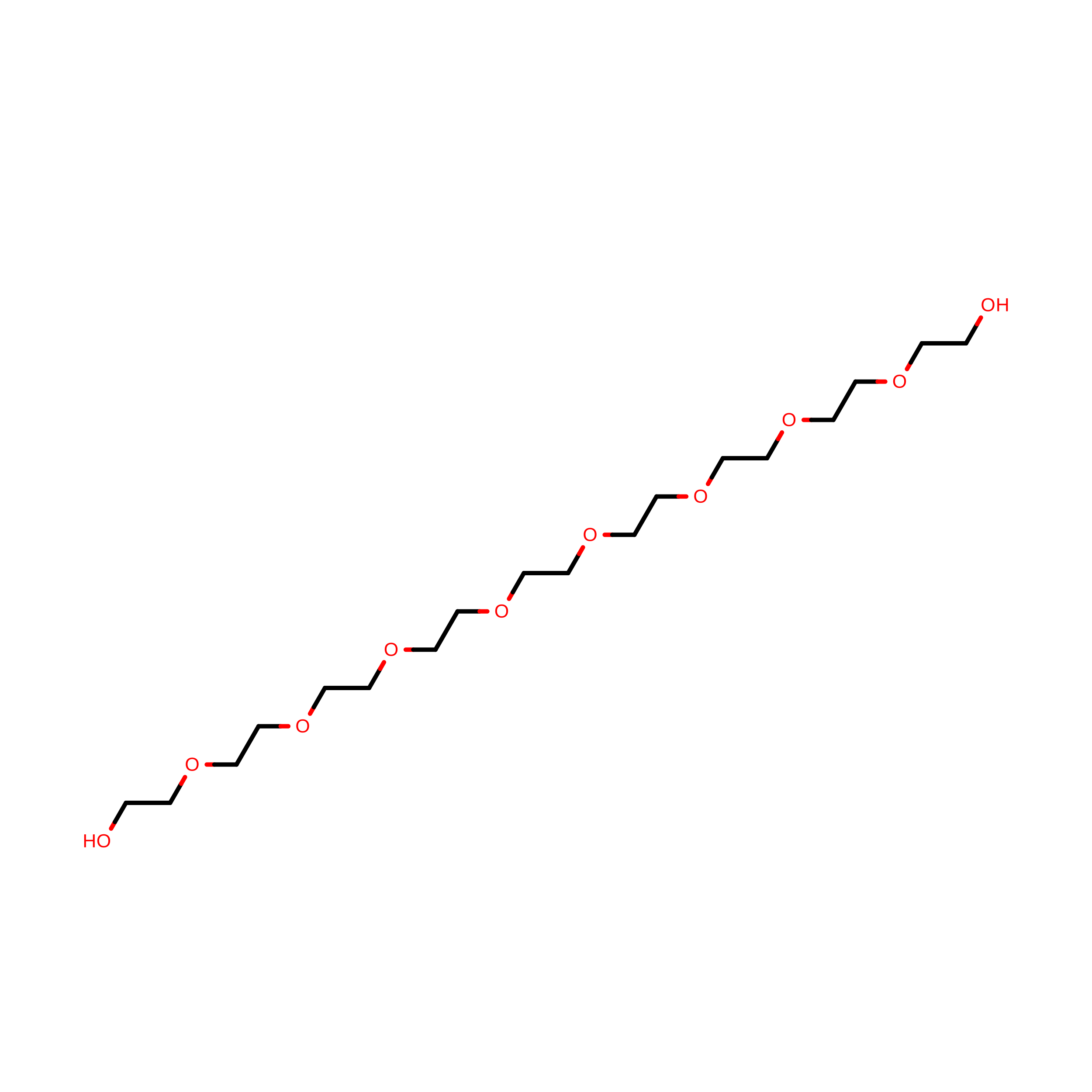
2PE

Query on 2PE


Download:Ideal Coordinates CCD File
C [auth A]NONAETHYLENE GLYCOL
C18 H38 O10
YZUUTMGDONTGTN-UHFFFAOYSA-N

Experimental Data & Validation

Experimental Data

  • Method: X-RAY DIFFRACTION
  • Resolution: 1.62 Å
  • R-Value Free:  0.202 (Depositor), 0.203 (DCC) 
  • R-Value Work:  0.161 (Depositor), 0.164 (DCC) 
  • R-Value Observed: 0.163 (Depositor) 
Space Group: P 21 21 21
Unit Cell:
Length ( Å )Angle ( ˚ )
a = 33.725α = 90
b = 48.506β = 90
c = 87.316γ = 90
Software Package:
Software NamePurpose
PHENIXrefinement
XDSdata reduction
Aimlessdata scaling
PHASERphasing

Structure Validation

View Full Validation Report


Ligand Structure Quality Assessment 


Entry History 

Deposition Data

Revision History  (Full details and data files)

  • Version 1.0: 2019-05-22
    Type: Initial release
  • Version 1.1: 2019-06-19
    Changes: Data collection, Database references
  • Version 1.2: 2019-07-10
    Changes: Data collection, Database references, Source and taxonomy, Structure summary
  • Version 2.0: 2019-11-20
    Changes: Derived calculations, Non-polymer description, Structure summary
  • Version 2.1: 2019-12-11
    Changes: Structure summary
  • Version 2.2: 2023-10-11
    Changes: Data collection, Database references, Derived calculations, Refinement description, Structure summary