6NF0 | pdb_00006nf0

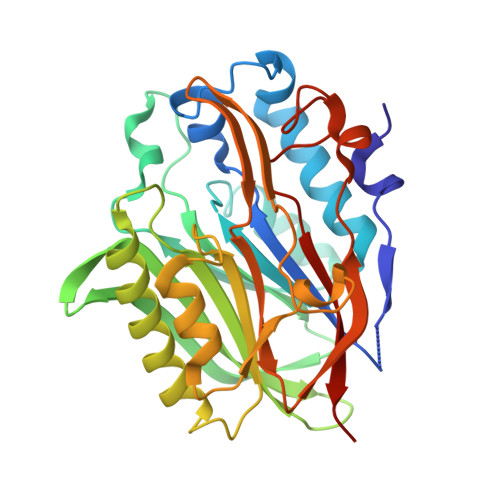
Nocturnin with bound NADPH substrate


Experimental Data Snapshot

  • Method: X-RAY DIFFRACTION
  • Resolution: 2.70 Å
  • R-Value Free: 
    0.264 (Depositor), 0.269 (DCC) 
  • R-Value Work: 
    0.206 (Depositor), 0.211 (DCC) 
  • R-Value Observed: 
    0.209 (Depositor) 

Starting Model: experimental
View more details

wwPDB Validation 3D Report Full Report

Validation slider image for 6NF0

Ligand Structure Quality Assessment 


This is version 1.3 of the entry. See complete history

Literature

The metabolites NADP+and NADPH are the targets of the circadian protein Nocturnin (Curled).

Estrella, M.A.Du, J.Chen, L.Rath, S.Prangley, E.Chitrakar, A.Aoki, T.Schedl, P.Rabinowitz, J.Korennykh, A.

(2019) Nat Commun 10: 2367-2367

  • DOI: https://doi.org/10.1038/s41467-019-10125-z
  • Primary Citation Related Structures: 
    6NF0

  • PubMed Abstract: 

    Nocturnin (NOCT) is a rhythmically expressed protein that regulates metabolism under the control of circadian clock. It has been proposed that NOCT deadenylates and regulates metabolic enzyme mRNAs. However, in contrast to other deadenylases, purified NOCT lacks the deadenylase activity. To identify the substrate of NOCT, we conducted a mass spectrometry screen and report that NOCT specifically and directly converts the dinucleotide NADP + into NAD + and NADPH into NADH. Further, we demonstrate that the Drosophila NOCT ortholog, Curled, has the same enzymatic activity. We obtained the 2.7 Å crystal structure of the human NOCT•NADPH complex, which revealed that NOCT recognizes the chemically unique ribose-phosphate backbone of the metabolite, placing the 2'-terminal phosphate productively for removal. We provide evidence for NOCT targeting to mitochondria and propose that NADP(H) regulation, which takes place at least in part in mitochondria, establishes the molecular link between circadian clock and metabolism.


  • Organizational Affiliation
    • 216 Schultz Laboratory, Department of Molecular Biology, Princeton, NJ, 08544, USA.

Macromolecule Content 

  • Total Structure Weight: 36.28 kDa 
  • Atom Count: 2,429 
  • Modeled Residue Count: 298 
  • Deposited Residue Count: 312 
  • Unique protein chains: 1

Macromolecules

Find similar proteins by:|  3D Structure
Entity ID: 1
MoleculeChains  Sequence LengthOrganismDetailsImage
Nocturnin312Homo sapiensMutation(s): 0 
Gene Names: NOCTCCR4CCRN4LNOC
EC: 3.1.13.4 (PDB Primary Data), 3.1.3.108 (UniProt)
UniProt & NIH Common Fund Data Resources
Find proteins for Q9UK39 (Homo sapiens)
Explore Q9UK39 
Go to UniProtKB:  Q9UK39
PHAROS:  Q9UK39
GTEx:  ENSG00000151014 
Entity Groups
Sequence Clusters30% Identity50% Identity70% Identity90% Identity95% Identity100% Identity
UniProt GroupQ9UK39
Sequence Annotations
Expand
Reference Sequence

Small Molecules

Ligands 2 Unique
IDChains Name / Formula / InChI Key2D Diagram3D Interactions
NDP

Query on NDP


Download:Ideal Coordinates CCD File
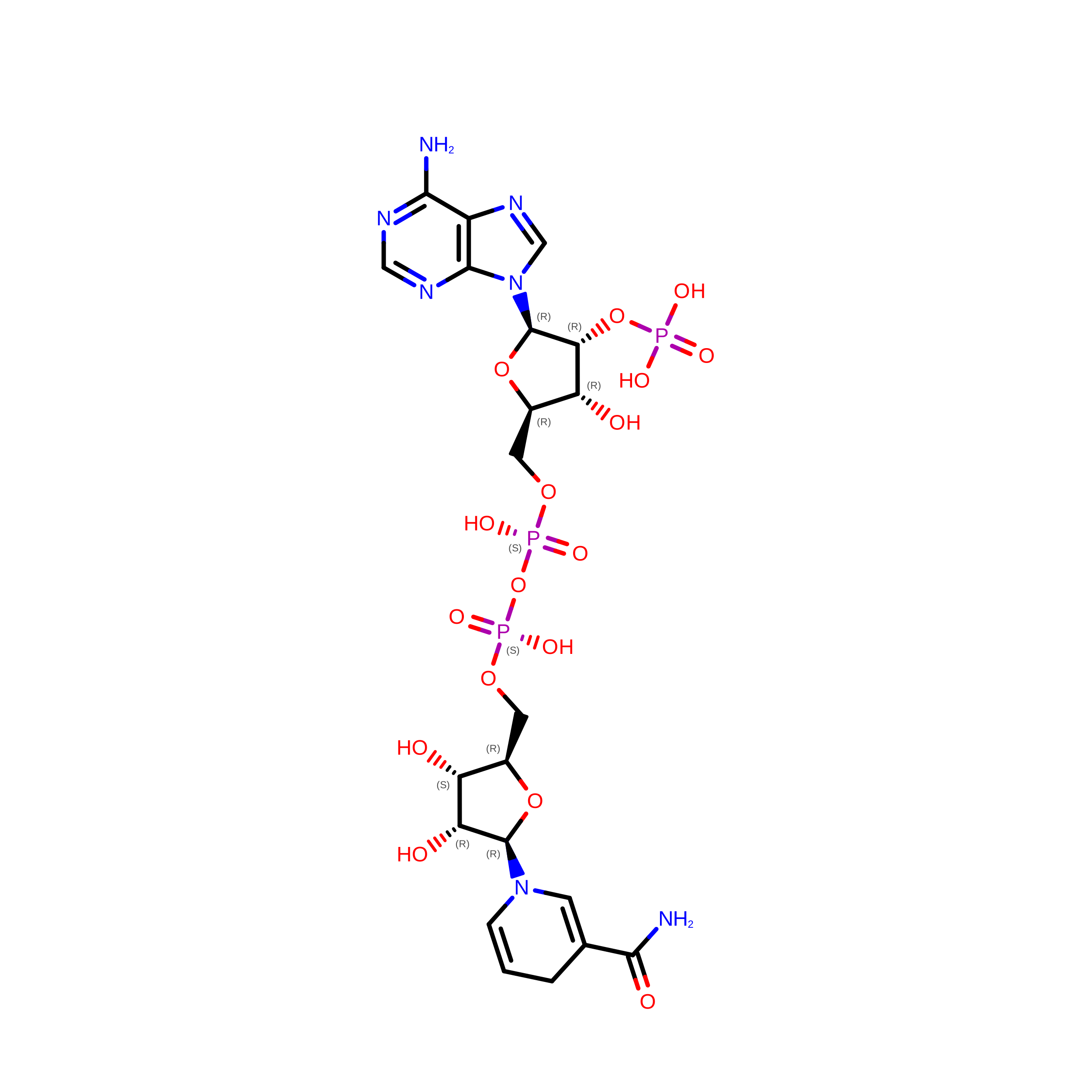
C [auth A]NADPH DIHYDRO-NICOTINAMIDE-ADENINE-DINUCLEOTIDE PHOSPHATE
C21 H30 N7 O17 P3
ACFIXJIJDZMPPO-NNYOXOHSSA-N
CA

Query on CA


Download:Ideal Coordinates CCD File
B [auth A]CALCIUM ION
Ca
BHPQYMZQTOCNFJ-UHFFFAOYSA-N

Experimental Data & Validation

Experimental Data

  • Method: X-RAY DIFFRACTION
  • Resolution: 2.70 Å
  • R-Value Free:  0.264 (Depositor), 0.269 (DCC) 
  • R-Value Work:  0.206 (Depositor), 0.211 (DCC) 
  • R-Value Observed: 0.209 (Depositor) 
Space Group: P 41 21 2
Unit Cell:
Length ( Å )Angle ( ˚ )
a = 62.888α = 90
b = 62.888β = 90
c = 153.597γ = 90
Software Package:
Software NamePurpose
PHENIXrefinement
XDSdata reduction
XSCALEdata scaling
PHASERphasing

Structure Validation

View Full Validation Report


Ligand Structure Quality Assessment 


Entry History 

& Funding Information

Deposition Data


Funding OrganizationLocationGrant Number
National Institutes of Health/National Institute of General Medical Sciences (NIH/NIGMS)United States1R01GM110161
Other privateUnited States1013579

Revision History  (Full details and data files)

  • Version 1.0: 2019-05-01
    Type: Initial release
  • Version 1.1: 2019-06-12
    Changes: Data collection, Database references
  • Version 1.2: 2020-01-01
    Changes: Author supporting evidence
  • Version 1.3: 2023-10-11
    Changes: Data collection, Database references, Refinement description