6M06 | pdb_00006m06

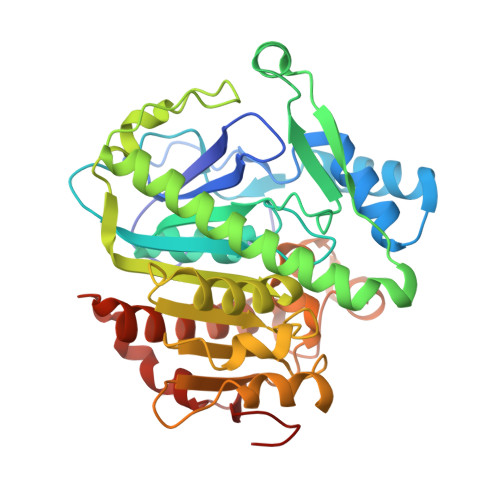
Crystal structure of Lp-PLA2 in complex with a novel covalent inhibitor


Experimental Data Snapshot

  • Method: X-RAY DIFFRACTION
  • Resolution: 2.10 Å
  • R-Value Free: 
    0.220 (Depositor), 0.225 (DCC) 
  • R-Value Work: 
    0.186 (Depositor), 0.192 (DCC) 
  • R-Value Observed: 
    0.188 (Depositor) 

Starting Model: experimental
View more details

wwPDB Validation 3D Report Full Report

Validation slider image for 6M06

Ligand Structure Quality Assessment 


This is version 2.2 of the entry. See complete history

Literature

Identification of Highly Selective Lipoprotein-Associated Phospholipase A2 (Lp-PLA2) Inhibitors by a Covalent Fragment-Based Approach.

Huang, F.Hu, H.Wang, K.Peng, C.Xu, W.Zhang, Y.Gao, J.Liu, Y.Zhou, H.Huang, R.Li, M.Shen, J.Xu, Y.

(2020) J Med Chem 63: 7052-7065

  • DOI: https://doi.org/10.1021/acs.jmedchem.0c00372
  • Primary Citation Related Structures: 
    6M06, 6M07, 6M08

  • PubMed Abstract: 

    Covalent ligands are of great interest as therapeutic drugs or biochemical tools. Here, we reported the discovery of highly selective and irreversible inhibitors of lipoprotein-associated phospholipase A2 (Lp-PLA2) using a covalent fragment-based approach. The crystal structure of Lp-PLA2 in complex with a covalent fragment not only reveals the covalent reaction mechanism but also provides a good starting point to design compound 8 , which has a more than 130,000-fold and 3900-fold increase in potency and selectivity, respectively, compared to those of the covalent fragment. Furthermore, fluorescent probes with high selectivity and sensitivity are developed to characterize Lp-PLA2 and its enzymatic activity in vitro or even in living cells in a way more convenient than immunoblotting tests or immunofluorescence imaging. Overall, we provide a paradigm for application of the covalent fragment-based strategy in covalent ligand discovery and the advantage of enol-cyclocarbamate as a new warhead in designing covalent inhibitors of serine hydrolases.


  • Organizational Affiliation
    • State Key Laboratory of Drug Research, Chinese Academy of Sciences, Shanghai 201203, China.

Macromolecule Content 

  • Total Structure Weight: 84.94 kDa 
  • Atom Count: 5,983 
  • Modeled Residue Count: 742 
  • Deposited Residue Count: 742 
  • Unique protein chains: 1

Macromolecules

Find similar proteins by:|  3D Structure
Entity ID: 1
MoleculeChains  Sequence LengthOrganismDetailsImage
Platelet-activating factor acetylhydrolase
A, B
371Homo sapiensMutation(s): 0 
Gene Names: PLA2G7PAFAH
EC: 3.1.1.47
UniProt & NIH Common Fund Data Resources
Find proteins for Q13093 (Homo sapiens)
Explore Q13093 
Go to UniProtKB:  Q13093
PHAROS:  Q13093
GTEx:  ENSG00000146070 
Entity Groups
Sequence Clusters30% Identity50% Identity70% Identity90% Identity95% Identity100% Identity
UniProt GroupQ13093
Sequence Annotations
Expand
Reference Sequence

Small Molecules

Ligands 1 Unique
IDChains Name / Formula / InChI Key2D Diagram3D Interactions
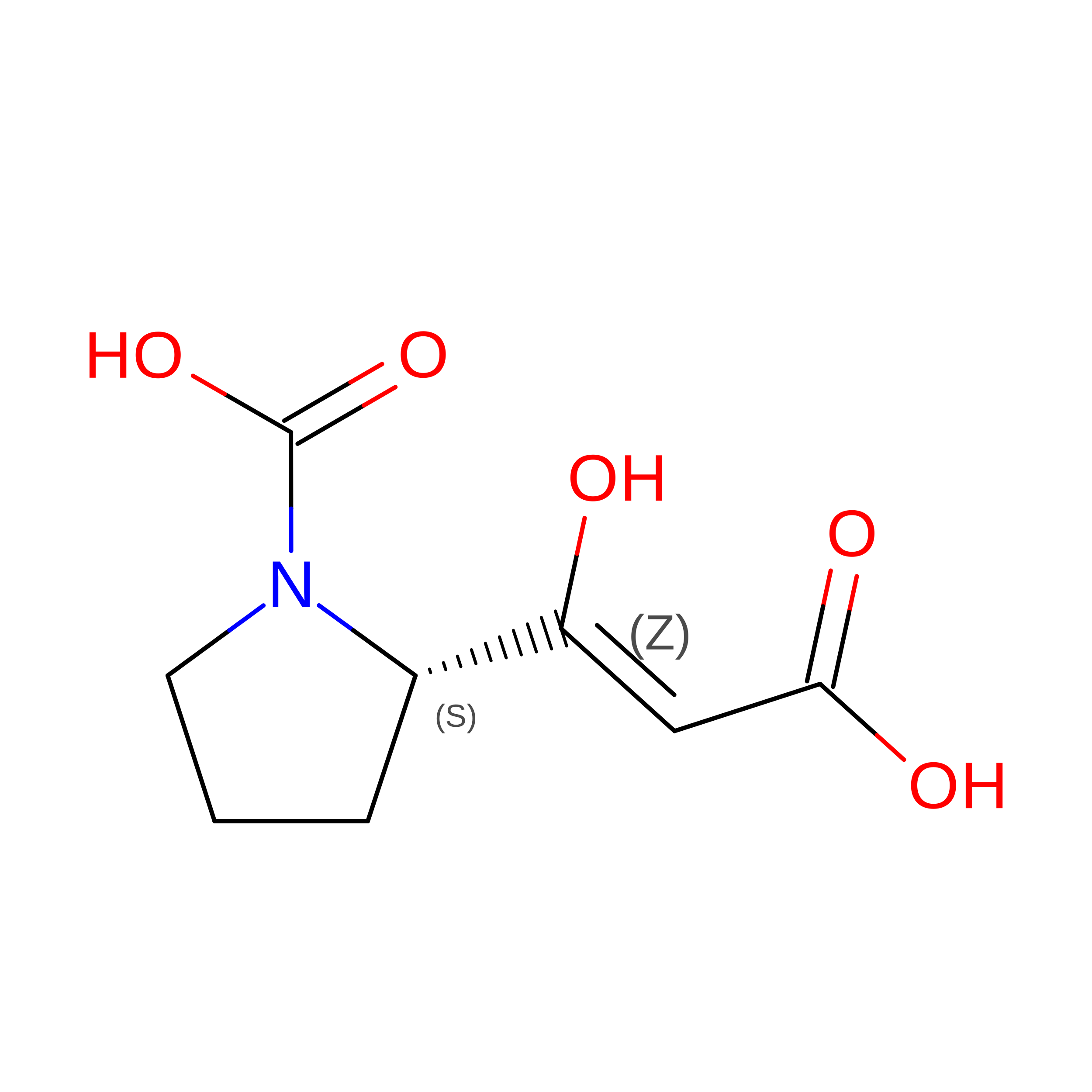
BWF
(Subject of Investigation/LOI)

Query on BWF


Download:Ideal Coordinates CCD File
C [auth A],
D [auth B]
(2S)-2-[(Z)-1,3-bis(oxidanyl)-3-oxidanylidene-prop-1-enyl]pyrrolidine-1-carboxylic acid
C8 H11 N O5
ROSCYVZNGZEOEY-YIWIKUPCSA-N

Experimental Data & Validation

Experimental Data

  • Method: X-RAY DIFFRACTION
  • Resolution: 2.10 Å
  • R-Value Free:  0.220 (Depositor), 0.225 (DCC) 
  • R-Value Work:  0.186 (Depositor), 0.192 (DCC) 
  • R-Value Observed: 0.188 (Depositor) 
Space Group: C 1 2 1
Unit Cell:
Length ( Å )Angle ( ˚ )
a = 116.014α = 90
b = 83.22β = 115.04
c = 96.581γ = 90
Software Package:
Software NamePurpose
HKL-2000data scaling
REFMACrefinement
PDB_EXTRACTdata extraction
HKL-3000data reduction
PHASERphasing

Structure Validation

View Full Validation Report


Ligand Structure Quality Assessment 


Entry History 

& Funding Information

Deposition Data


Funding OrganizationLocationGrant Number
National Natural Science Foundation of China (NSFC)China--

Revision History  (Full details and data files)

  • Version 1.0: 2020-12-30
    Type: Initial release
  • Version 2.0: 2021-01-13
    Changes: Derived calculations, Non-polymer description, Structure summary
  • Version 2.1: 2023-11-29
    Changes: Data collection, Database references, Refinement description
  • Version 2.2: 2024-10-23
    Changes: Structure summary