6LR6 | pdb_00006lr6

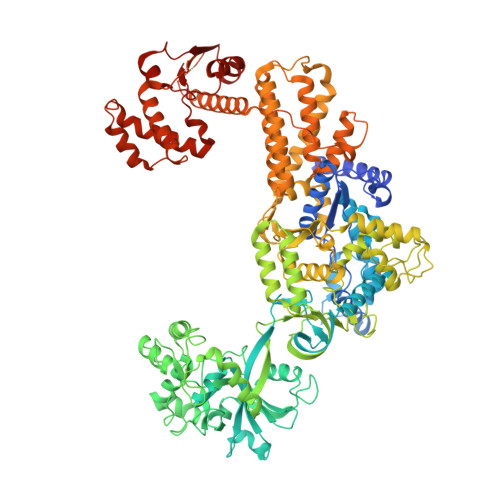
The crystal structure of human cytoplasmic LRS


Experimental Data Snapshot

  • Method: X-RAY DIFFRACTION
  • Resolution: 3.01 Å
  • R-Value Free: 
    0.260 (Depositor), 0.258 (DCC) 
  • R-Value Work: 
    0.211 (Depositor), 0.211 (DCC) 
  • R-Value Observed: 
    0.213 (Depositor) 

Starting Models: experimental
View more details

wwPDB Validation 3D Report Full Report

Validation slider image for 6LR6

Ligand Structure Quality Assessment 


This is version 1.3 of the entry. See complete history

Literature

Molecular basis of the multifaceted functions of human leucyl-tRNA synthetase in protein synthesis and beyond.

Liu, R.J.Long, T.Li, H.Zhao, J.Li, J.Wang, M.Palencia, A.Lin, J.Cusack, S.Wang, E.D.

(2020) Nucleic Acids Res 48: 4946-4959

  • DOI: https://doi.org/10.1093/nar/gkaa189
  • Primary Citation Related Structures: 
    6LPF, 6LR6

  • PubMed Abstract: 

    Human cytosolic leucyl-tRNA synthetase (hcLRS) is an essential and multifunctional enzyme. Its canonical function is to catalyze the covalent ligation of leucine to tRNALeu, and it may also hydrolyze mischarged tRNAs through an editing mechanism. Together with eight other aminoacyl-tRNA synthetases (AaRSs) and three auxiliary proteins, it forms a large multi-synthetase complex (MSC). Beyond its role in translation, hcLRS has an important moonlight function as a leucine sensor in the rapamycin complex 1 (mTORC1) pathway. Since this pathway is active in cancer development, hcLRS is a potential target for anti-tumor drug development. Moreover, LRS from pathogenic microbes are proven drug targets for developing antibiotics, which however should not inhibit hcLRS. Here we present the crystal structure of hcLRS at a 2.5 Å resolution, the first complete structure of a eukaryotic LRS, and analyze the binding of various compounds that target different sites of hcLRS. We also deduce the assembly mechanism of hcLRS into the MSC through reconstitution of the entire mega complex in vitro. Overall, our study provides the molecular basis for understanding both the multifaceted functions of hcLRS and for drug development targeting these functions.


  • Organizational Affiliation
    • School of Life Science and Technology, ShanghaiTech University, 100 Haike Road, Shanghai 201210, P.R. China.

Macromolecule Content 

  • Total Structure Weight: 252.43 kDa 
  • Atom Count: 16,358 
  • Modeled Residue Count: 2,008 
  • Deposited Residue Count: 2,184 
  • Unique protein chains: 1

Macromolecules

Find similar proteins by:|  3D Structure
Entity ID: 1
MoleculeChains  Sequence LengthOrganismDetailsImage
Leucine--tRNA ligase, cytoplasmic
A, B
1,092Homo sapiensMutation(s): 0 
Gene Names: LARSKIAA1352
EC: 6.1.1.4
UniProt & NIH Common Fund Data Resources
Find proteins for Q9P2J5 (Homo sapiens)
Explore Q9P2J5 
Go to UniProtKB:  Q9P2J5
PHAROS:  Q9P2J5
GTEx:  ENSG00000133706 
Entity Groups
Sequence Clusters30% Identity50% Identity70% Identity90% Identity95% Identity100% Identity
UniProt GroupQ9P2J5
Sequence Annotations
Expand
Reference Sequence

Small Molecules

Binding Affinity Annotations 
IDSourceBinding Affinity
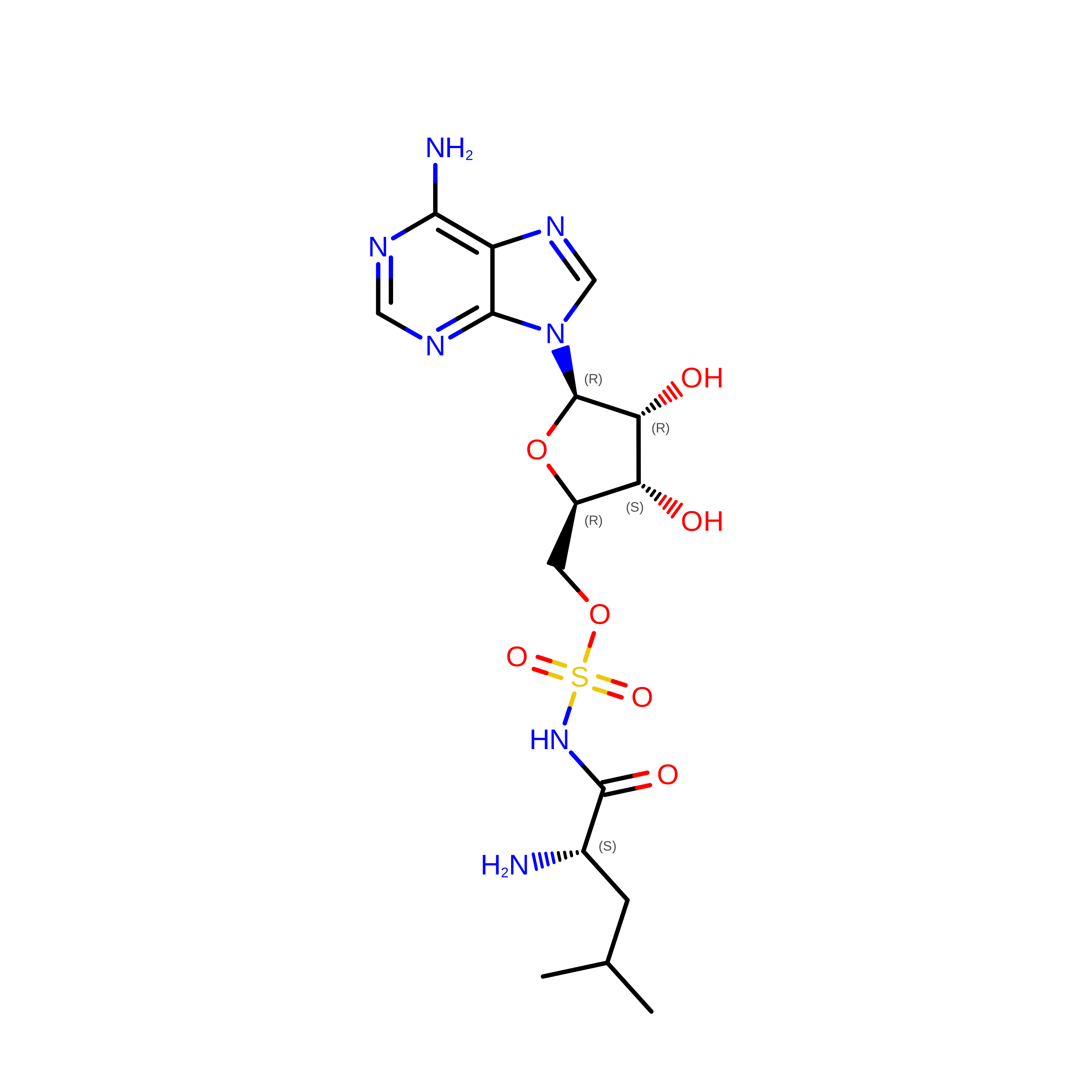
LSS BindingDB:  6LR6 IC50: 22 (nM) from 1 assay(s)

Experimental Data & Validation

Experimental Data

  • Method: X-RAY DIFFRACTION
  • Resolution: 3.01 Å
  • R-Value Free:  0.260 (Depositor), 0.258 (DCC) 
  • R-Value Work:  0.211 (Depositor), 0.211 (DCC) 
  • R-Value Observed: 0.213 (Depositor) 
Space Group: C 2 2 21
Unit Cell:
Length ( Å )Angle ( ˚ )
a = 88.854α = 90
b = 95.798β = 90
c = 682.388γ = 90
Software Package:
Software NamePurpose
HKL-2000data scaling
PHENIXrefinement
PDB_EXTRACTdata extraction
HKL-2000data reduction
PHASERphasing

Structure Validation

View Full Validation Report


Ligand Structure Quality Assessment 


Entry History 

& Funding Information

Deposition Data


Funding OrganizationLocationGrant Number
National Natural Science Foundation of China (NSFC)China31770842
National Natural Science Foundation of China (NSFC)China31971230

Revision History  (Full details and data files)

  • Version 1.0: 2020-03-25
    Type: Initial release
  • Version 1.1: 2020-04-15
    Changes: Database references
  • Version 1.2: 2020-05-27
    Changes: Database references
  • Version 1.3: 2023-11-29
    Changes: Data collection, Database references, Refinement description