6K7O | pdb_00006k7o

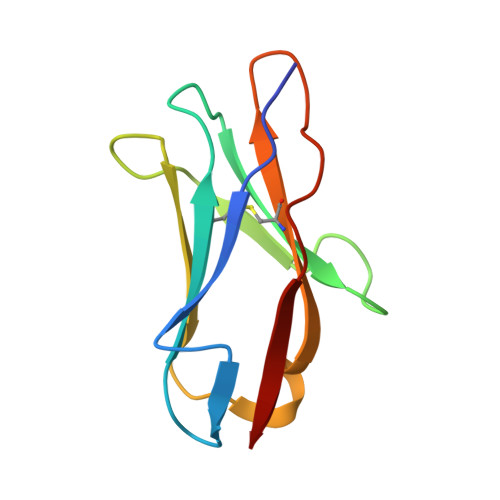
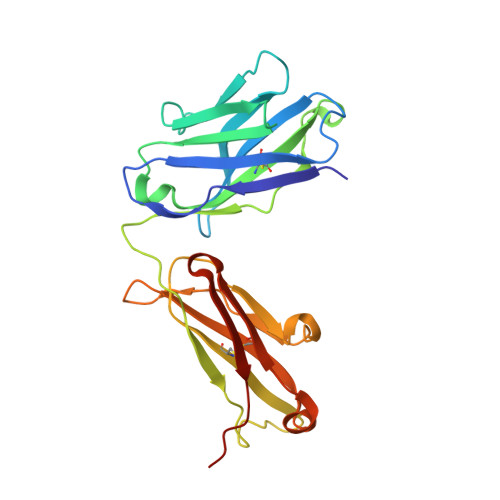
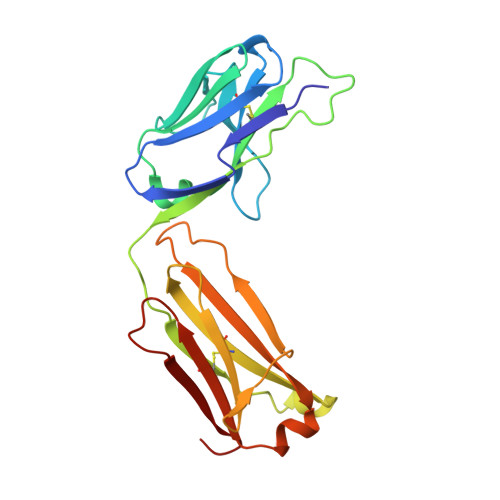
Complex structure of LILRB4 and h128-3 antibody


Experimental Data Snapshot

  • Method: X-RAY DIFFRACTION
  • Resolution: 3.00 Å
  • R-Value Free: 
    0.270 (Depositor), 0.270 (DCC) 
  • R-Value Work: 
    0.228 (Depositor), 0.229 (DCC) 
  • R-Value Observed: 
    0.230 (Depositor) 

Starting Model: experimental
View more details

wwPDB Validation 3D Report Full Report

Validation slider image for 6K7O

This is version 1.3 of the entry. See complete history

Literature

Disrupting LILRB4/APOE Interaction by an Efficacious Humanized Antibody Reverses T-cell Suppression and Blocks AML Development.

Gui, X.Deng, M.Song, H.Chen, Y.Xie, J.Li, Z.He, L.Huang, F.Xu, Y.Anami, Y.Yu, H.Yu, C.Li, L.Yuan, Z.Xu, X.Wang, Q.Chai, Y.Huang, T.Shi, Y.Tsuchikama, K.Liao, X.C.Xia, N.Gao, G.F.Zhang, N.Zhang, C.C.An, Z.

(2019) Cancer Immunol Res 7: 1244-1257

  • DOI: https://doi.org/10.1158/2326-6066.CIR-19-0036
  • Primary Citation Related Structures: 
    6K7O

  • PubMed Abstract: 

    Therapeutic strategies are urgently needed for patients with acute myeloid leukemia (AML). Leukocyte immunoglobulin-like receptor B4 (LILRB4), which suppresses T-cell activation and supports tissue infiltration of AML cells, represents an attractive drug target for anti-AML therapeutics. Here, we report the identification and development of an LILRB4-specific humanized mAb that blocks LILRB4 activation. This mAb, h128-3, showed potent activity in blocking the development of monocytic AML in various models including patient-derived xenograft mice and syngeneic immunocompetent AML mice. MAb h128-3 enhanced the anti-AML efficacy of chemotherapy treatment by stimulating mobilization of leukemia cells. Mechanistic studies revealed four concordant modes of action for the anti-AML activity of h128-3: (i) reversal of T-cell suppression, (ii) inhibition of monocytic AML cell tissue infiltration, (iii) antibody-dependent cellular cytotoxicity, and (iv) antibody-dependent cellular phagocytosis. Therefore, targeting LILRB4 with antibody represents an effective therapeutic strategy for treating monocytic AML.


  • Organizational Affiliation
    • Texas Therapeutics Institute, Brown Foundation Institute of Molecular Medicine, University of Texas Health Science Center, Houston, Texas.

Macromolecule Content 

  • Total Structure Weight: 235.46 kDa 
  • Atom Count: 16,436 
  • Modeled Residue Count: 2,148 
  • Deposited Residue Count: 2,164 
  • Unique protein chains: 3

Macromolecules

Find similar proteins by:|  3D Structure
Entity ID: 1
MoleculeChains  Sequence LengthOrganismDetailsImage
Leukocyte immunoglobulin-like receptor subfamily B member 4A,
J [auth P],
K [auth R],
L [auth Q]
95Homo sapiensMutation(s): 0 
Gene Names: LILRB4ILT3LIR5
UniProt & NIH Common Fund Data Resources
Find proteins for Q8NHJ6 (Homo sapiens)
Explore Q8NHJ6 
Go to UniProtKB:  Q8NHJ6
PHAROS:  Q8NHJ6
GTEx:  ENSG00000186818 
Entity Groups
Sequence Clusters30% Identity50% Identity70% Identity90% Identity95% Identity100% Identity
UniProt GroupQ8NHJ6
Sequence Annotations
Expand
Reference Sequence
Find similar proteins by:|  3D Structure
Entity ID: 2
MoleculeChains  Sequence LengthOrganismDetailsImage
h128-3 Fab heavy chain
B, D, F, H
228Homo sapiensMutation(s): 0 
Find similar proteins by:|  3D Structure
Entity ID: 3
MoleculeChains  Sequence LengthOrganismDetailsImage
h128-3 Fab light chainC,
E,
G,
I [auth L]
218Homo sapiensMutation(s): 0 

Experimental Data & Validation

Experimental Data

  • Method: X-RAY DIFFRACTION
  • Resolution: 3.00 Å
  • R-Value Free:  0.270 (Depositor), 0.270 (DCC) 
  • R-Value Work:  0.228 (Depositor), 0.229 (DCC) 
  • R-Value Observed: 0.230 (Depositor) 
Space Group: P 62
Unit Cell:
Length ( Å )Angle ( ˚ )
a = 187.276α = 90
b = 187.276β = 90
c = 183.819γ = 120
Software Package:
Software NamePurpose
PHENIXrefinement
HKL-2000data reduction
HKL-2000data scaling
PHASERphasing

Structure Validation

View Full Validation Report


Entry History 

Deposition Data

Revision History  (Full details and data files)

  • Version 1.0: 2019-07-03
    Type: Initial release
  • Version 1.1: 2019-08-14
    Changes: Data collection, Database references
  • Version 1.2: 2023-11-22
    Changes: Data collection, Database references, Refinement description
  • Version 1.3: 2024-11-13
    Changes: Structure summary