6I9L | pdb_00006i9l

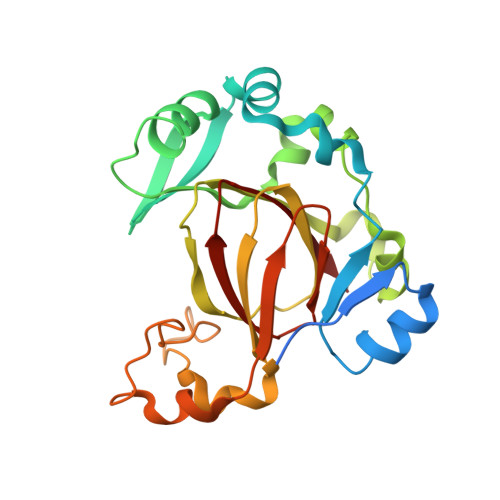
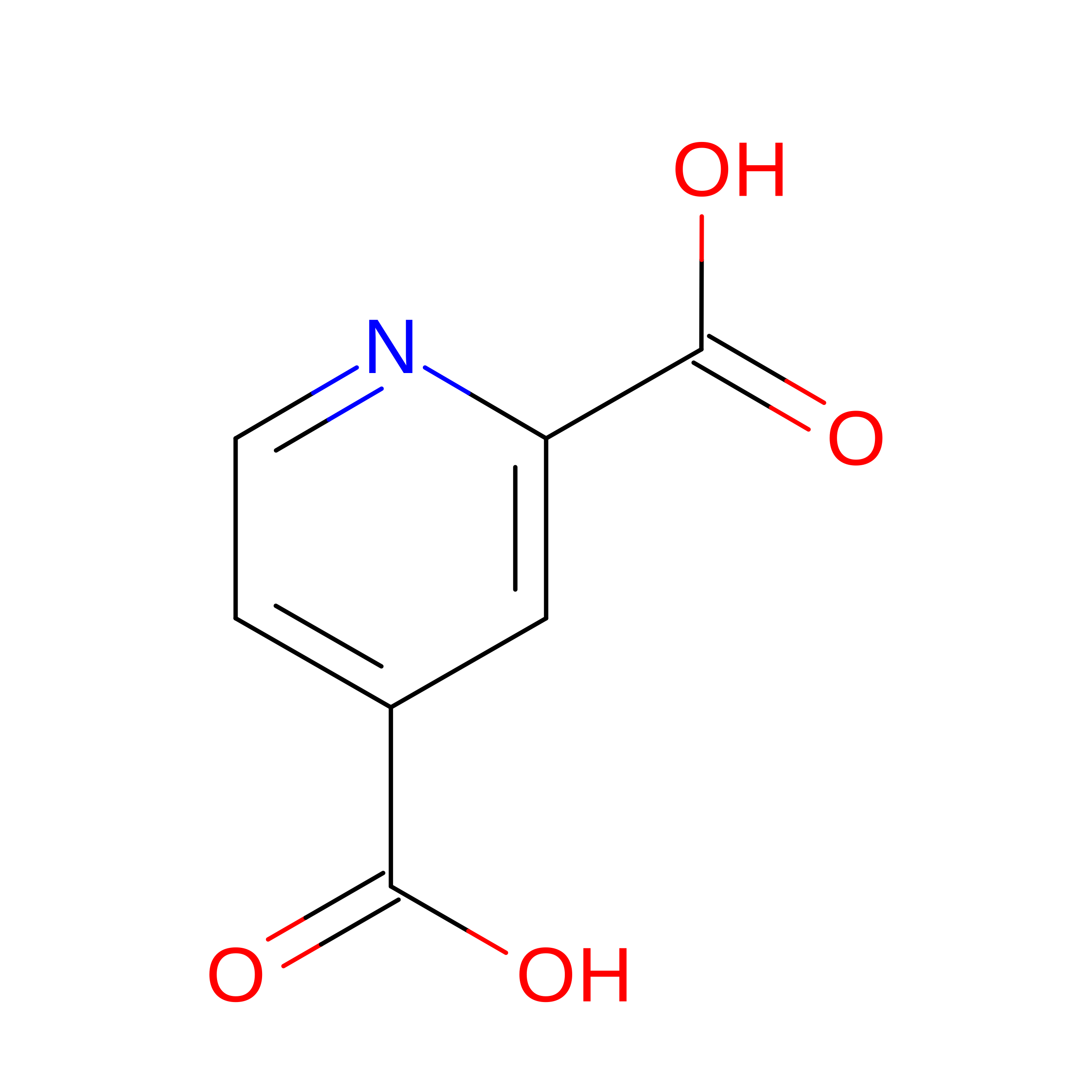
JmjC domain-containing protein 5 (JMJD5) in complex with Mn and pyridine-2,4-dicarboxylic acid (2,4-PDCA)


Experimental Data Snapshot

  • Method: X-RAY DIFFRACTION
  • Resolution: 1.53 Å
  • R-Value Free: 
    0.164 (Depositor), 0.168 (DCC) 
  • R-Value Work: 
    0.146 (Depositor), 0.150 (DCC) 
  • R-Value Observed: 
    0.147 (Depositor) 

Starting Model: experimental
View more details

wwPDB Validation 3D Report Full Report

Validation slider image for 6I9L

Ligand Structure Quality Assessment 


This is version 1.2 of the entry. See complete history

Literature

Structural analysis of the 2-oxoglutarate binding site of the circadian rhythm linked oxygenase JMJD5.

Islam, M.S.Markoulides, M.Chowdhury, R.Schofield, C.J.

(2022) Sci Rep 12: 20680-20680

  • DOI: https://doi.org/10.1038/s41598-022-24154-0
  • Primary Citation Related Structures: 
    6I9L, 6I9M, 6I9N, 7UQ3

  • PubMed Abstract: 

    JmjC (Jumonji-C) domain-containing 5 (JMJD5) plays important roles in circadian regulation in plants and humans and is involved in embryonic development and cell proliferation. JMJD5 is a 2-oxoglutarate (2OG) and Fe(II) dependent oxygenase of the JmjC subfamily, which includes histone N ε -methyl lysine-demethylases (KDMs) and hydroxylases catalysing formation of stable alcohol products. JMJD5 is reported to have KDM activity, but has been shown to catalyse C-3 hydroxylation of arginine residues in sequences from human regulator of chromosome condensation domain-containing protein 1 (RCCD1) and ribosomal protein S6 (RPS6) in vitro. We report crystallographic analyses of human JMJD5 complexed with 2OG analogues, including the widely used hypoxia mimic pyridine-2,4-dicarboxylate, both D- and L-enantiomers of the oncometabolite 2-hydroxyglutarate, and a cyclic N-hydroxyimide. The results support the assignment of JMJD5 as a protein hydroxylase and reveal JMJD5 has an unusually compact 2OG binding pocket suitable for exploitation in development of selective inhibitors. They will be useful in the development of chemical probes to investigate the physiologically relevant roles of JMJD5 in circadian rhythm and development and explore its potential as a medicinal chemistry target.


  • Organizational Affiliation
    • Chemistry Research Laboratory, Department of Chemistry and the Ineos Oxford Institute for Antimicrobial Research, University of Oxford, 12 Mansfield Road, Oxford, OX1 3TA, UK.

Macromolecule Content 

  • Total Structure Weight: 30.08 kDa 
  • Atom Count: 2,330 
  • Modeled Residue Count: 228 
  • Deposited Residue Count: 256 
  • Unique protein chains: 1

Macromolecules

Find similar proteins by:|  3D Structure
Entity ID: 1
MoleculeChains  Sequence LengthOrganismDetailsImage
JmjC domain-containing protein 5256Homo sapiensMutation(s): 0 
Gene Names: KDM8JMJD5
EC: 1.14.11.27 (PDB Primary Data), 3.4 (PDB Primary Data), 1.14.11.73 (UniProt)
UniProt & NIH Common Fund Data Resources
Find proteins for Q8N371 (Homo sapiens)
Explore Q8N371 
Go to UniProtKB:  Q8N371
PHAROS:  Q8N371
GTEx:  ENSG00000155666 
Entity Groups
Sequence Clusters30% Identity50% Identity70% Identity90% Identity95% Identity100% Identity
UniProt GroupQ8N371
Sequence Annotations
Expand
Reference Sequence

Small Molecules

Binding Affinity Annotations 
IDSourceBinding Affinity
PD2 BindingDB:  6I9L IC50: 500 (nM) from 1 assay(s)

Experimental Data & Validation

Experimental Data

  • Method: X-RAY DIFFRACTION
  • Resolution: 1.53 Å
  • R-Value Free:  0.164 (Depositor), 0.168 (DCC) 
  • R-Value Work:  0.146 (Depositor), 0.150 (DCC) 
  • R-Value Observed: 0.147 (Depositor) 
Space Group: P 21 21 21
Unit Cell:
Length ( Å )Angle ( ˚ )
a = 49.591α = 90
b = 64.809β = 90
c = 77.914γ = 90
Software Package:
Software NamePurpose
PHENIXrefinement
HKL-2000data reduction
HKL-2000data scaling
PHASERphasing

Structure Validation

View Full Validation Report


Ligand Structure Quality Assessment 


Entry History 

Deposition Data

Revision History  (Full details and data files)

  • Version 1.0: 2019-12-04
    Type: Initial release
  • Version 1.1: 2022-12-21
    Changes: Database references, Derived calculations
  • Version 1.2: 2024-01-31
    Changes: Data collection, Refinement description