6EJC | pdb_00006ejc

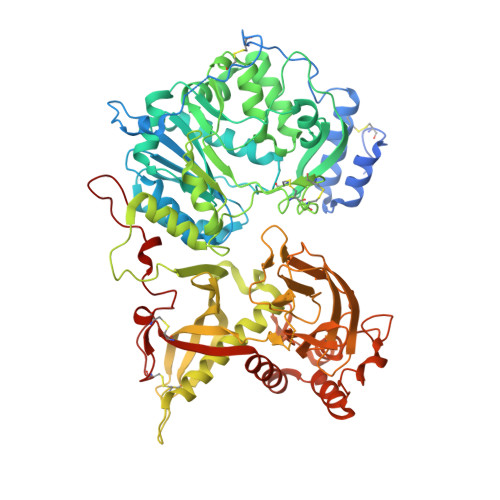
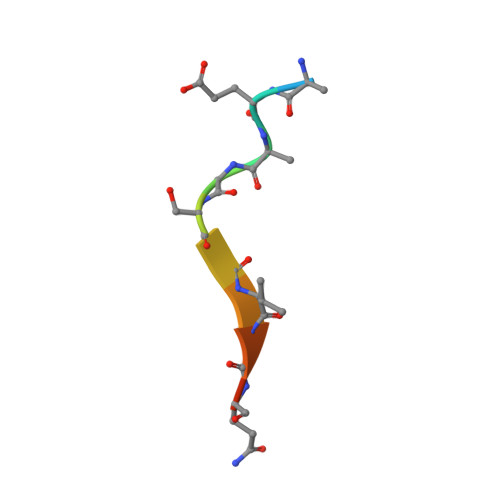
Human Xylosyltransferase 1 in complex with peptide QEEEGSGVGQGG


Experimental Data Snapshot

  • Method: X-RAY DIFFRACTION
  • Resolution: 2.06 Å
  • R-Value Free: 
    0.273 (Depositor), 0.274 (DCC) 
  • R-Value Work: 
    0.242 (Depositor), 0.243 (DCC) 
  • R-Value Observed: 
    0.243 (Depositor) 

Starting Model: experimental
View more details

wwPDB Validation 3D Report Full Report

Validation slider image for 6EJC

This is version 1.3 of the entry. See complete history

Literature

Structural Basis for the Initiation of Glycosaminoglycan Biosynthesis by Human Xylosyltransferase 1.

Briggs, D.C.Hohenester, E.

(2018) Structure 26: 801-809.e3

  • DOI: https://doi.org/10.1016/j.str.2018.03.014
  • Primary Citation Related Structures: 
    6EJ7, 6EJ8, 6EJ9, 6EJA, 6EJB, 6EJC, 6EJD, 6EJE, 6FOA

  • PubMed Abstract: 

    Proteoglycans (PGs) are essential components of the animal extracellular matrix and are required for cell adhesion, migration, signaling, and immune function. PGs are composed of a core protein and long glycosaminoglycan (GAG) chains, which often specify PG function. GAG biosynthesis is initiated by peptide O-xylosyltransferases, which transfer xylose onto selected serine residues in the core proteins. We have determined crystal structures of human xylosyltransferase 1 (XT1) in complex with the sugar donor, UDP-xylose, and various acceptor peptides. The structures reveal unique active-site features that, in conjunction with functional experiments, explain the substrate specificity of XT1. A constriction within the peptide binding cleft requires the acceptor serine to be followed by glycine or alanine. The remainder of the cleft can accommodate a wide variety of sequences, but with a general preference for acidic residues. These findings provide a framework for understanding the selectivity of GAG attachment.


  • Organizational Affiliation
    • Department of Life Sciences, Imperial College London, London SW7 2AZ, UK. Electronic address: david.briggs@crick.ac.uk.

Macromolecule Content 

  • Total Structure Weight: 87.37 kDa 
  • Atom Count: 5,669 
  • Modeled Residue Count: 710 
  • Deposited Residue Count: 763 
  • Unique protein chains: 2

Macromolecules

Find similar proteins by:|  3D Structure
Entity ID: 1
MoleculeChains  Sequence LengthOrganismDetailsImage
Xylosyltransferase 1751Homo sapiensMutation(s): 0 
Gene Names: XYLT1XT1
EC: 2.4.2.26
UniProt & NIH Common Fund Data Resources
Find proteins for Q86Y38 (Homo sapiens)
Explore Q86Y38 
Go to UniProtKB:  Q86Y38
PHAROS:  Q86Y38
GTEx:  ENSG00000103489 
Entity Groups
Sequence Clusters30% Identity50% Identity70% Identity90% Identity95% Identity100% Identity
UniProt GroupQ86Y38
Sequence Annotations
Expand
Reference Sequence
Find similar proteins by:  Sequence   |   3D Structure  
Entity ID: 2
MoleculeChains  Sequence LengthOrganismDetailsImage
Protein AMBP12Homo sapiensMutation(s): 3 
UniProt & NIH Common Fund Data Resources
Find proteins for P02760 (Homo sapiens)
Explore P02760 
Go to UniProtKB:  P02760
PHAROS:  P02760
GTEx:  ENSG00000106927 
Entity Groups
Sequence Clusters30% Identity50% Identity70% Identity90% Identity95% Identity100% Identity
UniProt GroupP02760
Sequence Annotations
Expand
Reference Sequence

Experimental Data & Validation

Experimental Data

  • Method: X-RAY DIFFRACTION
  • Resolution: 2.06 Å
  • R-Value Free:  0.273 (Depositor), 0.274 (DCC) 
  • R-Value Work:  0.242 (Depositor), 0.243 (DCC) 
  • R-Value Observed: 0.243 (Depositor) 
Space Group: P 21 21 21
Unit Cell:
Length ( Å )Angle ( ˚ )
a = 67.626α = 90
b = 86.898β = 90
c = 152.389γ = 90
Software Package:
Software NamePurpose
Aimlessdata scaling
PHENIXrefinement
PDB_EXTRACTdata extraction
xia2data reduction
PHASERphasing

Structure Validation

View Full Validation Report


Entry History 

& Funding Information

Deposition Data


Funding OrganizationLocationGrant Number
Wellcome TrustUnited Kingdom101748/Z/13/Z

Revision History  (Full details and data files)

  • Version 1.0: 2018-05-02
    Type: Initial release
  • Version 1.1: 2018-06-13
    Changes: Data collection, Database references
  • Version 1.2: 2024-01-17
    Changes: Data collection, Database references, Refinement description
  • Version 1.3: 2024-10-23
    Changes: Structure summary