6DCZ | pdb_00006dcz

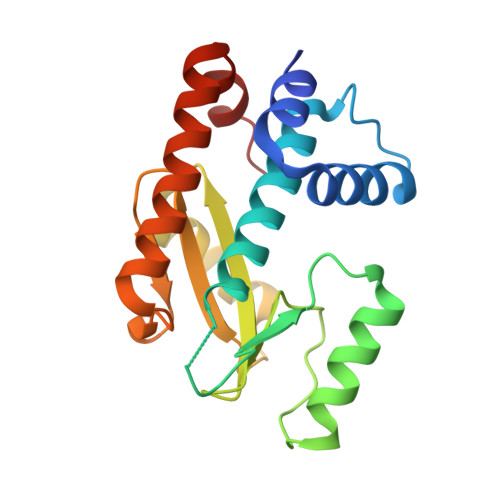
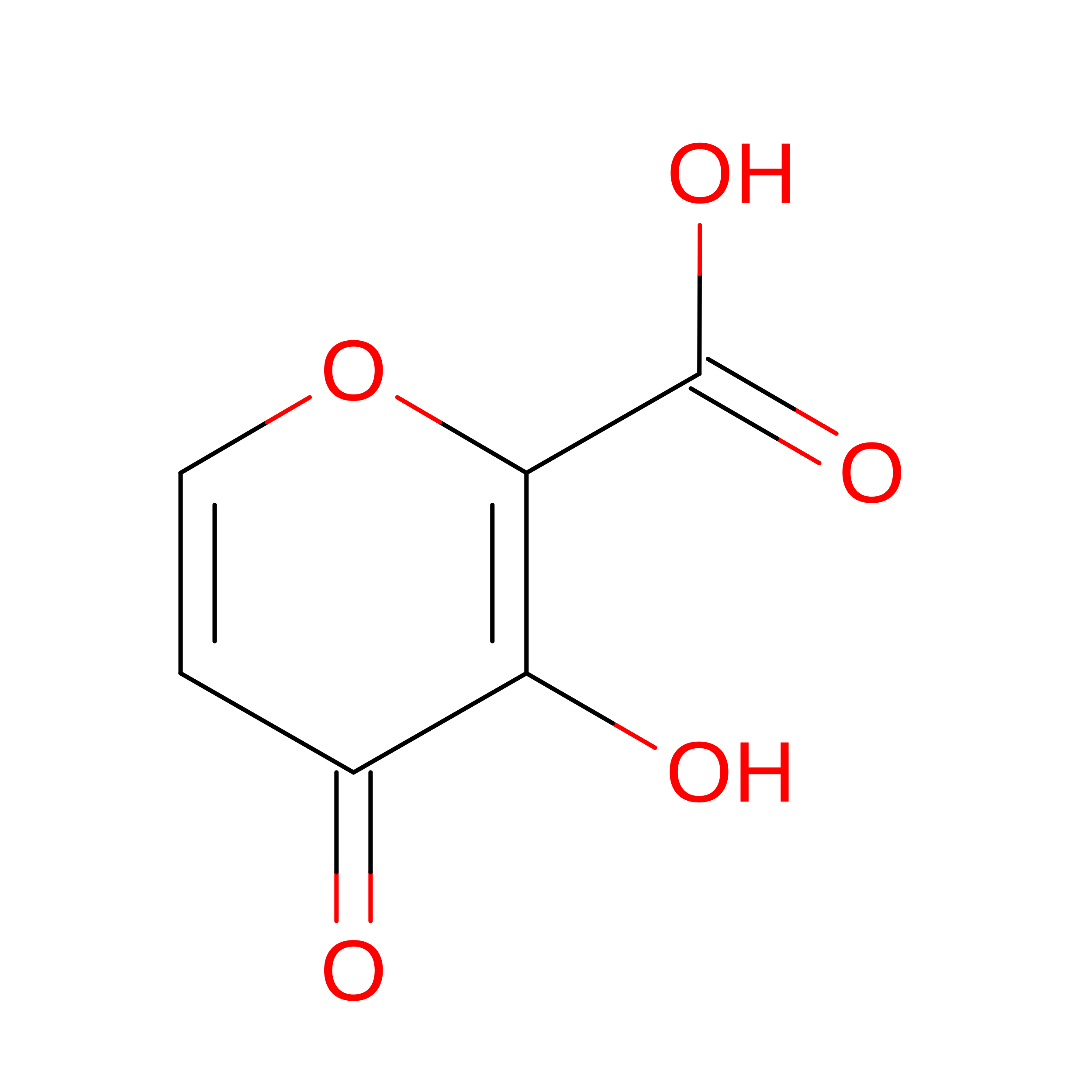
The N-terminal domain of PA endonuclease from the influenza H1N1 virus in complex with 3-hydroxy-4-oxo-4H-pyran-2-carboxylic acid


Experimental Data Snapshot

  • Method: X-RAY DIFFRACTION
  • Resolution: 2.89 Å
  • R-Value Free: 
    0.276 (Depositor), 0.280 (DCC) 
  • R-Value Work: 
    0.200 (Depositor), 0.208 (DCC) 
  • R-Value Observed: 
    0.207 (Depositor) 

Starting Model: experimental
View more details

wwPDB Validation 3D Report Full Report

Validation slider image for 6DCZ

Ligand Structure Quality Assessment 


This is version 1.3 of the entry. See complete history

Literature

Structure-Activity Relationships in Metal-Binding Pharmacophores for Influenza Endonuclease.

Credille, C.V.Dick, B.L.Morrison, C.N.Stokes, R.W.Adamek, R.N.Wu, N.C.Wilson, I.A.Cohen, S.M.

(2018) J Med Chem 61: 10206-10217

  • DOI: https://doi.org/10.1021/acs.jmedchem.8b01363
  • Primary Citation Related Structures: 
    6DCY, 6DCZ, 6DZQ, 6E0Q

  • PubMed Abstract: 

    Metalloenzymes represent an important target space for drug discovery. A limitation to the early development of metalloenzyme inhibitors has been the lack of established structure-activity relationships (SARs) for molecules that bind the metal ion cofactor(s) of a metalloenzyme. Herein, we employed a bioinorganic perspective to develop an SAR for inhibition of the metalloenzyme influenza RNA polymerase PA N endonuclease. The identified trends highlight the importance of the electronics of the metal-binding pharmacophore (MBP), in addition to MBP sterics, for achieving improved inhibition and selectivity. By optimization of the MBPs for PA N endonuclease, a class of highly active and selective fragments was developed that displays IC 50 values <50 nM. This SAR led to structurally distinct molecules that also displayed IC 50 values of ∼10 nM, illustrating the utility of a metal-centric development campaign in generating highly active and selective metalloenzyme inhibitors.


  • Organizational Affiliation
    • Department of Chemistry and Biochemistry , University of California, San Diego , La Jolla , California 92093 , United States.

Macromolecule Content 

  • Total Structure Weight: 22.73 kDa 
  • Atom Count: 1,513 
  • Modeled Residue Count: 180 
  • Deposited Residue Count: 192 
  • Unique protein chains: 1

Macromolecules

Find similar proteins by:|  3D Structure
Entity ID: 1
MoleculeChains  Sequence LengthOrganismDetailsImage
Polymerase acidic protein192Influenza A virus (A/California/04/2009(H1N1))Mutation(s): 0 
Gene Names: PA
EC: 3.1
UniProt
Find proteins for C3W5S0 (Influenza A virus (strain swl A/California/04/2009 H1N1))
Explore C3W5S0 
Go to UniProtKB:  C3W5S0
Entity Groups
Sequence Clusters30% Identity50% Identity70% Identity90% Identity95% Identity100% Identity
UniProt GroupC3W5S0
Sequence Annotations
Expand
Reference Sequence

Small Molecules

Binding Affinity Annotations 
IDSourceBinding Affinity
G5Y BindingDB:  6DCZ IC50: min: 1.97e+4, max: 2.00e+4 (nM) from 2 assay(s)

Experimental Data & Validation

Experimental Data

  • Method: X-RAY DIFFRACTION
  • Resolution: 2.89 Å
  • R-Value Free:  0.276 (Depositor), 0.280 (DCC) 
  • R-Value Work:  0.200 (Depositor), 0.208 (DCC) 
  • R-Value Observed: 0.207 (Depositor) 
Space Group: P 62 2 2
Unit Cell:
Length ( Å )Angle ( ˚ )
a = 75.84α = 90
b = 75.84β = 90
c = 121.3γ = 120
Software Package:
Software NamePurpose
REFMACrefinement
iMOSFLMdata reduction
Aimlessdata scaling
PHASERphasing

Structure Validation

View Full Validation Report


Ligand Structure Quality Assessment 


Entry History 

& Funding Information

Deposition Data


Funding OrganizationLocationGrant Number
National Institutes of Health/National Institute of General Medical Sciences (NIH/NIGMS)United StatesR01GM098435

Revision History  (Full details and data files)

  • Version 1.0: 2018-11-07
    Type: Initial release
  • Version 1.1: 2018-12-05
    Changes: Data collection, Database references
  • Version 1.2: 2020-01-01
    Changes: Author supporting evidence
  • Version 1.3: 2023-10-11
    Changes: Data collection, Database references, Derived calculations, Refinement description