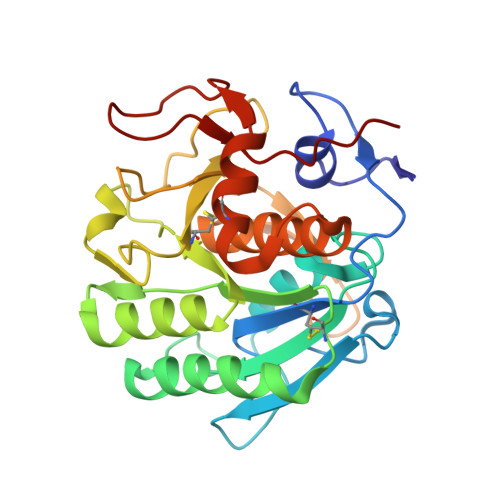
6CL9 | pdb_00006cl9

2.20 A MicroED structure of proteinase K at 4.3 e- / A^2


Experimental Data Snapshot

  • Method: ELECTRON CRYSTALLOGRAPHY
  • Resolution: 2.20 Å
  • R-Value Free: 
    0.302 (Depositor) 
  • R-Value Work: 
    0.239 (Depositor) 
  • R-Value Observed: 
    0.243 (Depositor) 

Starting Model: experimental
View more details

wwPDB Validation 3D Report Full Report

Validation slider image for 6CL9

This is version 1.2 of the entry. See complete history

Literature

Analysis of Global and Site-Specific Radiation Damage in Cryo-EM.

Hattne, J.Shi, D.Glynn, C.Zee, C.T.Gallagher-Jones, M.Martynowycz, M.W.Rodriguez, J.A.Gonen, T.

(2018) Structure 26: 759-766.e4

  • DOI: https://doi.org/10.1016/j.str.2018.03.021
  • Primary Citation Related Structures: 
    6CL7, 6CL8, 6CL9, 6CLA, 6CLB, 6CLC, 6CLD, 6CLE, 6CLF, 6CLG, 6CLH, 6CLI, 6CLJ, 6CLK, 6CLL, 6CLM, 6CLN, 6CLO, 6CLP, 6CLQ, 6CLR, 6CLS, 6CLT

  • PubMed Abstract: 

    Micro-crystal electron diffraction (MicroED) combines the efficiency of electron scattering with diffraction to allow structure determination from nano-sized crystalline samples in cryoelectron microscopy (cryo-EM). It has been used to solve structures of a diverse set of biomolecules and materials, in some cases to sub-atomic resolution. However, little is known about the damaging effects of the electron beam on samples during such measurements. We assess global and site-specific damage from electron radiation on nanocrystals of proteinase K and of a prion hepta-peptide and find that the dynamics of electron-induced damage follow well-established trends observed in X-ray crystallography. Metal ions are perturbed, disulfide bonds are broken, and acidic side chains are decarboxylated while the diffracted intensities decay exponentially with increasing exposure. A better understanding of radiation damage in MicroED improves our assessment and processing of all types of cryo-EM data.


  • Organizational Affiliation
    • Howard Hughes Medical Institute, University of California, Los Angeles, Los Angeles CA 90095, USA; Janelia Research Campus, Howard Hughes Medical Institute, Ashburn, VA 20147, USA.

Macromolecule Content 

  • Total Structure Weight: 28.93 kDa 
  • Atom Count: 2,029 
  • Modeled Residue Count: 279 
  • Deposited Residue Count: 279 
  • Unique protein chains: 1

Macromolecules

Find similar proteins by:|  3D Structure
Entity ID: 1
MoleculeChains  Sequence LengthOrganismDetailsImage
Proteinase K279Parengyodontium albumMutation(s): 0 
EC: 3.4.21.64
UniProt
Find proteins for P06873 (Parengyodontium album)
Explore P06873 
Go to UniProtKB:  P06873
Entity Groups
Sequence Clusters30% Identity50% Identity70% Identity90% Identity95% Identity100% Identity
UniProt GroupP06873
Sequence Annotations
Expand
Reference Sequence

Experimental Data & Validation

Experimental Data

  • Method: ELECTRON CRYSTALLOGRAPHY
  • Resolution: 2.20 Å
  • R-Value Free:  0.302 (Depositor) 
  • R-Value Work:  0.239 (Depositor) 
  • R-Value Observed: 0.243 (Depositor) 
Space Group: P 43 21 2
Unit Cell:
Length ( Å )Angle ( ˚ )
a = 67.253α = 90
b = 67.253β = 90
c = 100.933γ = 90
Software Package:
Software NamePurpose
REFMACrefinement
MOSFLMdata reduction
Aimlessdata scaling
EM Software:
TaskSoftware PackageVersion
MODEL REFINEMENTREFMAC5.8.0194

Structure Validation

View Full Validation Report


Entry History 

Deposition Data

Revision History  (Full details and data files)

  • Version 1.0: 2018-05-16
    Type: Initial release
  • Version 1.1: 2023-10-04
    Changes: Data collection, Database references, Refinement description
  • Version 1.2: 2024-10-23
    Changes: Data collection, Structure summary