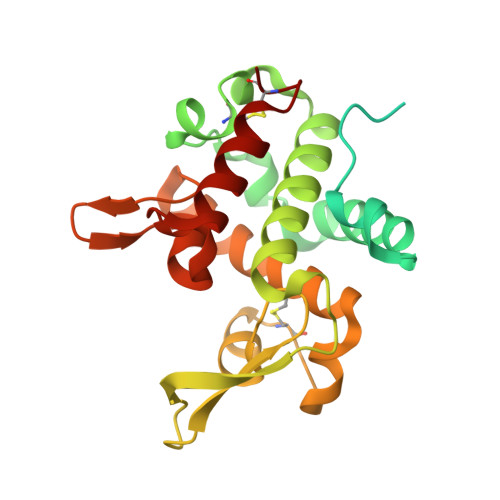
6TA9 | pdb_00006ta9

Bd0314 DslA wild-type form 1


Experimental Data Snapshot

  • Method: X-RAY DIFFRACTION
  • Resolution: 1.36 Å
  • R-Value Free: 
    0.180 (Depositor), 0.187 (DCC) 
  • R-Value Work: 
    0.140 (Depositor), 0.151 (DCC) 
  • R-Value Observed: 
    0.142 (Depositor) 

Starting Model: other
View more details

wwPDB Validation 3D Report Full Report

Validation slider image for 6TA9

This is version 1.3 of the entry. See complete history

Literature

A lysozyme with altered substrate specificity facilitates prey cell exit by the periplasmic predator Bdellovibrio bacteriovorus.

Harding, C.J.Huwiler, S.G.Somers, H.Lambert, C.Ray, L.J.Till, R.Taylor, G.Moynihan, P.J.Sockett, R.E.Lovering, A.L.

(2020) Nat Commun 11: 4817-4817

  • DOI: https://doi.org/10.1038/s41467-020-18139-8
  • Primary Citation Related Structures: 
    6TA9, 6TAB, 6TAD, 6TAF

  • PubMed Abstract: 

    Lysozymes are among the best-characterized enzymes, acting upon the cell wall substrate peptidoglycan. Here, examining the invasive bacterial periplasmic predator Bdellovibrio bacteriovorus, we report a diversified lysozyme, DslA, which acts, unusually, upon (GlcNAc-) deacetylated peptidoglycan. B. bacteriovorus are known to deacetylate the peptidoglycan of the prey bacterium, generating an important chemical difference between prey and self walls and implying usage of a putative deacetyl-specific "exit enzyme". DslA performs this role, and ΔDslA strains exhibit a delay in leaving from prey. The structure of DslA reveals a modified lysozyme superfamily fold, with several adaptations. Biochemical assays confirm DslA specificity for deacetylated cell wall, and usage of two glutamate residues for catalysis. Exogenous DslA, added ex vivo, is able to prematurely liberate B. bacteriovorus from prey, part-way through the predatory lifecycle. We define a mechanism for specificity that invokes steric selection, and use the resultant motif to identify wider DslA homologues.


  • Organizational Affiliation
    • Institute for Microbiology and Infection, School of Biosciences, University of Birmingham, Birmingham, B15 2TT, UK.

Macromolecule Content 

  • Total Structure Weight: 28.28 kDa 
  • Atom Count: 1,673 
  • Modeled Residue Count: 182 
  • Deposited Residue Count: 254 
  • Unique protein chains: 1

Macromolecules

Find similar proteins by:|  3D Structure
Entity ID: 1
MoleculeChains  Sequence LengthOrganismDetailsImage
SLT domain-containing protein254Bdellovibrio bacteriovorus HD100Mutation(s): 0 
Gene Names: Bd0314
UniProt
Find proteins for Q6MQY8 (Bdellovibrio bacteriovorus (strain ATCC 15356 / DSM 50701 / NCIMB 9529 / HD100))
Explore Q6MQY8 
Go to UniProtKB:  Q6MQY8
Entity Groups
Sequence Clusters30% Identity50% Identity70% Identity90% Identity95% Identity100% Identity
UniProt GroupQ6MQY8
Sequence Annotations
Expand
Reference Sequence

Experimental Data & Validation

Experimental Data

  • Method: X-RAY DIFFRACTION
  • Resolution: 1.36 Å
  • R-Value Free:  0.180 (Depositor), 0.187 (DCC) 
  • R-Value Work:  0.140 (Depositor), 0.151 (DCC) 
  • R-Value Observed: 0.142 (Depositor) 
Space Group: P 21 21 2
Unit Cell:
Length ( Å )Angle ( ˚ )
a = 84.696α = 90
b = 47.818β = 90
c = 49.191γ = 90
Software Package:
Software NamePurpose
PHENIXrefinement
XDSdata reduction
PDB_EXTRACTdata extraction
autoPROCdata scaling
PHASERphasing

Structure Validation

View Full Validation Report


Entry History 

& Funding Information

Deposition Data


Funding OrganizationLocationGrant Number
Biotechnology and Biological Sciences Research CouncilUnited Kingdomstudentship

Revision History  (Full details and data files)

  • Version 1.0: 2020-07-15
    Type: Initial release
  • Version 1.1: 2020-10-07
    Changes: Database references, Refinement description
  • Version 1.2: 2024-05-01
    Changes: Data collection, Database references, Refinement description
  • Version 1.3: 2024-11-20
    Changes: Structure summary