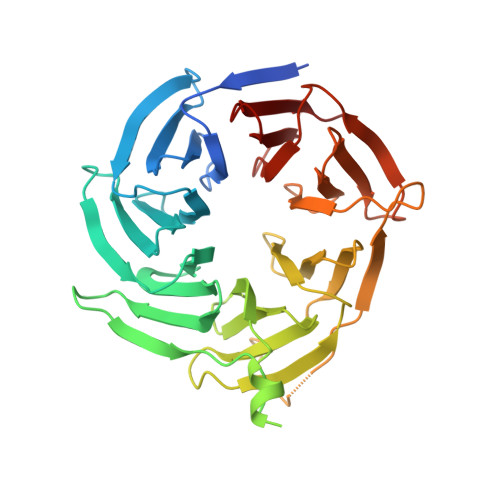
6E29 | pdb_00006e29

Crystal structure of Myceliophteria_thermophila Cps50 (Swd1) beta-propeller domain


Experimental Data Snapshot

  • Method: X-RAY DIFFRACTION
  • Resolution: 1.82 Å
  • R-Value Free: 
    0.216 (Depositor), 0.219 (DCC) 
  • R-Value Work: 
    0.168 (Depositor), 0.172 (DCC) 
  • R-Value Observed: 
    0.170 (Depositor) 

Starting Model: experimental
View more details

wwPDB Validation 3D Report Full Report

Validation slider image for 6E29

This is version 1.4 of the entry. See complete history

Literature

Structure and Conformational Dynamics of a COMPASS Histone H3K4 Methyltransferase Complex.

Qu, Q.Takahashi, Y.H.Yang, Y.Hu, H.Zhang, Y.Brunzelle, J.S.Couture, J.F.Shilatifard, A.Skiniotis, G.

(2018) Cell 174: 1117

  • DOI: https://doi.org/10.1016/j.cell.2018.07.020
  • Primary Citation Related Structures: 
    6BX3, 6E29

  • PubMed Abstract: 

    The methylation of histone 3 lysine 4 (H3K4) is carried out by an evolutionarily conserved family of methyltransferases referred to as complex of proteins associated with Set1 (COMPASS). The activity of the catalytic SET domain (su(var)3-9, enhancer-of-zeste, and trithorax) is endowed through forming a complex with a set of core proteins that are widely shared from yeast to humans. We obtained cryo-electron microscopy (cryo-EM) maps of the yeast Set1/COMPASS core complex at overall 4.0- to 4.4-Å resolution, providing insights into its structural organization and conformational dynamics. The Cps50 C-terminal tail weaves within the complex to provide a central scaffold for assembly. The SET domain, snugly positioned at the junction of the Y-shaped complex, is extensively contacted by Cps60 (Bre2), Cps50 (Swd1), and Cps30 (Swd3). The mobile SET-I motif of the SET domain is engaged by Cps30, explaining its key role in COMPASS catalytic activity toward higher H3K4 methylation states.


  • Organizational Affiliation
    • Department of Molecular and Cellular Physiology, Stanford University School of Medicine, Stanford, CA 94305, USA; Department of Structural Biology, Stanford University School of Medicine, Stanford, CA 94305, USA.

Macromolecule Content 

  • Total Structure Weight: 156.45 kDa 
  • Atom Count: 10,930 
  • Modeled Residue Count: 1,268 
  • Deposited Residue Count: 1,380 
  • Unique protein chains: 1

Macromolecules

Find similar proteins by:|  3D Structure
Entity ID: 1
MoleculeChains  Sequence LengthOrganismDetailsImage
SWD1-like proteinA [auth D],
B [auth A],
C [auth B],
D [auth C]
345Thermothelomyces thermophilusMutation(s): 0 
Gene Names: MYCTH_2294520
UniProt
Find proteins for G2Q1Q9 (Thermothelomyces thermophilus (strain ATCC 42464 / BCRC 31852 / DSM 1799))
Explore G2Q1Q9 
Go to UniProtKB:  G2Q1Q9
Entity Groups
Sequence Clusters30% Identity50% Identity70% Identity90% Identity95% Identity100% Identity
UniProt GroupG2Q1Q9
Sequence Annotations
Expand
Reference Sequence

Experimental Data & Validation

Experimental Data

  • Method: X-RAY DIFFRACTION
  • Resolution: 1.82 Å
  • R-Value Free:  0.216 (Depositor), 0.219 (DCC) 
  • R-Value Work:  0.168 (Depositor), 0.172 (DCC) 
  • R-Value Observed: 0.170 (Depositor) 
Space Group: P 1 21 1
Unit Cell:
Length ( Å )Angle ( ˚ )
a = 59.784α = 90
b = 88.9β = 94.3
c = 124.319γ = 90
Software Package:
Software NamePurpose
PHENIXrefinement
XDSdata reduction
Aimlessdata scaling
PHASERphasing

Structure Validation

View Full Validation Report


Entry History 

Deposition Data

Revision History  (Full details and data files)

  • Version 1.0: 2018-07-25
    Type: Initial release
  • Version 1.1: 2018-08-29
    Changes: Data collection, Database references
  • Version 1.2: 2018-09-05
    Changes: Data collection, Database references
  • Version 1.3: 2020-01-22
    Changes: Author supporting evidence
  • Version 1.4: 2023-10-11
    Changes: Advisory, Data collection, Database references, Refinement description