5ZAU | pdb_00005zau

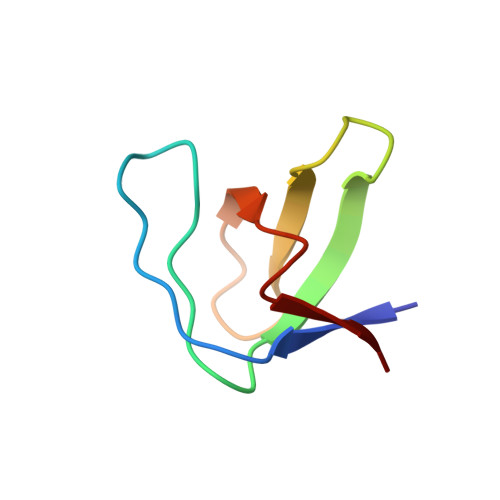
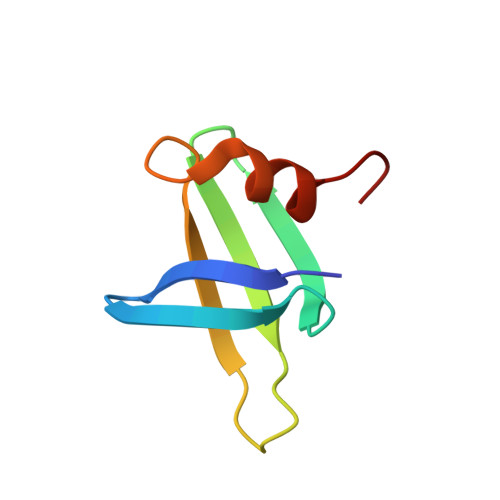
Complex of the human FYN SH3 and monobody binder


Experimental Data Snapshot

  • Method: SOLUTION NMR
  • Conformers Calculated: 200 
  • Conformers Submitted: 20 
  • Selection Criteria: structures with the lowest energy 

wwPDB Validation 3D Report Full Report

Validation slider image for 5ZAU

This is version 1.3 of the entry. See complete history. 

Literature

A Fyn biosensor reveals pulsatile, spatially localized kinase activity and signaling crosstalk in live mammalian cells.

Mukherjee, A., Singh, R., Udayan, S., Biswas, S., Reddy, P.P., Manmadhan, S., George, G., Kumar, S., Das, R., Rao, B.M., Gulyani, A.

(2020) Elife 9

  • DOI: https://doi.org/10.7554/eLife.50571
  • Primary Citation Related Structures: 
    5ZAU

  • PubMed Abstract: 

    Cell behavior is controlled through spatio-temporally localized protein activity. Despite unique and often contradictory roles played by Src-family-kinases (SFKs) in regulating cell physiology, activity patterns of individual SFKs have remained elusive. Here, we report a biosensor for specifically visualizing active conformation of SFK-Fyn in live cells. We deployed combinatorial library screening to isolate a binding-protein (F29) targeting activated Fyn. Nuclear-magnetic-resonance (NMR) analysis provides the structural basis of F29 specificity for Fyn over homologous SFKs. Using F29, we engineered a sensitive, minimally-perturbing fluorescence-resonance-energy-transfer (FRET) biosensor ( FynSensor ) that reveals cellular Fyn activity to be spatially localized, pulsatile and sensitive to adhesion/integrin signaling. Strikingly, growth factor stimulation further enhanced Fyn activity in pre-activated intracellular zones. However, inhibition of focal-adhesion-kinase activity not only attenuates Fyn activity, but abolishes growth-factor modulation. FynSensor imaging uncovers spatially organized, sensitized signaling clusters, direct crosstalk between integrin and growth-factor-signaling, and clarifies how compartmentalized Src-kinase activity may drive cell fate.


  • Organizational Affiliation: 
    • Institute for Stem Cell Science and Regenerative Medicine, Bangalore, India.

Macromolecule Content 

  • Total Structure Weight: 13.89 kDa 
  • Atom Count: 983 
  • Modeled Residue Count: 121 
  • Deposited Residue Count: 121 
  • Unique protein chains: 2

Macromolecules

Find similar proteins by:|  3D Structure
Entity ID: 1
MoleculeChains  Sequence LengthOrganismDetailsImage
Tyrosine-protein kinase Fyn57Homo sapiensMutation(s): 0 
Gene Names: FYN
EC: 2.7.10.2
UniProt & NIH Common Fund Data Resources
Find proteins for P06241 (Homo sapiens)
Explore P06241 
Go to UniProtKB:  P06241
PHAROS:  P06241
GTEx:  ENSG00000010810 
Entity Groups
Sequence Clusters30% Identity50% Identity70% Identity90% Identity95% Identity100% Identity
UniProt GroupP06241
Sequence Annotations
Expand
Reference Sequence
Find similar proteins by:|  3D Structure
Entity ID: 2
MoleculeChains  Sequence LengthOrganismDetailsImage
Monobody Binder64Saccharolobus solfataricusMutation(s): 0 
Entity Groups
Sequence Clusters30% Identity50% Identity70% Identity90% Identity95% Identity100% Identity
Sequence Annotations
Expand
Reference Sequence

Experimental Data & Validation

Experimental Data

  • Method: SOLUTION NMR
  • Conformers Calculated: 200 
  • Conformers Submitted: 20 
  • Selection Criteria: structures with the lowest energy 

Structure Validation

View Full Validation Report


Entry History 

& Funding Information

Deposition Data


Funding OrganizationLocationGrant Number
TIFRIndia--

Revision History  (Full details and data files)

  • Version 1.0: 2019-09-11
    Type: Initial release
  • Version 1.1: 2020-03-25
    Changes: Database references
  • Version 1.2: 2023-06-14
    Changes: Database references, Other
  • Version 1.3: 2024-05-15
    Changes: Data collection, Database references