5Y0Z | pdb_00005y0z

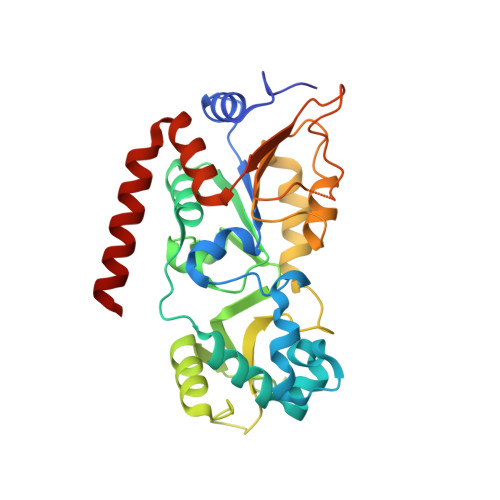
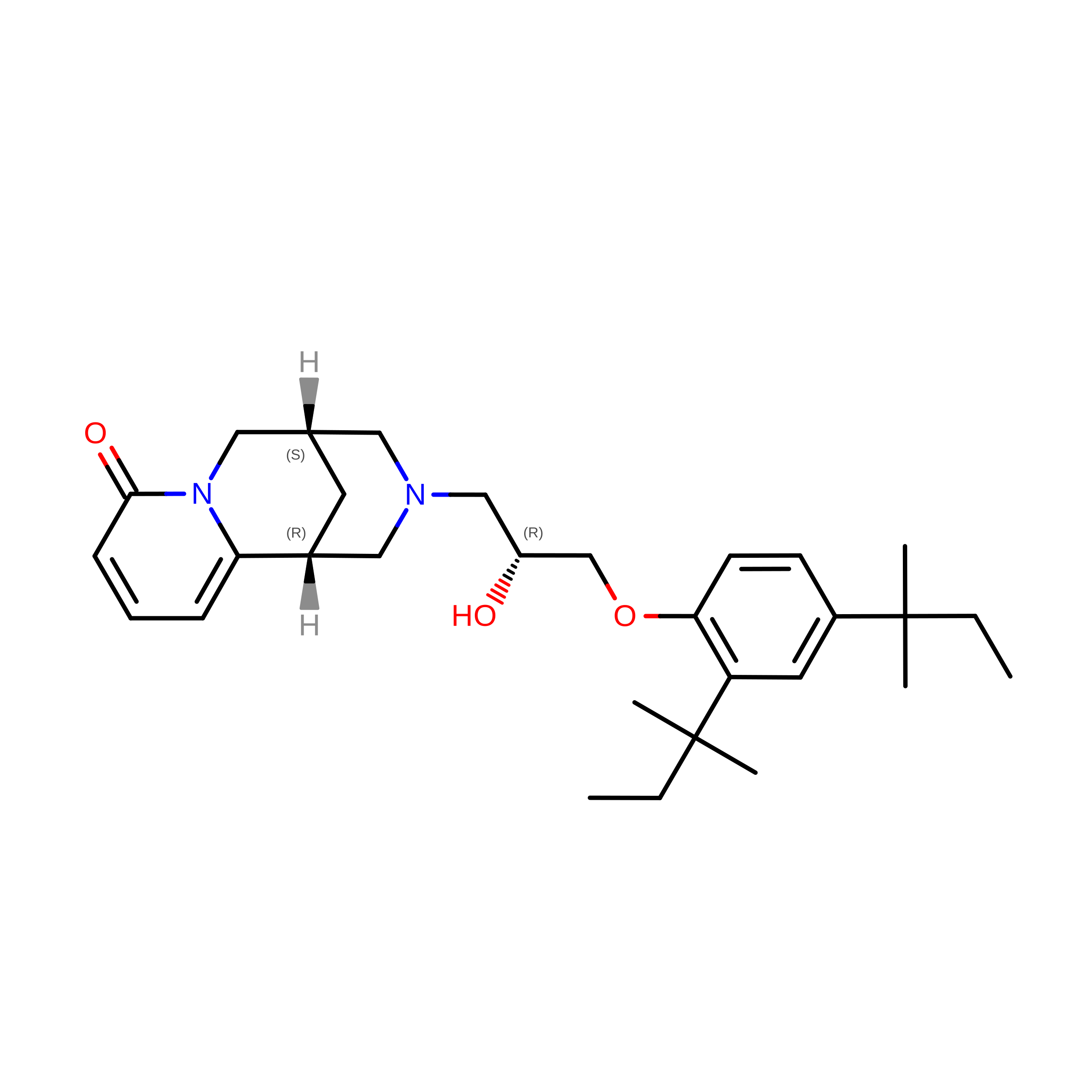
Human SIRT2 in complex with a specific inhibitor, NPD11033


Experimental Data Snapshot

  • Method: X-RAY DIFFRACTION
  • Resolution: 2.00 Å
  • R-Value Free: 
    0.242 (Depositor), 0.242 (DCC) 
  • R-Value Work: 
    0.210 (Depositor), 0.211 (DCC) 
  • R-Value Observed: 
    0.212 (Depositor) 

Starting Model: experimental
View more details

wwPDB Validation 3D Report Full Report

Validation slider image for 5Y0Z

Ligand Structure Quality Assessment 


This is version 1.1 of the entry. See complete history

Literature

Identification of a novel small molecule that inhibits deacetylase but not defatty-acylase reaction catalysed by SIRT2.

Kudo, N.Ito, A.Arata, M.Nakata, A.Yoshida, M.

(2018) Philos Trans R Soc Lond B Biol Sci 373

  • DOI: https://doi.org/10.1098/rstb.2017.0070
  • Primary Citation Related Structures: 
    5Y0Z

  • PubMed Abstract: 

    SIRT2 is a member of the human sirtuin family of proteins and possesses NAD + -dependent lysine deacetylase/deacylase activity. SIRT2 has been implicated in carcinogenesis in various cancers including leukaemia and is considered an attractive target for cancer therapy. Here, we identified NPD11033, a selective small-molecule SIRT2 inhibitor, by a high-throughput screen using the RIKEN NPDepo chemical library. NPD11033 was largely inactive against other sirtuins and zinc-dependent deacetylases. Crystallographic analysis revealed a unique mode of action, in which NPD11033 creates a hydrophobic cavity behind the substrate-binding pocket after a conformational change of the Zn-binding small domain of SIRT2. Furthermore, it forms a hydrogen bond to the active site histidine residue. In addition, NPD11033 inhibited cell growth of human pancreatic cancer PANC-1 cells with a concomitant increase in the acetylation of eukaryotic translation initiation factor 5A, a physiological substrate of SIRT2. Importantly, NPD11033 failed to inhibit defatty-acylase activity of SIRT2, despite its potent inhibitory effect on its deacetylase activity. Thus, NPD11033 will serve as a useful tool for both developing novel anti-cancer agents and elucidating the role of SIRT2 in various cellular biological processes.This article is part of a discussion meeting issue 'Frontiers in epigenetic chemical biology'.


  • Organizational Affiliation
    • Seed Compounds Exploratory Unit for Drug Discovery Platform, RIKEN Center for Sustainable Resource Science, 2-1 Hirosawa, Wako, Saitama 351-0198, Japan.

Macromolecule Content 

  • Total Structure Weight: 67.49 kDa 
  • Atom Count: 4,817 
  • Modeled Residue Count: 577 
  • Deposited Residue Count: 586 
  • Unique protein chains: 1

Macromolecules

Find similar proteins by:|  3D Structure
Entity ID: 1
MoleculeChains  Sequence LengthOrganismDetailsImage
NAD-dependent protein deacetylase sirtuin-2
A, B
293Homo sapiensMutation(s): 0 
Gene Names: SIRT2SIR2LSIR2L2
EC: 3.5.1 (PDB Primary Data), 2.3.1 (UniProt), 2.3.1.286 (UniProt)
UniProt & NIH Common Fund Data Resources
Find proteins for Q8IXJ6 (Homo sapiens)
Explore Q8IXJ6 
Go to UniProtKB:  Q8IXJ6
PHAROS:  Q8IXJ6
GTEx:  ENSG00000068903 
Entity Groups
Sequence Clusters30% Identity50% Identity70% Identity90% Identity95% Identity100% Identity
UniProt GroupQ8IXJ6
Sequence Annotations
Expand
Reference Sequence

Experimental Data & Validation

Experimental Data

  • Method: X-RAY DIFFRACTION
  • Resolution: 2.00 Å
  • R-Value Free:  0.242 (Depositor), 0.242 (DCC) 
  • R-Value Work:  0.210 (Depositor), 0.211 (DCC) 
  • R-Value Observed: 0.212 (Depositor) 
Space Group: P 1 21 1
Unit Cell:
Length ( Å )Angle ( ˚ )
a = 34.987α = 90
b = 115.685β = 89.99
c = 71.055γ = 90
Software Package:
Software NamePurpose
REFMACrefinement
HKL-2000data reduction
HKL-2000data scaling
MOLREPphasing

Structure Validation

View Full Validation Report


Ligand Structure Quality Assessment 


Entry History 

& Funding Information

Deposition Data


Funding OrganizationLocationGrant Number
Japan Society for the Promotion of ScienceJapan26221204
Japan Society for the Promotion of ScienceJapan16K14674

Revision History  (Full details and data files)

  • Version 1.0: 2018-07-25
    Type: Initial release
  • Version 1.1: 2023-11-22
    Changes: Data collection, Database references, Refinement description