5XAS | pdb_00005xas

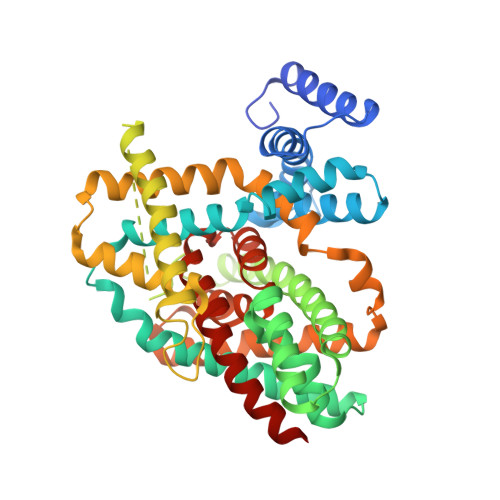
Structural insights into the elevator-like mechanism of the sodium/citrate symporter CitS


Experimental Data Snapshot

  • Method: X-RAY DIFFRACTION
  • Resolution: 3.47 Å
  • R-Value Free: 
    0.295 (Depositor), 0.304 (DCC) 
  • R-Value Work: 
    0.246 (Depositor), 0.256 (DCC) 
  • R-Value Observed: 
    0.248 (Depositor) 

Starting Model: experimental
View more details

wwPDB Validation 3D Report Full Report

Validation slider image for 5XAS

Ligand Structure Quality Assessment 


This is version 1.2 of the entry. See complete history

Literature

Structural insights into the elevator-like mechanism of the sodium/citrate symporter CitS

Kim, J.W.Kim, S.Kim, S.Lee, H.Lee, J.O.Jin, M.S.

(2017) Sci Rep 7: 2548-2548

  • DOI: https://doi.org/10.1038/s41598-017-02794-x
  • Primary Citation Related Structures: 
    5X9R, 5XAR, 5XAS, 5XAT

  • PubMed Abstract: 

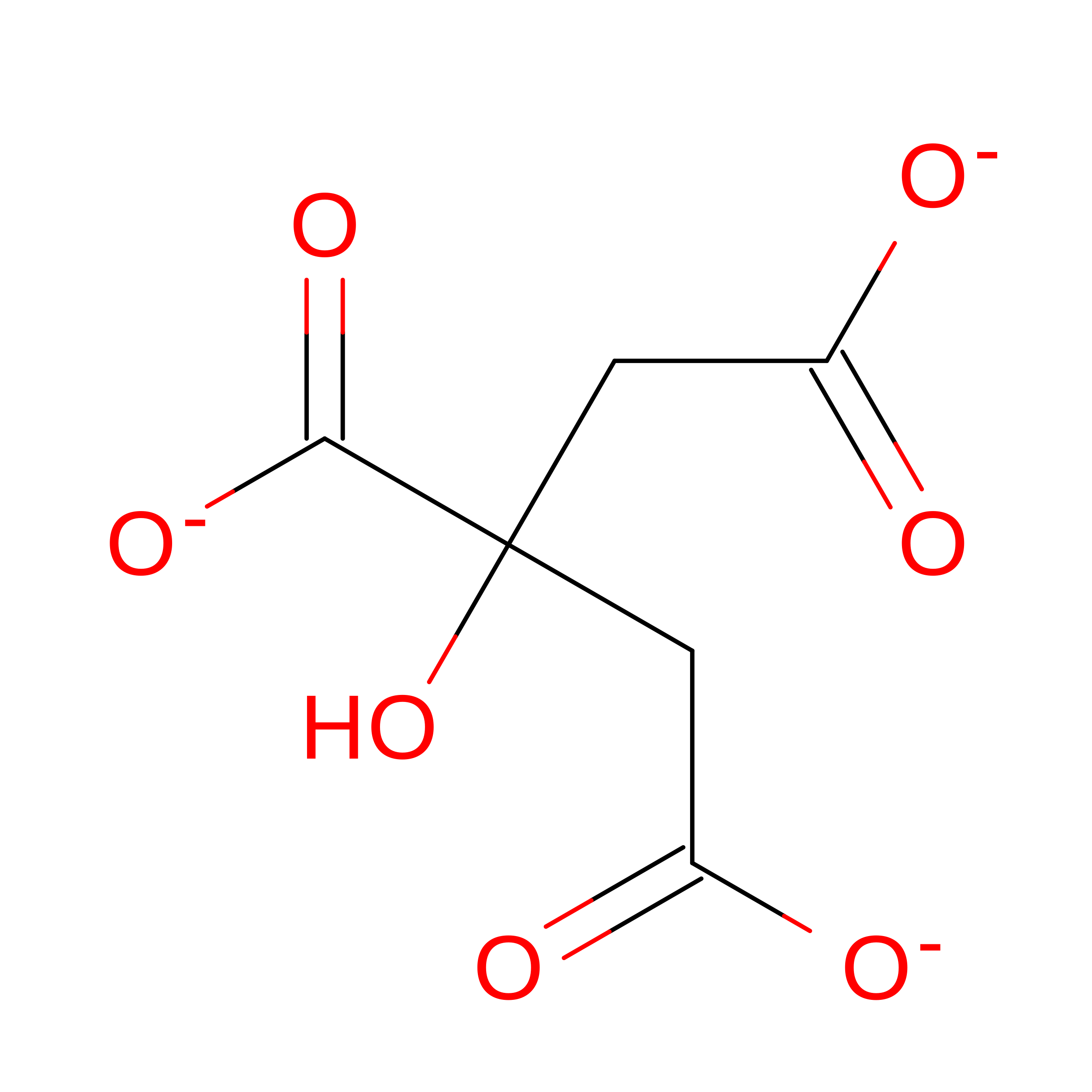
    The sodium-dependent citrate transporter of Klebsiella pneumoniae (KpCitS) belongs to the 2-hydroxycarboxylate transporter (2-HCT) family and allows the cell to use citrate as sole carbon and energy source in anaerobic conditions. Here we present crystal structures of KpCitS in citrate-bound outward-facing, citrate-bound asymmetric, and citrate-free inward-facing state. The structures reveal that the KpCitS dimerization domain remains stationary throughout the transport cycle due to a hydrogen bond network as well as extensive hydrophobic interactions. In contrast, its transport domain undergoes a ~35° rigid-body rotation and a ~17 Å translocation perpendicular to the membrane to expose the substrate-binding site alternately to either side of the membrane. Furthermore, homology models of two other 2-HCT proteins based on the KpCitS structure offer structural insights into their differences in substrate specificity at a molecular level. On the basis of our results and previous biochemical data, we propose that the activity of the 2-HCT CitS involves an elevator-like movement in which the transport domain itself traverses the lipid bilayer, carrying the substrate into the cell in a sodium-dependent manner.


  • Organizational Affiliation
    • Department of Chemistry, KAIST, 291 Daehak-ro, Yuseong-gu, Daejeon, 34141, Republic of Korea.

Macromolecule Content 

  • Total Structure Weight: 94.06 kDa 
  • Atom Count: 6,156 
  • Modeled Residue Count: 816 
  • Deposited Residue Count: 876 
  • Unique protein chains: 1

Macromolecules

Find similar proteins by:|  3D Structure
Entity ID: 1
MoleculeChains  Sequence LengthOrganismDetailsImage
Citrate-sodium symporter
A, B
438Klebsiella pneumoniaeMutation(s): 0 
Gene Names: citS
Membrane Entity: Yes 
UniProt
Find proteins for P31602 (Klebsiella pneumoniae)
Explore P31602 
Go to UniProtKB:  P31602
Entity Groups
Sequence Clusters30% Identity50% Identity70% Identity90% Identity95% Identity100% Identity
UniProt GroupP31602
Sequence Annotations
Expand
Reference Sequence

Experimental Data & Validation

Experimental Data

  • Method: X-RAY DIFFRACTION
  • Resolution: 3.47 Å
  • R-Value Free:  0.295 (Depositor), 0.304 (DCC) 
  • R-Value Work:  0.246 (Depositor), 0.256 (DCC) 
  • R-Value Observed: 0.248 (Depositor) 
Space Group: P 1
Unit Cell:
Length ( Å )Angle ( ˚ )
a = 51.705α = 97.14
b = 83.34β = 100.16
c = 81.06γ = 94.59
Software Package:
Software NamePurpose
REFMACrefinement
HKL-2000data reduction
HKL-2000data scaling
PHASERphasing

Structure Validation

View Full Validation Report


Ligand Structure Quality Assessment 


Entry History 

& Funding Information

Deposition Data


Funding OrganizationLocationGrant Number
National Research FoundationKorea, Republic OfNRF-2014R1A1A3050966
National Research FoundationKorea, Republic OfNRF-2015M2A2A4A03044653
National Research FoundationKorea, Republic OfNRF-2014R1A2A1A10050436

Revision History  (Full details and data files)

  • Version 1.0: 2017-06-14
    Type: Initial release
  • Version 1.1: 2020-07-29
    Type: Remediation
    Reason: Carbohydrate remediation
    Changes: Data collection, Derived calculations, Structure summary
  • Version 1.2: 2023-11-22
    Changes: Data collection, Database references, Refinement description, Structure summary