5X03 | pdb_00005x03

Crystal structure of the C-terminal domain of Bacillus subtilis GabR reveals a closed conformation by the binding of gamma-aminobutyric acid, inducing the transcriptional activation


Experimental Data Snapshot

  • Method: X-RAY DIFFRACTION
  • Resolution: 2.00 Å
  • R-Value Free: 
    0.216 (Depositor) 
  • R-Value Work: 
    0.173 (Depositor) 
  • R-Value Observed: 
    0.174 (Depositor) 

wwPDB Validation 3D Report Full Report

Validation slider image for 5X03

Ligand Structure Quality Assessment 


This is version 2.0 of the entry. See complete history

Literature

Crystal structure of the C-terminal domain of Bacillus subtilis GabR reveals a closed conformation by gamma-aminobutyric acid binding, inducing transcriptional activation

Park, S.A.Park, Y.S.Lee, K.S.

(2017) Biochem Biophys Res Commun 487: 287-291

  • DOI: https://doi.org/10.1016/j.bbrc.2017.04.052
  • Primary Citation Related Structures: 
    5X03

  • PubMed Abstract: 

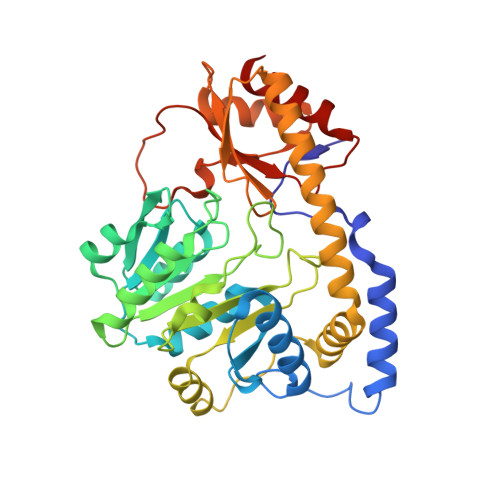
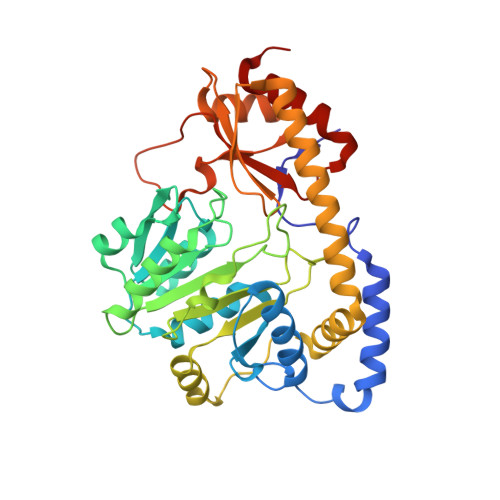
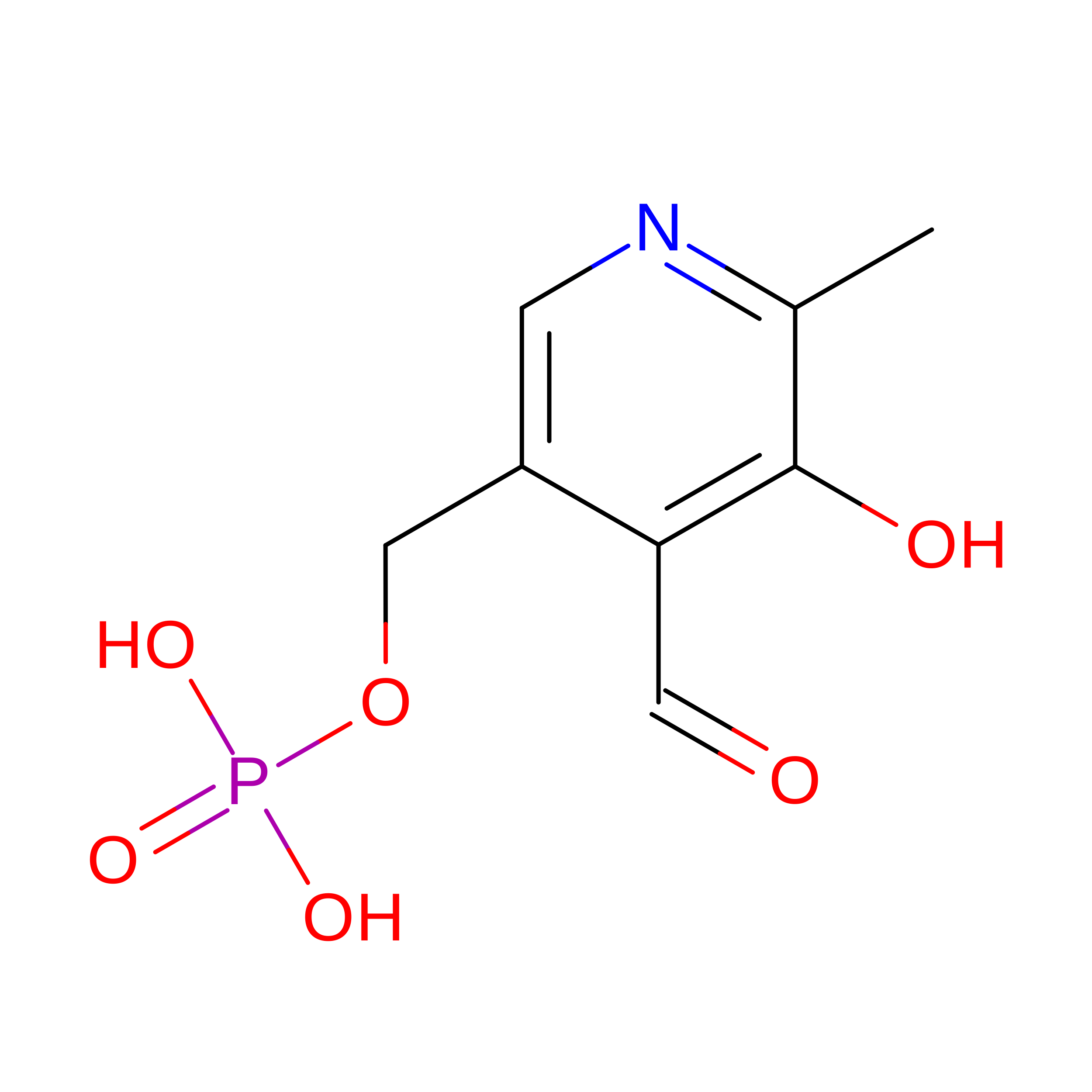
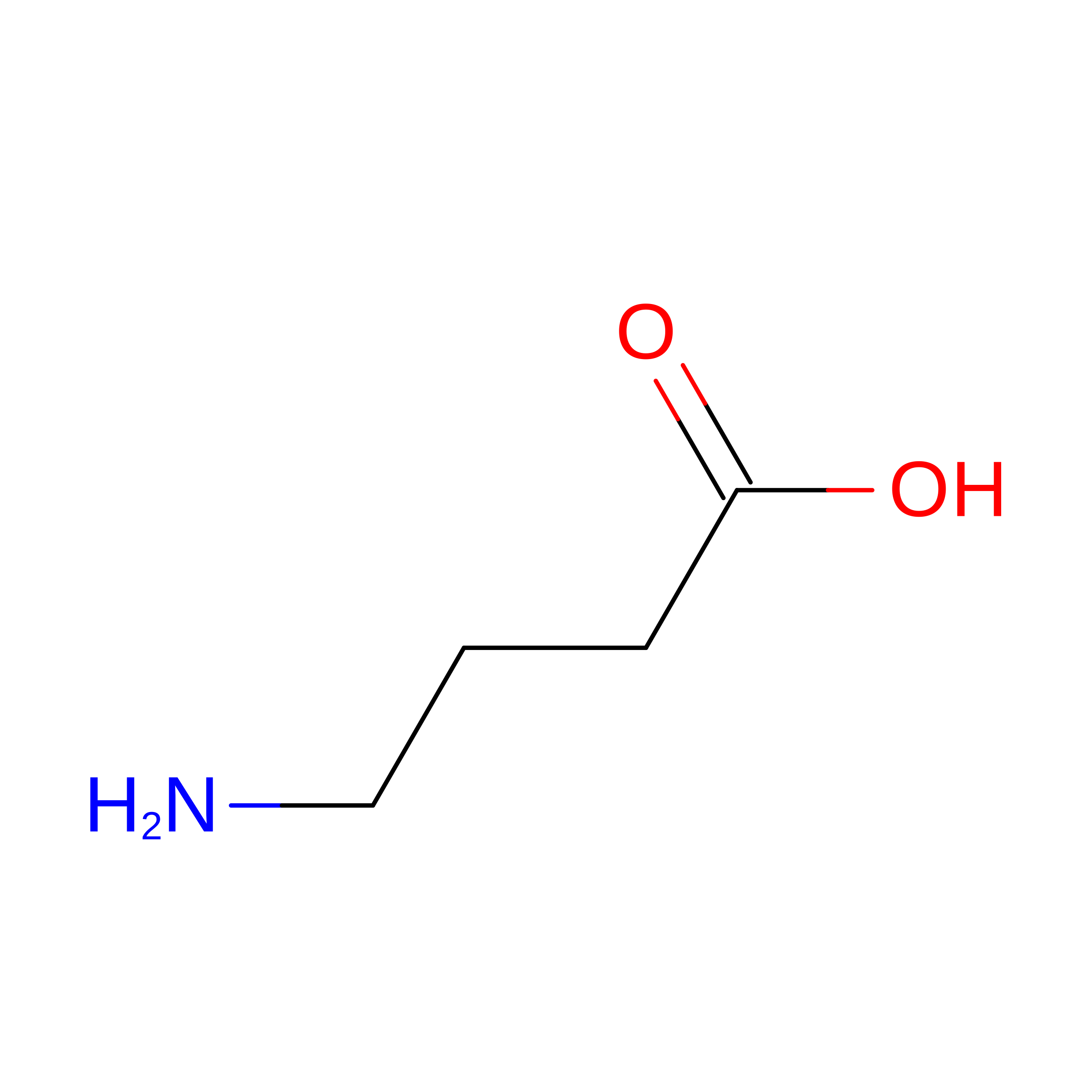
    Bacillus subtilis GabR (BsGabR) is involved in the γ-aminobutyric acid (GABA) catabolism as a transcriptional regulator, consisting of an N-terminal helix-turn-helix DNA-binding domain and a C-terminal aminotransferase-like (AT-like) domain. Research on the C-terminal AT-like domain of BsGabR (BsGabR-CTD) has focused on the interaction with GABA as an effector, but most its functional details remain unclear. To understand the underlying mechanism, we report the crystal structure of BsGabR-CTD in complex with pyridoxal 5'-phosphate (PLP) and GABA at 2.0 Å resolution. The structure of ligand-bound BsGabR-CTD revealed two distinct monomeric states in a homodimer. One subunit is a closed-form containing the PLP-GABA adduct, and the other subunit is a PLP-bound open-form. Our structural studies provide a detailed mechanism indicating that the open-to-closed transition by the binding of GABA induces the conformational rearrangement of BsGabR-CTD, which may trigger the activation of transcription.


  • Organizational Affiliation
    • Department of Clinical Laboratory Science, College of Health Sciences, Catholic University of Pusan, Busan 46252, Republic of Korea.

Macromolecule Content 

  • Total Structure Weight: 84.53 kDa 
  • Atom Count: 6,176 
  • Modeled Residue Count: 728 
  • Deposited Residue Count: 728 
  • Unique protein chains: 2

Macromolecules

Find similar proteins by:|  3D Structure
Entity ID: 1
MoleculeChains  Sequence LengthOrganismDetailsImage
HTH-type transcriptional regulatory protein GabR363Bacillus subtilis subsp. subtilis str. 168Mutation(s): 0 
Gene Names: gabRycnFBSU03890
UniProt
Find proteins for P94426 (Bacillus subtilis (strain 168))
Explore P94426 
Go to UniProtKB:  P94426
Entity Groups
Sequence Clusters30% Identity50% Identity70% Identity90% Identity95% Identity100% Identity
UniProt GroupP94426
Sequence Annotations
Expand
Reference Sequence
Find similar proteins by:|  3D Structure
Entity ID: 2
MoleculeChains  Sequence LengthOrganismDetailsImage
HTH-type transcriptional regulatory protein GabR365Bacillus subtilis subsp. subtilis str. 168Mutation(s): 1 
Gene Names: gabRycnFBSU03890
UniProt
Find proteins for P94426 (Bacillus subtilis (strain 168))
Explore P94426 
Go to UniProtKB:  P94426
Entity Groups
Sequence Clusters30% Identity50% Identity70% Identity90% Identity95% Identity100% Identity
UniProt GroupP94426
Sequence Annotations
Expand
Reference Sequence

Experimental Data & Validation

Experimental Data

  • Method: X-RAY DIFFRACTION
  • Resolution: 2.00 Å
  • R-Value Free:  0.216 (Depositor) 
  • R-Value Work:  0.173 (Depositor) 
  • R-Value Observed: 0.174 (Depositor) 
Space Group: P 41
Unit Cell:
Length ( Å )Angle ( ˚ )
a = 118.497α = 90
b = 118.497β = 90
c = 75.862γ = 90
Software Package:
Software NamePurpose
PHENIXrefinement
HKL-2000data reduction
HKL-2000data scaling
MOLREPphasing

Structure Validation

View Full Validation Report


Ligand Structure Quality Assessment 


Entry History 

Deposition Data

Revision History  (Full details and data files)

  • Version 1.0: 2017-05-24
    Type: Initial release
  • Version 2.0: 2023-11-15
    Changes: Atomic model, Data collection, Database references, Derived calculations