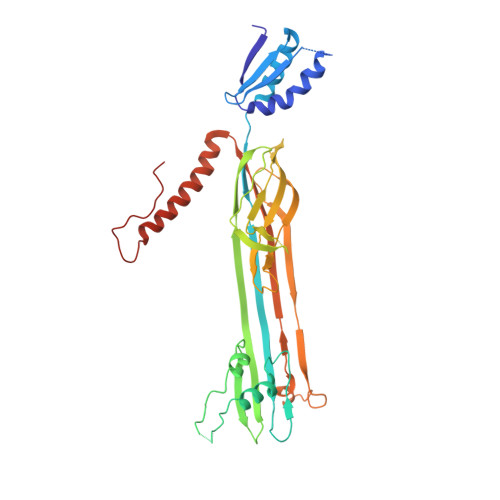
5W68 | pdb_00005w68

Type II secretin from Enteropathogenic Escherichia coli - GspD


Experimental Data Snapshot

  • Method: ELECTRON MICROSCOPY
  • Resolution: 3.30 Å
  • Aggregation State: PARTICLE 
  • Reconstruction Method: SINGLE PARTICLE 

wwPDB Validation 3D Report Full Report

Validation slider image for 5W68

This is version 1.5 of the entry. See complete history

Literature

Structure and Membrane Topography of the Vibrio-Type Secretin Complex from the Type 2 Secretion System of Enteropathogenic Escherichia coli.

Hay, I.D.Belousoff, M.J.Dunstan, R.A.Bamert, R.S.Lithgow, T.

(2018) J Bacteriol 200

  • DOI: https://doi.org/10.1128/JB.00521-17
  • Primary Citation Related Structures: 
    5W68

  • PubMed Abstract: 

    The β-barrel assembly machinery (BAM) complex is the core machinery for the assembly of β-barrel membrane proteins, and inhibition of BAM complex activity is lethal to bacteria. Discovery of integral membrane proteins that are key to pathogenesis and yet do not require assistance from the BAM complex raises the question of how these proteins assemble into bacterial outer membranes. Here, we address this question through a structural analysis of the type 2 secretion system (T2SS) secretin from enteropathogenic Escherichia coli O127:H6 strain E2348/69. Long β-strands assemble into a barrel extending 17 Å through and beyond the outer membrane, adding insight to how these extensive β-strands are assembled into the E. coli outer membrane. The substrate docking chamber of this secretin is shown to be sufficient to accommodate the substrate mucinase SteC. IMPORTANCE In order to cause disease, bacterial pathogens inhibit immune responses and induce pathology that will favor their replication and dissemination. In Gram-negative bacteria, these key attributes of pathogenesis depend on structures assembled into or onto the outer membrane. One of these is the T2SS. The Vibrio -type T2SS mediates cholera toxin secretion in Vibrio cholerae , and in Escherichia coli O127:H6 strain E2348/69, the same machinery mediates secretion of the mucinases that enable the pathogen to penetrate intestinal mucus and thereby establish deadly infections.


  • Organizational Affiliation
    • Infection and Immunity Program, Biomedicine Discovery Institute and Department of Microbiology, Monash University, Clayton, Australia.

Macromolecule Content 

  • Total Structure Weight: 617.89 kDa 
  • Atom Count: 39,390 
  • Modeled Residue Count: 5,250 
  • Deposited Residue Count: 5,805 
  • Unique protein chains: 1

Macromolecules

Find similar proteins by:|  3D Structure
Entity ID: 1
MoleculeChains  Sequence LengthOrganismDetailsImage
Putative type II secretion protein
A, B, C, D, E
A, B, C, D, E, F, G, H, I, J, K, L, M, N, O
387Escherichia coli O127:H6 str. E2348/69Mutation(s): 0 
Gene Names: gspDE2348C_3249
Membrane Entity: Yes 
UniProt
Find proteins for B7UI37 (Escherichia coli O127:H6 (strain E2348/69 / EPEC))
Explore B7UI37 
Go to UniProtKB:  B7UI37
Entity Groups
Sequence Clusters30% Identity50% Identity70% Identity90% Identity95% Identity100% Identity
UniProt GroupB7UI37
Sequence Annotations
Expand
Reference Sequence

Experimental Data & Validation

Experimental Data

  • Method: ELECTRON MICROSCOPY
  • Resolution: 3.30 Å
  • Aggregation State: PARTICLE 
  • Reconstruction Method: SINGLE PARTICLE 
EM Software:
TaskSoftware PackageVersion
MODEL REFINEMENTPHENIX1.12
RECONSTRUCTIONcryoSPARC0.4

Structure Validation

View Full Validation Report


Entry History 

& Funding Information

Deposition Data


Funding OrganizationLocationGrant Number
National Health and Medical Research Council (NHMRC, Australia)Australia1092262
Australian Research Council (ARC)AustraliaFL130100038

Revision History  (Full details and data files)

  • Version 1.0: 2017-11-15
    Type: Initial release
  • Version 1.1: 2018-01-17
    Changes: Author supporting evidence
  • Version 1.2: 2018-02-21
    Changes: Database references
  • Version 1.3: 2018-07-18
    Changes: Data collection
  • Version 1.4: 2020-01-15
    Changes: Author supporting evidence
  • Version 1.5: 2024-03-13
    Changes: Data collection, Database references