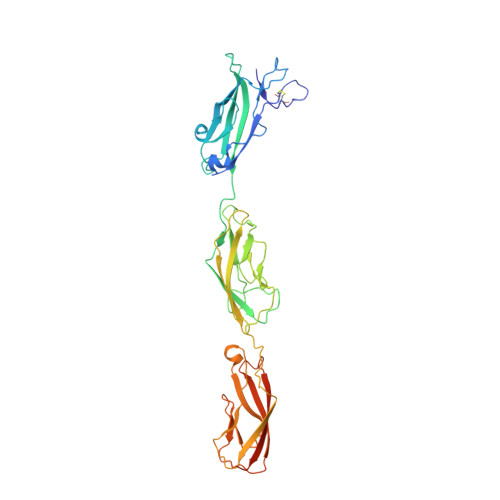
5T4M | pdb_00005t4m

Crystal Structure of Human Protocadherin-15 EC3-5


Experimental Data Snapshot

  • Method: X-RAY DIFFRACTION
  • Resolution: 2.24 Å
  • R-Value Free: 
    0.221 (Depositor), 0.225 (DCC) 
  • R-Value Work: 
    0.189 (Depositor), 0.195 (DCC) 

Starting Model: experimental
View more details

wwPDB Validation 3D Report Full Report

Validation slider image for 5T4M

This is version 1.5 of the entry. See complete history

Literature

A Partial Calcium-Free Linker Confers Flexibility to Inner-Ear Protocadherin-15.

Powers, R.E.Gaudet, R.Sotomayor, M.

(2017) Structure 25: 482-495

  • DOI: https://doi.org/10.1016/j.str.2017.01.014
  • Primary Citation Related Structures: 
    5T4M, 5T4N

  • PubMed Abstract: 

    Tip links of the inner ear are protein filaments essential for hearing and balance. Two atypical cadherins, cadherin-23 and protocadherin-15, interact in a Ca 2+ -dependent manner to form tip links. The largely unknown structure and mechanics of these proteins are integral to understanding how tip links pull on ion channels to initiate sensory perception. Protocadherin-15 has 11 extracellular cadherin (EC) repeats. Its EC3-4 linker lacks several of the canonical Ca 2+ -binding residues, and contains an aspartate-to-alanine polymorphism (D414A) under positive selection in East Asian populations. We present structures of protocadherin-15 EC3-5 featuring two Ca 2+ -binding linker regions: canonical EC4-5 linker binding three Ca 2+ ions, and non-canonical EC3-4 linker binding only two Ca 2+ ions. Our structures and biochemical assays reveal little difference between the D414 and D414A variants. Simulations predict that the partial Ca 2+ -free EC3-4 linker exhibits increased flexural flexibility without compromised mechanical strength, providing insight into the dynamics of tip links and other atypical cadherins.


  • Organizational Affiliation
    • Department of Molecular and Cellular Biology, Harvard University, 52 Oxford Street, Cambridge, MA 02138, USA; Biophysics Graduate Program, Harvard University, Boston, MA 02115, USA.

Macromolecule Content 

  • Total Structure Weight: 82.2 kDa 
  • Atom Count: 5,725 
  • Modeled Residue Count: 693 
  • Deposited Residue Count: 730 
  • Unique protein chains: 1

Macromolecules

Find similar proteins by:|  3D Structure
Entity ID: 1
MoleculeChains  Sequence LengthOrganismDetailsImage
Protocadherin-15
A, B
365Homo sapiensMutation(s): 0 
Gene Names: PCDH15USH1F
UniProt & NIH Common Fund Data Resources
Find proteins for Q96QU1 (Homo sapiens)
Explore Q96QU1 
Go to UniProtKB:  Q96QU1
PHAROS:  Q96QU1
GTEx:  ENSG00000150275 
Entity Groups
Sequence Clusters30% Identity50% Identity70% Identity90% Identity95% Identity100% Identity
UniProt GroupQ96QU1
Sequence Annotations
Expand
Reference Sequence

Small Molecules

Ligands 2 Unique
IDChains Name / Formula / InChI Key2D Diagram3D Interactions
CA

Query on CA


Download:Ideal Coordinates CCD File
C [auth A]
D [auth A]
E [auth A]
F [auth A]
G [auth A]
C [auth A],
D [auth A],
E [auth A],
F [auth A],
G [auth A],
H [auth B],
I [auth B],
J [auth B],
K [auth B],
L [auth B]
CALCIUM ION
Ca
BHPQYMZQTOCNFJ-UHFFFAOYSA-N
CL

Query on CL


Download:Ideal Coordinates CCD File
M [auth B]CHLORIDE ION
Cl
VEXZGXHMUGYJMC-UHFFFAOYSA-M

Experimental Data & Validation

Experimental Data

  • Method: X-RAY DIFFRACTION
  • Resolution: 2.24 Å
  • R-Value Free:  0.221 (Depositor), 0.225 (DCC) 
  • R-Value Work:  0.189 (Depositor), 0.195 (DCC) 
Space Group: P 65
Unit Cell:
Length ( Å )Angle ( ˚ )
a = 105.608α = 90
b = 105.608β = 90
c = 193.672γ = 120
Software Package:
Software NamePurpose
PHENIXrefinement
HKL-2000data reduction
HKL-2000data collection
HKL-2000data scaling
Cootmodel building
PHENIXphasing

Structure Validation

View Full Validation Report


Entry History 

& Funding Information

Deposition Data


Funding OrganizationLocationGrant Number
National Institutes of Health/National Institute on Deafness and Other Communication Disorders (NIH/NIDCD)United StatesK99/R00 DC012534
National Institutes of Health/National Institute on Deafness and Other Communication Disorders (NIH/NIDCD)United StatesR01 DC02281

Revision History  (Full details and data files)

  • Version 1.0: 2017-02-22
    Type: Initial release
  • Version 1.1: 2017-09-20
    Changes: Author supporting evidence
  • Version 1.2: 2018-08-01
    Changes: Data collection, Database references
  • Version 1.3: 2019-12-18
    Changes: Author supporting evidence
  • Version 1.4: 2023-10-04
    Changes: Data collection, Database references, Derived calculations, Refinement description
  • Version 1.5: 2024-10-23
    Changes: Structure summary