Download Mendeley
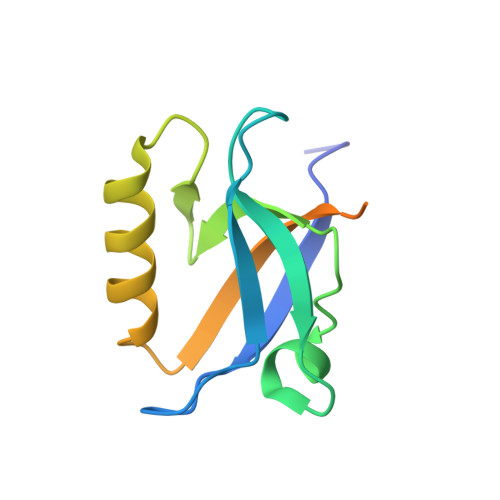
Structural basis for the interaction between the cell polarity proteins Par3 and Par6.
Renschler, F.A., Bruekner, S.R., Salomon, P.L., Mukherjee, A., Kullmann, L., Schutz-Stoffregen, M.C., Henzler, C., Pawson, T., Krahn, M.P., Wiesner, S.(2018) Sci Signal 11
- PubMed: 29440511 Search on PubMed
- DOI: https://doi.org/10.1126/scisignal.aam9899
- Primary Citation Related Structures:
5OAK - PubMed Abstract:
Polarity is a fundamental property of most cell types. The Par protein complex is a major driving force in generating asymmetrically localized protein networks and consists of atypical protein kinase C (aPKC), Par3, and Par6. Dysfunction of this complex causes developmental abnormalities and diseases such as cancer. We identified a PDZ domain-binding motif in Par6 that was essential for its interaction with Par3 in vitro and for Par3-mediated membrane localization of Par6 in cultured cells. In fly embryos, we observed that the PDZ domain-binding motif was functionally redundant with the PDZ domain in targeting Par6 to the cortex of epithelial cells. Our structural analyses by x-ray crystallography and NMR spectroscopy showed that both the PDZ1 and PDZ3 domains but not the PDZ2 domain in Par3 engaged in a canonical interaction with the PDZ domain-binding motif in Par6. Par3 thus has the potential to recruit two Par6 proteins simultaneously, which may facilitate the assembly of polarity protein networks through multivalent PDZ domain interactions.
- Max Planck Institute for Developmental Biology, Max-Planck-Ring 5, 72076 Tübingen, Germany.
Organizational Affiliation: