5LU1 | pdb_00005lu1

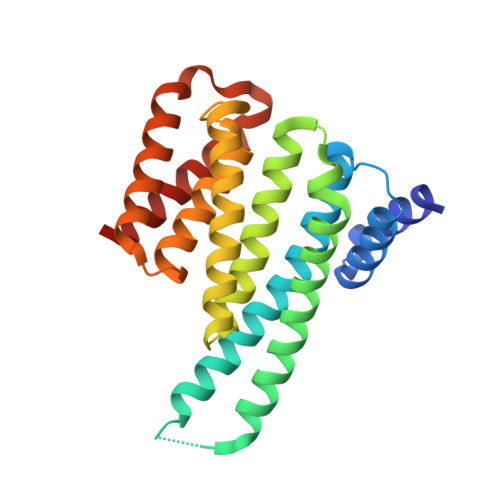
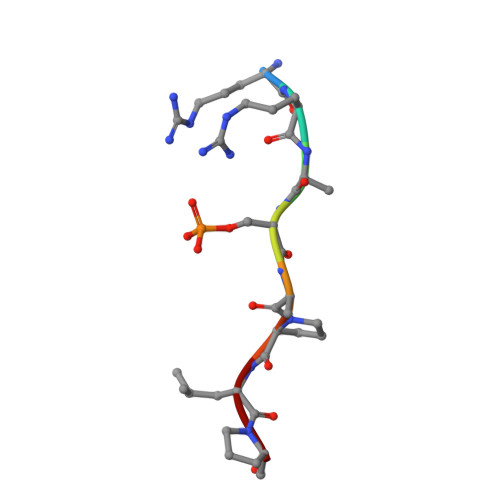
Human 14-3-3 sigma CLU3 mutant complexed with short HSPB6 phosphopeptide


Experimental Data Snapshot

  • Method: X-RAY DIFFRACTION
  • Resolution: 2.40 Å
  • R-Value Free: 
    0.214 (Depositor), 0.207 (DCC) 
  • R-Value Work: 
    0.184 (Depositor) 
  • R-Value Observed: 
    0.186 (Depositor) 

Starting Model: experimental
View more details

wwPDB Validation 3D Report Full Report

Validation slider image for 5LU1

This is version 1.3 of the entry. See complete history

Literature

Structural Basis for the Interaction of a Human Small Heat Shock Protein with the 14-3-3 Universal Signaling Regulator.

Sluchanko, N.N.Beelen, S.Kulikova, A.A.Weeks, S.D.Antson, A.A.Gusev, N.B.Strelkov, S.V.

(2017) Structure 25: 305-316

  • DOI: https://doi.org/10.1016/j.str.2016.12.005
  • Primary Citation Related Structures: 
    5LTW, 5LU1, 5LU2, 5LUM

  • PubMed Abstract: 

    By interacting with hundreds of protein partners, 14-3-3 proteins coordinate vital cellular processes. Phosphorylation of the small heat shock protein, HSPB6, within its intrinsically disordered N-terminal domain activates its interaction with 14-3-3, ultimately triggering smooth muscle relaxation. After analyzing the binding of an HSPB6-derived phosphopeptide to 14-3-3 using isothermal calorimetry and X-ray crystallography, we have determined the crystal structure of the complete assembly consisting of the 14-3-3 dimer and full-length HSPB6 dimer and further characterized this complex in solution using fluorescence spectroscopy, small-angle X-ray scattering, and limited proteolysis. We show that selected intrinsically disordered regions of HSPB6 are transformed into well-defined conformations upon the interaction, whereby an unexpectedly asymmetric structure is formed. This structure provides the first atomic resolution snapshot of a human small HSP in functional state, explains how 14-3-3 proteins sequester their regulatory partners, and can inform the design of small-molecule interaction modifiers to be used as myorelaxants.


  • Organizational Affiliation
    • Laboratory of Structural Biochemistry of Proteins, A.N. Bach Institute of Biochemistry, Federal Research Center "Fundamentals of Biotechnology", Russian Academy of Sciences, 119071 Moscow, Russia. Electronic address: nikolai.sluchanko@mail.ru.

Macromolecule Content 

  • Total Structure Weight: 109.31 kDa 
  • Atom Count: 7,842 
  • Modeled Residue Count: 941 
  • Deposited Residue Count: 968 
  • Unique protein chains: 2

Macromolecules

Find similar proteins by:|  3D Structure
Entity ID: 1
MoleculeChains  Sequence LengthOrganismDetailsImage
14-3-3 protein sigma
A, B, E, F
234Homo sapiensMutation(s): 3 
Gene Names: SFNHME1
UniProt & NIH Common Fund Data Resources
Find proteins for P31947 (Homo sapiens)
Explore P31947 
Go to UniProtKB:  P31947
PHAROS:  P31947
GTEx:  ENSG00000175793 
Entity Groups
Sequence Clusters30% Identity50% Identity70% Identity90% Identity95% Identity100% Identity
UniProt GroupP31947
Sequence Annotations
Expand
Reference Sequence
Find similar proteins by:  Sequence   |   3D Structure  
Entity ID: 2
MoleculeChains  Sequence LengthOrganismDetailsImage
Heat shock protein beta-6
C, D, G, H
8Homo sapiensMutation(s): 0 
UniProt & NIH Common Fund Data Resources
Find proteins for O14558 (Homo sapiens)
Explore O14558 
Go to UniProtKB:  O14558
PHAROS:  O14558
GTEx:  ENSG00000004776 
Entity Groups
UniProt GroupO14558
Sequence Annotations
Expand
Reference Sequence

Experimental Data & Validation

Experimental Data

  • Method: X-RAY DIFFRACTION
  • Resolution: 2.40 Å
  • R-Value Free:  0.214 (Depositor), 0.207 (DCC) 
  • R-Value Work:  0.184 (Depositor) 
  • R-Value Observed: 0.186 (Depositor) 
Space Group: P 1 21 1
Unit Cell:
Length ( Å )Angle ( ˚ )
a = 55.61α = 90
b = 104.01β = 93.89
c = 123.07γ = 90
Software Package:
Software NamePurpose
XSCALEdata scaling
BUSTER-TNTrefinement
PDB_EXTRACTdata extraction
XDSdata reduction
MOLREPphasing

Structure Validation

View Full Validation Report


Entry History 

Deposition Data

Revision History  (Full details and data files)

  • Version 1.0: 2017-02-01
    Type: Initial release
  • Version 1.1: 2017-02-15
    Changes: Database references
  • Version 1.2: 2024-01-17
    Changes: Data collection, Database references, Refinement description
  • Version 1.3: 2024-10-09
    Changes: Structure summary