5LRL | pdb_00005lrl

CRYSTAL STRUCTURE OF HSP90 IN COMPLEX WITH A003492875


Experimental Data Snapshot

  • Method: X-RAY DIFFRACTION
  • Resolution: 1.33 Å
  • R-Value Free: 
    0.189 (Depositor), 0.189 (DCC) 
  • R-Value Work: 
    0.174 (Depositor), 0.173 (DCC) 
  • R-Value Observed: 
    0.175 (Depositor) 

Starting Model: experimental
View more details

wwPDB Validation 3D Report Full Report

Validation slider image for 5LRL

Ligand Structure Quality Assessment 


This is version 1.3 of the entry. See complete history

Literature

Estimation of Protein-Ligand Unbinding Kinetics Using Non-Equilibrium Targeted Molecular Dynamics Simulations.

Wolf, S.Amaral, M.Lowinski, M.Vallee, F.Musil, D.Guldenhaupt, J.Dreyer, M.K.Bomke, J.Frech, M.Schlitter, J.Gerwert, K.

(2019) J Chem Inf Model 59: 5135-5147

  • DOI: https://doi.org/10.1021/acs.jcim.9b00592
  • Primary Citation Related Structures: 
    5LRL

  • PubMed Abstract: 

    We here report on nonequilibrium targeted molecular dynamics simulations as a tool for the estimation of protein-ligand unbinding kinetics. Correlating simulations with experimental data from SPR kinetics measurements and X-ray crystallography on two small molecule compound libraries bound to the N-terminal domain of the chaperone Hsp90, we show that the mean nonequilibrium work computed in an ensemble of trajectories of enforced ligand unbinding is a promising predictor for ligand unbinding rates. We furthermore investigate the molecular basis determining unbinding rates within the compound libraries. We propose ligand conformational changes and protein-ligand nonbonded interactions to impact on unbinding rates. Ligands may remain longer at the protein if they exhibit strong electrostatic and/or van der Waals interactions with the target. In the case of ligands with a rigid chemical scaffold that exhibit longer residence times, transient electrostatic interactions with the protein appear to facilitate unbinding. Our results imply that understanding the unbinding pathway and the protein-ligand interactions along this path is crucial for the prediction of small molecule ligands with defined unbinding kinetics.


  • Organizational Affiliation
    • Department of Biophysics , Ruhr-University Bochum , 44780 Bochum , Germany.

Macromolecule Content 

  • Total Structure Weight: 23.76 kDa 
  • Atom Count: 2,028 
  • Modeled Residue Count: 208 
  • Deposited Residue Count: 208 
  • Unique protein chains: 1

Macromolecules

Find similar proteins by:|  3D Structure
Entity ID: 1
MoleculeChains  Sequence LengthOrganismDetailsImage
Heat shock protein HSP 90-alpha208Homo sapiensMutation(s): 0 
Gene Names: HSP90AA1HSP90AHSPC1HSPCA
EC: 3.6.4.10
UniProt & NIH Common Fund Data Resources
Find proteins for P07900 (Homo sapiens)
Explore P07900 
Go to UniProtKB:  P07900
PHAROS:  P07900
GTEx:  ENSG00000080824 
Entity Groups
Sequence Clusters30% Identity50% Identity70% Identity90% Identity95% Identity100% Identity
UniProt GroupP07900
Sequence Annotations
Expand
Reference Sequence

Small Molecules

Ligands 1 Unique
IDChains Name / Formula / InChI Key2D Diagram3D Interactions
73S

Query on 73S


Download:Ideal Coordinates CCD File
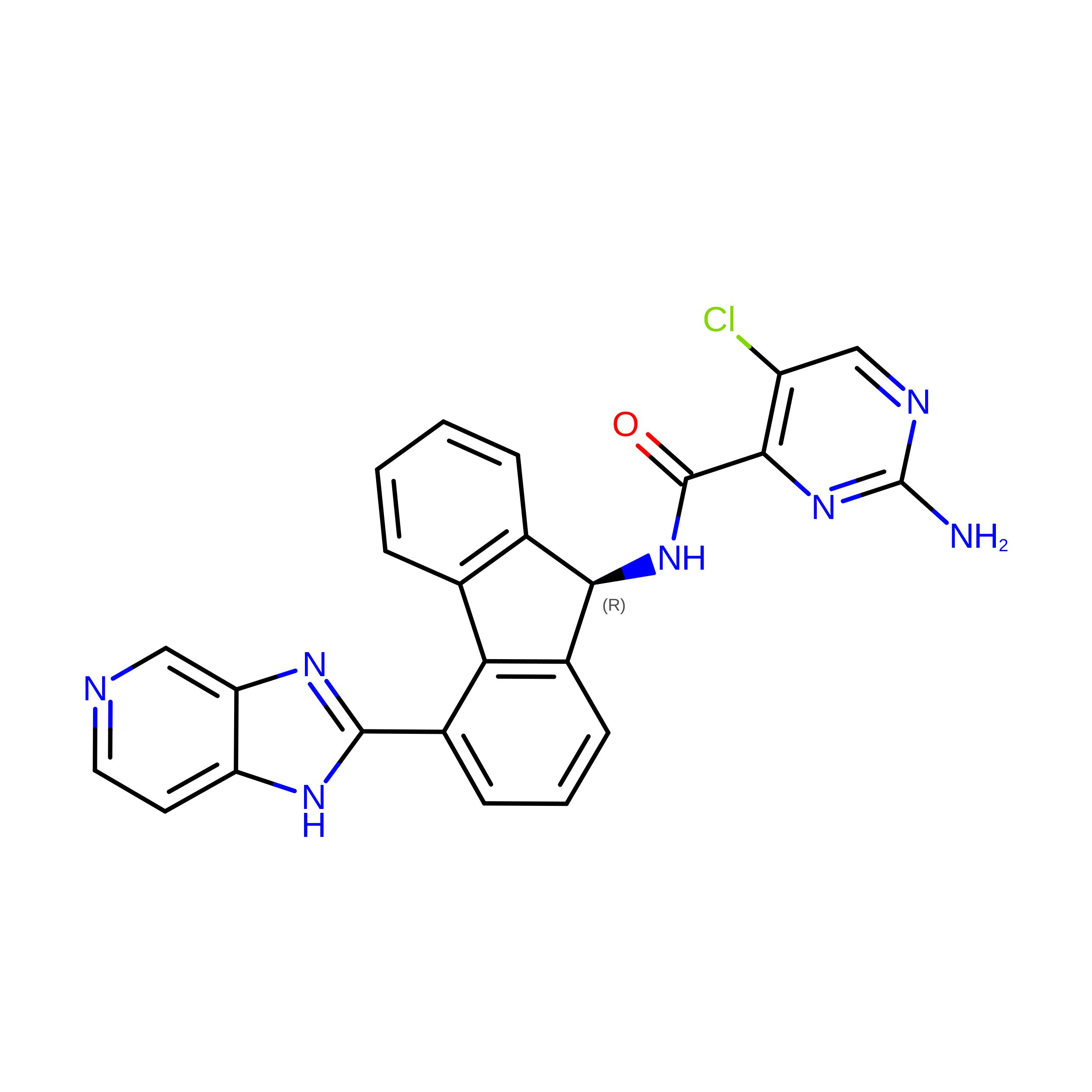
B [auth A]2-azanyl-5-chloranyl-~{N}-[(9~{R})-4-(1~{H}-imidazo[4,5-c]pyridin-2-yl)-9~{H}-fluoren-9-yl]pyrimidine-4-carboxamide
C24 H16 Cl N7 O
RCHSWIOHLXMCES-HXUWFJFHSA-N

Experimental Data & Validation

Experimental Data

  • Method: X-RAY DIFFRACTION
  • Resolution: 1.33 Å
  • R-Value Free:  0.189 (Depositor), 0.189 (DCC) 
  • R-Value Work:  0.174 (Depositor), 0.173 (DCC) 
  • R-Value Observed: 0.175 (Depositor) 
Space Group: I 2 2 2
Unit Cell:
Length ( Å )Angle ( ˚ )
a = 66.46α = 90
b = 90.7β = 90
c = 98.53γ = 90
Software Package:
Software NamePurpose
BUSTERrefinement
XDSdata reduction
Aimlessdata scaling
PHASERphasing

Structure Validation

View Full Validation Report


Ligand Structure Quality Assessment 


Entry History 

Deposition Data

Revision History  (Full details and data files)

  • Version 1.0: 2017-08-23
    Type: Initial release
  • Version 1.1: 2019-06-12
    Changes: Data collection, Database references, Structure summary
  • Version 1.2: 2021-08-11
    Changes: Database references
  • Version 1.3: 2024-01-10
    Changes: Data collection, Refinement description