5KXF | pdb_00005kxf

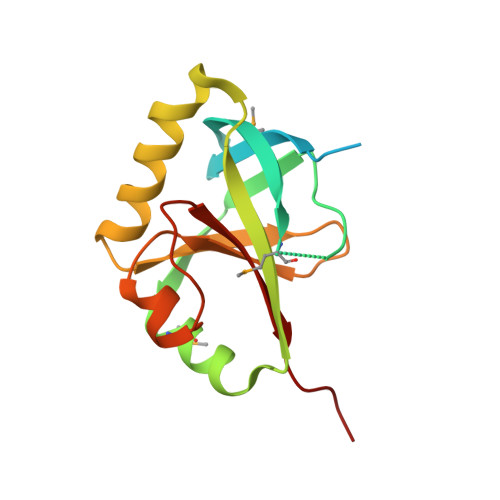
Crystal structure of the SPOC domain of the Arabidopsis flowering regulator FPA


Experimental Data Snapshot

  • Method: X-RAY DIFFRACTION
  • Resolution: 2.70 Å
  • R-Value Free: 
    0.254 (Depositor), 0.255 (DCC) 
  • R-Value Work: 
    0.192 (Depositor), 0.203 (DCC) 
  • R-Value Observed: 
    0.198 (Depositor) 

wwPDB Validation 3D Report Full Report

Validation slider image for 5KXF

This is version 1.3 of the entry. See complete history

Literature

Crystal Structure of the SPOC Domain of the Arabidopsis Flowering Regulator FPA.

Zhang, Y.Rataj, K.Simpson, G.G.Tong, L.

(2016) PLoS One 11: e0160694-e0160694

  • DOI: https://doi.org/10.1371/journal.pone.0160694
  • Primary Citation Related Structures: 
    5KXF

  • PubMed Abstract: 

    The Arabidopsis protein FPA controls flowering time by regulating the alternative 3'-end processing of the FLOWERING LOCUS (FLC) antisense RNA. FPA belongs to the split ends (SPEN) family of proteins, which contain N-terminal RNA recognition motifs (RRMs) and a SPEN paralog and ortholog C-terminal (SPOC) domain. The SPOC domain is highly conserved among FPA homologs in plants, but the conservation with the domain in other SPEN proteins is much lower. We have determined the crystal structure of Arabidopsis thaliana FPA SPOC domain at 2.7 Å resolution. The overall structure is similar to that of the SPOC domain in human SMRT/HDAC1 Associated Repressor Protein (SHARP), although there are also substantial conformational differences between them. Structural and sequence analyses identify a surface patch that is conserved among plant FPA homologs. Mutations of two residues in this surface patch did not disrupt FPA functions, suggesting that either the SPOC domain is not required for the role of FPA in regulating RNA 3'-end formation or the functions of the FPA SPOC domain cannot be disrupted by the combination of mutations, in contrast to observations with the SHARP SPOC domain.


  • Organizational Affiliation
    • Department of Biological Sciences, Columbia University, New York, NY, 10027, United States of America.

Macromolecule Content 

  • Total Structure Weight: 17.33 kDa 
  • Atom Count: 959 
  • Modeled Residue Count: 123 
  • Deposited Residue Count: 156 
  • Unique protein chains: 1

Macromolecules

Find similar proteins by:|  3D Structure
Entity ID: 1
MoleculeChains  Sequence LengthOrganismDetailsImage
Flowering time control protein FPA156Arabidopsis thalianaMutation(s): 0 
Gene Names: FPAAt2g43410T1O24.15
UniProt
Find proteins for Q8LPQ9 (Arabidopsis thaliana)
Explore Q8LPQ9 
Go to UniProtKB:  Q8LPQ9
Entity Groups
Sequence Clusters30% Identity50% Identity70% Identity90% Identity95% Identity100% Identity
UniProt GroupQ8LPQ9
Sequence Annotations
Expand
Reference Sequence

Small Molecules

Modified Residues  1 Unique
IDChains TypeFormula2D DiagramParent
MSE
Query on MSE
A
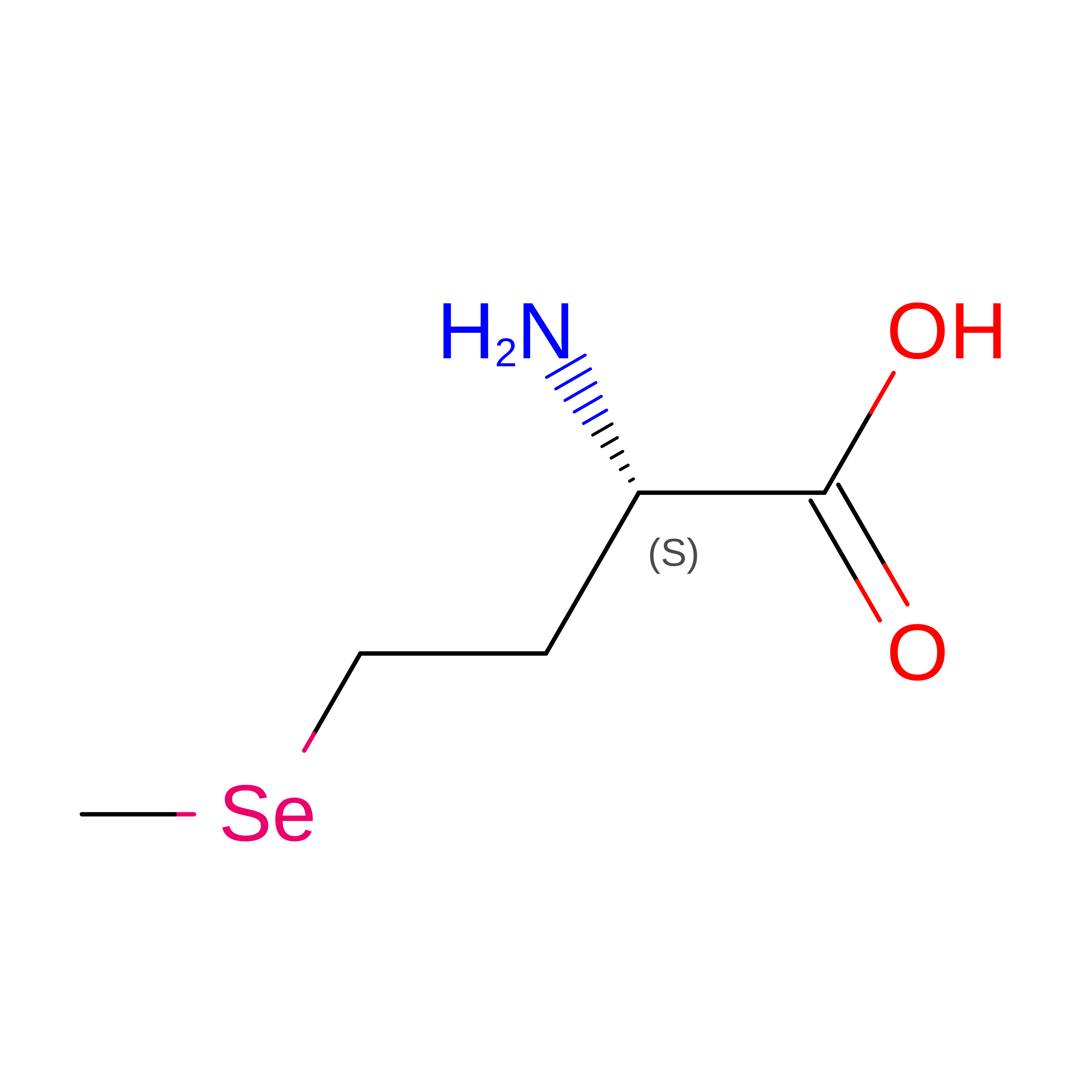
L-PEPTIDE LINKINGC5 H11 N O2 SeMET

Experimental Data & Validation

Experimental Data

  • Method: X-RAY DIFFRACTION
  • Resolution: 2.70 Å
  • R-Value Free:  0.254 (Depositor), 0.255 (DCC) 
  • R-Value Work:  0.192 (Depositor), 0.203 (DCC) 
  • R-Value Observed: 0.198 (Depositor) 
Space Group: P 65
Unit Cell:
Length ( Å )Angle ( ˚ )
a = 108.151α = 90
b = 108.151β = 90
c = 34.208γ = 120
Software Package:
Software NamePurpose
REFMACrefinement
HKL-2000data reduction
HKL-2000data scaling
autoSHARPphasing

Structure Validation

View Full Validation Report


Entry History 

& Funding Information

Deposition Data


Funding OrganizationLocationGrant Number
National Institutes of Health/National Institute of General Medical Sciences (NIH/NIGMS)United StatesGM077175

Revision History  (Full details and data files)

  • Version 1.0: 2016-10-12
    Type: Initial release
  • Version 1.1: 2017-09-13
    Changes: Author supporting evidence, Derived calculations
  • Version 1.2: 2019-12-25
    Changes: Author supporting evidence
  • Version 1.3: 2024-11-06
    Changes: Data collection, Database references, Structure summary