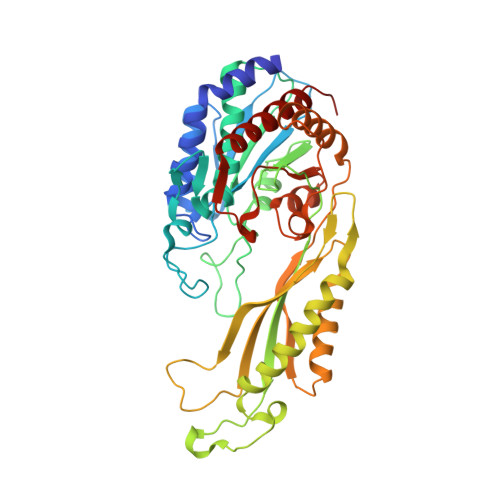
5K8N | pdb_00005k8n

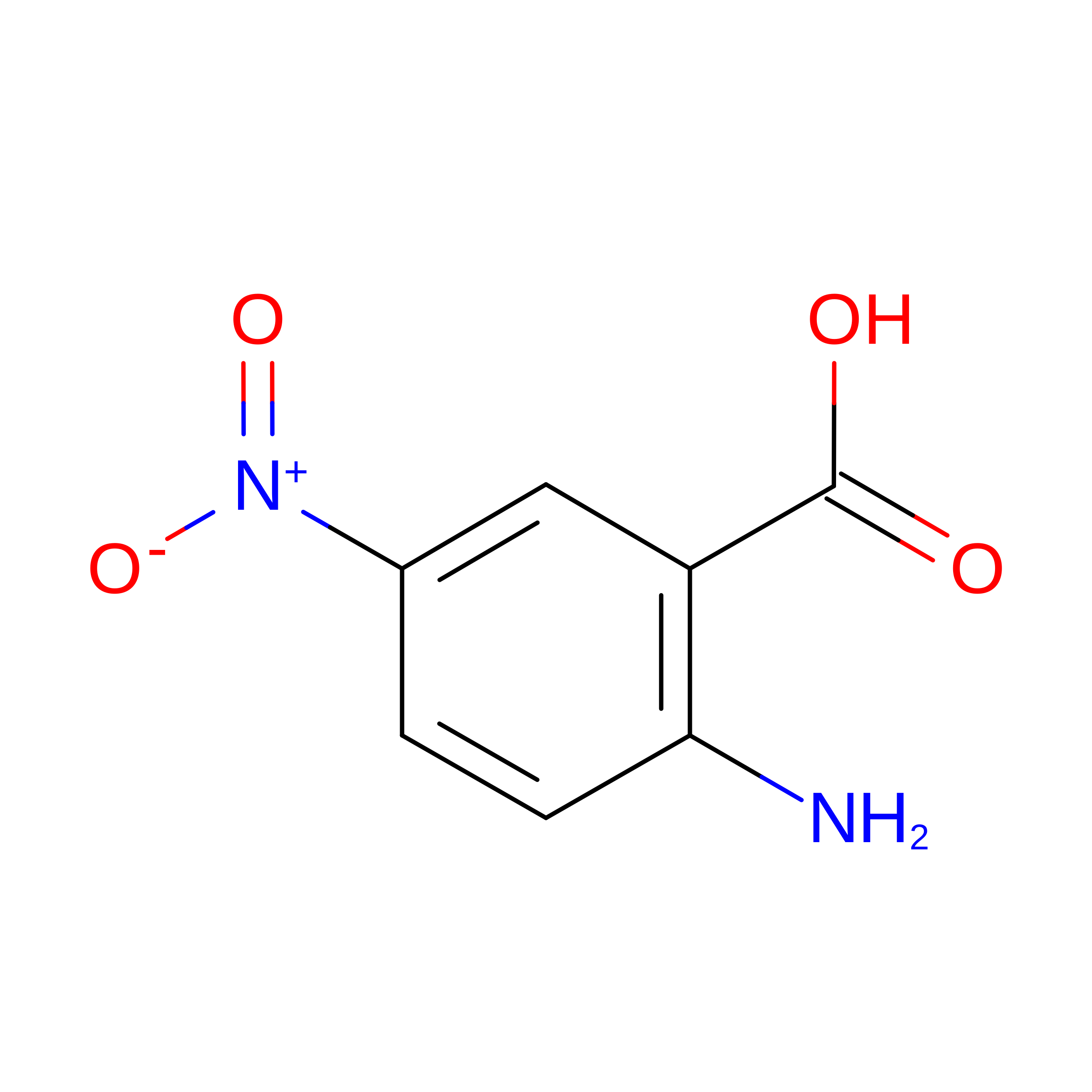
5NAA-bound 5-nitroanthranilate aminohydrolase


Experimental Data Snapshot

  • Method: X-RAY DIFFRACTION
  • Resolution: 3.23 Å
  • R-Value Free: 
    0.217 (Depositor), 0.220 (DCC) 
  • R-Value Work: 
    0.177 (Depositor), 0.180 (DCC) 
  • R-Value Observed: 
    0.178 (Depositor) 

wwPDB Validation 3D Report Full Report

Validation slider image for 5K8N

Ligand Structure Quality Assessment 


This is version 1.3 of the entry. See complete history

Literature

Enzymatic hydrolysis by transition-metal-dependent nucleophilic aromatic substitution.

Kalyoncu, S.Heaner, D.P.Kurt, Z.Bethel, C.M.Ukachukwu, C.U.Chakravarthy, S.Spain, J.C.Lieberman, R.L.

(2016) Nat Chem Biol 12: 1031-1036

  • DOI: https://doi.org/10.1038/nchembio.2191
  • Primary Citation Related Structures: 
    5K8M, 5K8N, 5K8O, 5K8P

  • PubMed Abstract: 

    Nitroaromatic compounds are typically toxic and resistant to degradation. Bradyrhizobium species strain JS329 metabolizes 5-nitroanthranilic acid (5NAA), which is a molecule secreted by Streptomyces scabies, the plant pathogen responsible for potato scab. The first biodegradation enzyme is 5NAA-aminohydrolase (5NAA-A), a metalloprotease family member that converts 5NAA to 5-nitrosalicylic acid. We characterized 5NAA-A biochemically and obtained snapshots of its mechanism. 5NAA-A, an octamer that can use several divalent transition metals for catalysis in vitro, employs a nucleophilic aromatic substitution mechanism. Unexpectedly, the metal in 5NAA-A is labile but is readily loaded in the presence of substrate. 5NAA-A is specific for 5NAA and cannot hydrolyze other tested derivatives, which are likewise poor inhibitors. The 5NAA-A structure and mechanism expand our understanding of the chemical ecology of an agriculturally important plant and pathogen, and will inform bioremediation and biocatalytic approaches to mitigate the environmental and ecological impact of nitroanilines and other challenging substrates.


  • Organizational Affiliation
    • School of Chemistry & Biochemistry, Georgia Institute of Technology, Atlanta, GA.

Macromolecule Content 

  • Total Structure Weight: 372.66 kDa 
  • Atom Count: 25,920 
  • Modeled Residue Count: 3,360 
  • Deposited Residue Count: 3,400 
  • Unique protein chains: 1

Macromolecules

Find similar proteins by:|  3D Structure
Entity ID: 1
MoleculeChains  Sequence LengthOrganismDetailsImage
5-nitroanthranilic acid aminohydrolase
A, B, C, D, E
A, B, C, D, E, F, G, H
425Bradyrhizobium sp.Mutation(s): 0 
Gene Names: naaA
EC: 3.5.99.8
UniProt
Find proteins for D3WZ85 (Bradyrhizobium sp)
Explore D3WZ85 
Go to UniProtKB:  D3WZ85
Entity Groups
Sequence Clusters30% Identity50% Identity70% Identity90% Identity95% Identity100% Identity
UniProt GroupD3WZ85
Sequence Annotations
Expand
Reference Sequence

Experimental Data & Validation

Experimental Data

  • Method: X-RAY DIFFRACTION
  • Resolution: 3.23 Å
  • R-Value Free:  0.217 (Depositor), 0.220 (DCC) 
  • R-Value Work:  0.177 (Depositor), 0.180 (DCC) 
  • R-Value Observed: 0.178 (Depositor) 
Space Group: C 2 2 21
Unit Cell:
Length ( Å )Angle ( ˚ )
a = 186.463α = 90
b = 248.875β = 90
c = 249.284γ = 90
Software Package:
Software NamePurpose
PHENIXrefinement
HKL-2000data reduction
HKL-2000data scaling
PHASERphasing

Structure Validation

View Full Validation Report


Ligand Structure Quality Assessment 


Entry History 

Deposition Data

  • Released Date: 2016-10-05 
  • Deposition Author(s): Kalyoncu, S.

Revision History  (Full details and data files)

  • Version 1.0: 2016-10-05
    Type: Initial release
  • Version 1.1: 2016-10-19
    Changes: Database references
  • Version 1.2: 2016-11-23
    Changes: Database references
  • Version 1.3: 2023-11-29
    Changes: Data collection, Database references