5JK9 | pdb_00005jk9

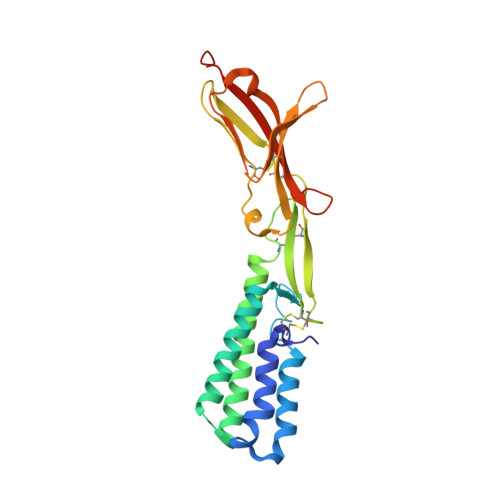
Crystal structure of human IZUMO1


Experimental Data Snapshot

  • Method: X-RAY DIFFRACTION
  • Resolution: 2.10 Å
  • R-Value Free: 
    0.231 (Depositor), 0.232 (DCC) 
  • R-Value Work: 
    0.194 (Depositor) 
  • R-Value Observed: 
    0.196 (Depositor) 

wwPDB Validation 3D Report Full Report

Validation slider image for 5JK9

Ligand Structure Quality Assessment 


This is version 1.4 of the entry. See complete history

Literature

Structure of IZUMO1-JUNO reveals sperm-oocyte recognition during mammalian fertilization

Ohto, U.Ishida, H.Krayukhina, E.Uchiyama, S.Inoue, N.Shimizu, T.

(2016) Nature 534: 566-569

  • DOI: https://doi.org/10.1038/nature18596
  • Primary Citation Related Structures: 
    5JK9, 5JKA, 5JKB, 5JKC, 5JKD, 5JKE

  • PubMed Abstract: 

    Fertilization is a fundamental process in sexual reproduction, creating a new individual through the combination of male and female gametes. The IZUMO1 sperm membrane protein and its counterpart oocyte receptor JUNO have been identified as essential factors for sperm-oocyte interaction and fusion. However, the mechanism underlying their specific recognition remains poorly defined. Here, we show the crystal structures of human IZUMO1, JUNO and the IZUMO1-JUNO complex, establishing the structural basis for the IZUMO1-JUNO-mediated sperm-oocyte interaction. IZUMO1 exhibits an elongated rod-shaped structure comprised of a helical bundle IZUMO domain and an immunoglobulin-like domain that are each firmly anchored to an intervening β-hairpin region through conserved disulfide bonds. The central β-hairpin region of IZUMO1 provides the main platform for JUNO binding, while the surface located behind the putative JUNO ligand binding pocket is involved in IZUMO1 binding. Structure-based mutagenesis analysis confirms the biological importance of the IZUMO1-JUNO interaction. This structure provides a major step towards elucidating an essential phase of fertilization and it will contribute to the development of new therapeutic interventions for fertility, such as contraceptive agents.


  • Organizational Affiliation
    • Graduate School of Pharmaceutical Sciences, The University of Tokyo, Hongo, Bunkyo-ku, Tokyo 113-0033, Japan.

Macromolecule Content 

  • Total Structure Weight: 170.31 kDa 
  • Atom Count: 11,717 
  • Modeled Residue Count: 1,390 
  • Deposited Residue Count: 1,476 
  • Unique protein chains: 1

Macromolecules

Find similar proteins by:|  3D Structure
Entity ID: 1
MoleculeChains  Sequence LengthOrganismDetailsImage
Izumo sperm-egg fusion protein 1
A, B, C, D, E
A, B, C, D, E, F
246Homo sapiensMutation(s): 0 
Gene Names: IZUMO1
UniProt & NIH Common Fund Data Resources
Find proteins for Q8IYV9 (Homo sapiens)
Explore Q8IYV9 
Go to UniProtKB:  Q8IYV9
PHAROS:  Q8IYV9
GTEx:  ENSG00000182264 
Entity Groups
Sequence Clusters30% Identity50% Identity70% Identity90% Identity95% Identity100% Identity
UniProt GroupQ8IYV9
Glycosylation
Glycosylation Sites: 1Go to GlyGen: Q8IYV9-1
Sequence Annotations
Expand
Reference Sequence

Experimental Data & Validation

Experimental Data

  • Method: X-RAY DIFFRACTION
  • Resolution: 2.10 Å
  • R-Value Free:  0.231 (Depositor), 0.232 (DCC) 
  • R-Value Work:  0.194 (Depositor) 
  • R-Value Observed: 0.196 (Depositor) 
Space Group: P 1
Unit Cell:
Length ( Å )Angle ( ˚ )
a = 64.936α = 77.65
b = 75.067β = 79.11
c = 108.885γ = 70.66
Software Package:
Software NamePurpose
REFMACrefinement
HKL-2000data reduction
HKL-2000data scaling
autoSHARPphasing

Structure Validation

View Full Validation Report


Ligand Structure Quality Assessment 


Entry History 

Deposition Data

Revision History  (Full details and data files)

  • Version 1.0: 2016-06-22
    Type: Initial release
  • Version 1.1: 2016-06-29
    Changes: Database references
  • Version 1.2: 2020-02-19
    Changes: Data collection, Database references, Derived calculations
  • Version 1.3: 2020-07-29
    Type: Remediation
    Reason: Carbohydrate remediation
    Changes: Data collection, Derived calculations, Structure summary
  • Version 1.4: 2024-11-13
    Changes: Data collection, Database references, Structure summary