5J8O | pdb_00005j8o

Structure of human Programmed cell death 1 ligand 1 (PD-L1) with low molecular mass inhibitor


Experimental Data Snapshot

  • Method: X-RAY DIFFRACTION
  • Resolution: 2.30 Å
  • R-Value Free: 
    0.305 (Depositor), 0.285 (DCC) 
  • R-Value Work: 
    0.241 (Depositor) 
  • R-Value Observed: 
    0.244 (Depositor) 

Starting Model: experimental
View more details

wwPDB Validation 3D Report Full Report

Validation slider image for 5J8O

Ligand Structure Quality Assessment 


This is version 1.3 of the entry. See complete history

Literature

Structural basis for small molecule targeting of the programmed death ligand 1 (PD-L1).

Zak, K.M.Grudnik, P.Guzik, K.Zieba, B.J.Musielak, B.Domling, A.Dubin, G.Holak, T.A.

(2016) Oncotarget 7: 30323-30335

  • DOI: https://doi.org/10.18632/oncotarget.8730
  • Primary Citation Related Structures: 
    5J89, 5J8O

  • PubMed Abstract: 

    Targeting the PD-1/PD-L1 immunologic checkpoint with monoclonal antibodies has provided unprecedented results in cancer treatment in the recent years. Development of chemical inhibitors for this pathway lags the antibody development because of insufficient structural information. The first nonpeptidic chemical inhibitors that target the PD-1/PD-L1 interaction have only been recently disclosed by Bristol-Myers Squibb. Here, we show that these small-molecule compounds bind directly to PD-L1 and that they potently block PD-1 binding. Structural studies reveal a dimeric protein complex with a single small molecule which stabilizes the dimer thus occluding the PD-1 interaction surface of PD-L1s. The small-molecule interaction "hot spots" on PD-L1 surfaces suggest approaches for the PD-1/PD-L1 antagonist drug discovery.


  • Organizational Affiliation
    • Malopolska Centre of Biotechnology, Jagiellonian University, Gronostajowa, Krakow, Poland.

Macromolecule Content 

  • Total Structure Weight: 28.75 kDa 
  • Atom Count: 1,968 
  • Modeled Residue Count: 246 
  • Deposited Residue Count: 248 
  • Unique protein chains: 1

Macromolecules

Find similar proteins by:|  3D Structure
Entity ID: 1
MoleculeChains  Sequence LengthOrganismDetailsImage
Programmed cell death 1 ligand 1
A, B
124Homo sapiensMutation(s): 0 
Gene Names: CD274B7H1PDCD1L1PDCD1LG1PDL1
UniProt & NIH Common Fund Data Resources
Find proteins for Q9NZQ7 (Homo sapiens)
Explore Q9NZQ7 
Go to UniProtKB:  Q9NZQ7
PHAROS:  Q9NZQ7
GTEx:  ENSG00000120217 
Entity Groups
Sequence Clusters30% Identity50% Identity70% Identity90% Identity95% Identity100% Identity
UniProt GroupQ9NZQ7
Sequence Annotations
Expand
Reference Sequence

Small Molecules

Ligands 1 Unique
IDChains Name / Formula / InChI Key2D Diagram3D Interactions
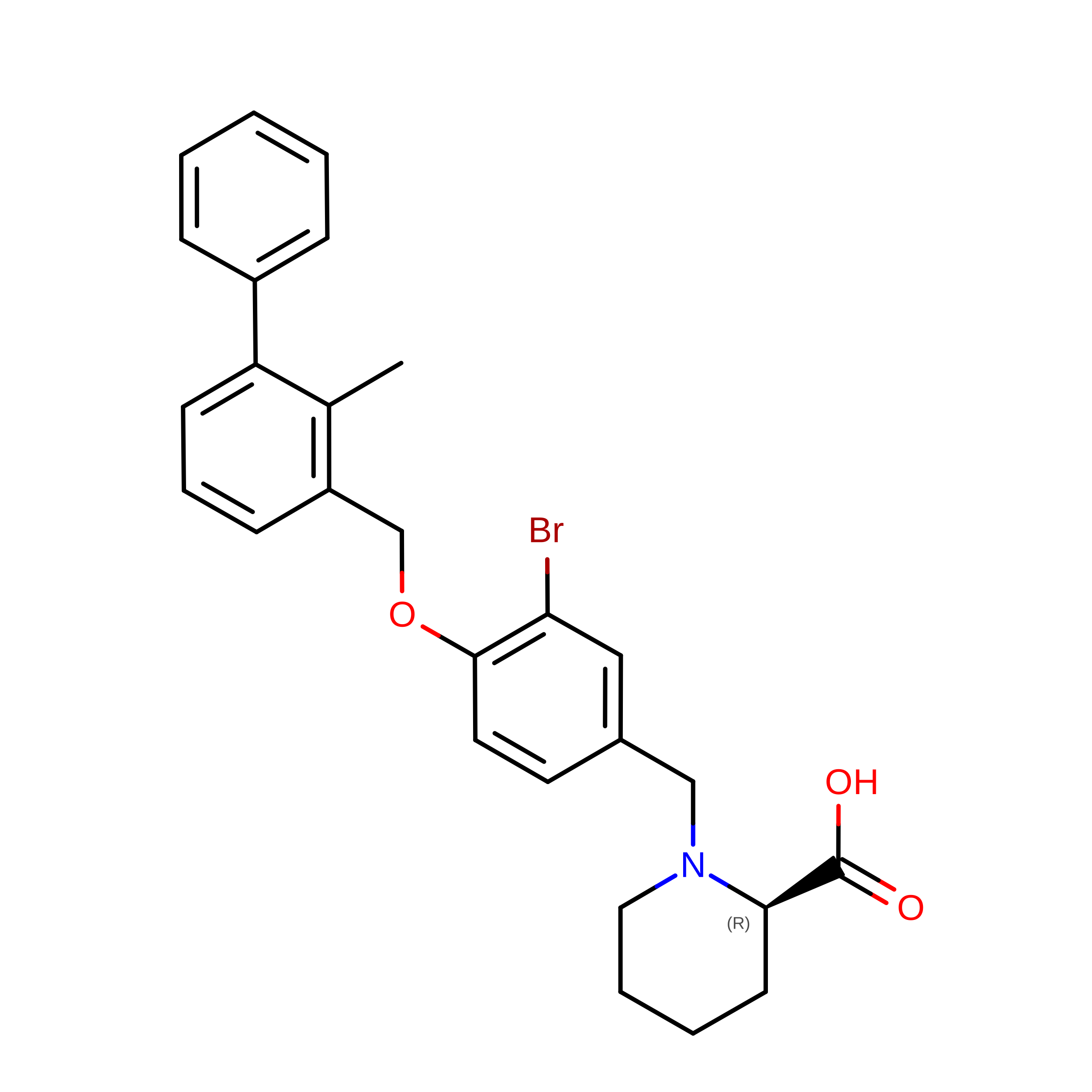
6GZ

Query on 6GZ


Download:Ideal Coordinates CCD File
C [auth A](2R)-1-({3-bromo-4-[(2-methyl[1,1'-biphenyl]-3-yl)methoxy]phenyl}methyl)piperidine-2-carboxylic acid
C27 H28 Br N O3
QRXBPPWUGITQLE-RUZDIDTESA-N

Experimental Data & Validation

Experimental Data

  • Method: X-RAY DIFFRACTION
  • Resolution: 2.30 Å
  • R-Value Free:  0.305 (Depositor), 0.285 (DCC) 
  • R-Value Work:  0.241 (Depositor) 
  • R-Value Observed: 0.244 (Depositor) 
Space Group: P 2 21 21
Unit Cell:
Length ( Å )Angle ( ˚ )
a = 34.313α = 90
b = 55.182β = 90
c = 141.773γ = 90
Software Package:
Software NamePurpose
Aimlessdata scaling
PHASERphasing
REFMACrefinement
PDB_EXTRACTdata extraction
XDSdata reduction
PHASERphasing

Structure Validation

View Full Validation Report


Ligand Structure Quality Assessment 


Entry History 

& Funding Information

Deposition Data


Funding OrganizationLocationGrant Number
European Community Framework ProgrammePolandMarie Curie FP7-Reintegration-Grant
National Science CentrePolandUMO-2012/06/A/ST5/00224
National Science CentrePolandUMO-2014/12/W/NZ1/00457
National Science CentrePolandUMO-2011/01/D/NZ1/01169
National Science CentrePolandUMO-2012/07/E/NZ1/01907
European Union structural fundsPolandPOIG.02.01.00-12-064/08
European Union structural fundsPolandPOIG.02.01.00-12-167/08

Revision History  (Full details and data files)

  • Version 1.0: 2016-04-27
    Type: Initial release
  • Version 1.1: 2016-09-14
    Changes: Database references
  • Version 1.2: 2024-01-10
    Changes: Data collection, Database references, Refinement description
  • Version 1.3: 2024-10-09
    Changes: Structure summary