Download Mendeley
The outer-membrane export signal of Porphyromonas gingivalis type IX secretion system (T9SS) is a conserved C-terminal beta-sandwich domain.
de Diego, I., Ksiazek, M., Mizgalska, D., Koneru, L., Golik, P., Szmigielski, B., Nowak, M., Nowakowska, Z., Potempa, B., Houston, J.A., Enghild, J.J., Thgersen, I.B., Gao, J., Kwan, A.H., Trewhella, J., Dubin, G., Gomis-Ruth, F.X., Nguyen, K.A., Potempa, J.(2016) Sci Rep 6: 23123-23123
- PubMed: 27005013 Search on PubMedSearch on PubMed Central
- DOI: https://doi.org/10.1038/srep23123
- Primary Citation Related Structures:
5AG8, 5AG9, 5HFS - PubMed Abstract:
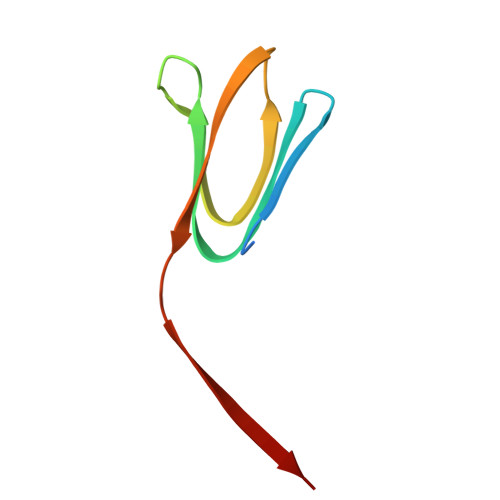
In the recently characterized Type IX Secretion System (T9SS), the conserved C-terminal domain (CTD) in secreted proteins functions as an outer membrane translocation signal for export of virulence factors to the cell surface in the Gram-negative Bacteroidetes phylum. In the periodontal pathogen Porphyromonas gingivalis, the CTD is cleaved off by PorU sortase in a sequence-independent manner, and anionic lipopolysaccharide (A-LPS) is attached to many translocated proteins, thus anchoring them to the bacterial surface. Here, we solved the atomic structure of the CTD of gingipain B (RgpB) from P. gingivalis, alone and together with a preceding immunoglobulin-superfamily domain (IgSF). The CTD was found to possess a typical Ig-like fold encompassing seven antiparallel β-strands organized in two β-sheets, packed into a β-sandwich structure that can spontaneously dimerise through C-terminal strand swapping. Small angle X-ray scattering (SAXS) revealed no fixed orientation of the CTD with respect to the IgSF. By introducing insertion or substitution of residues within the inter-domain linker in the native protein, we were able to show that despite the region being unstructured, it nevertheless is resistant to general proteolysis. These data suggest structural motifs located in the two adjacent Ig-like domains dictate the processing of CTDs by the T9SS secretion pathway.
- Proteolysis Lab; Department of Structural Biology; "María de Maeztu" Unit of Excellence; Molecular Biology Institute of Barcelona, CSIC; Barcelona Science Park, Barcelona, Spain.
Organizational Affiliation: