5GQG | pdb_00005gqg

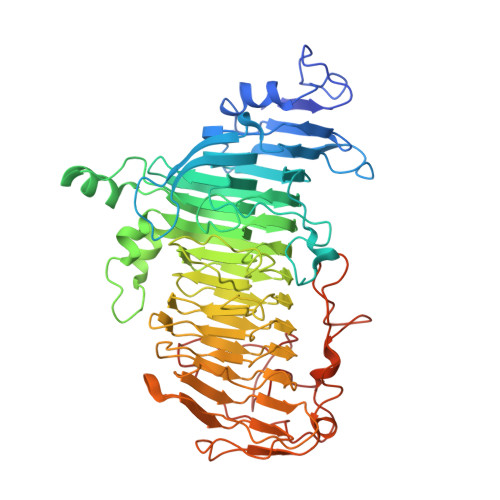
Crystal structure of lacto-N-biosidase LnbX from Bifidobacterium longum subsp. longum, galacto-N-biose complex


Experimental Data Snapshot

  • Method: X-RAY DIFFRACTION
  • Resolution: 2.70 Å
  • R-Value Free: 
    0.253 (Depositor), 0.226 (DCC) 
  • R-Value Work: 
    0.190 (Depositor) 
  • R-Value Observed: 
    0.193 (Depositor) 

wwPDB Validation 3D Report Full Report

Validation slider image for 5GQG

This is version 2.1 of the entry. See complete history

Literature

Molecular Insight into Evolution of Symbiosis between Breast-Fed Infants and a Member of the Human Gut Microbiome Bifidobacterium longum

Yamada, C.Gotoh, A.Sakanaka, M.Hattie, M.Stubbs, K.A.Katayama-Ikegami, A.Hirose, J.Kurihara, S.Arakawa, T.Kitaoka, M.Okuda, S.Katayama, T.Fushinobu, S.

(2017) Cell Chem Biol 24: 515-524.e5

  • DOI: https://doi.org/10.1016/j.chembiol.2017.03.012
  • Primary Citation Related Structures: 
    5GQC, 5GQF, 5GQG

  • PubMed Abstract: 

    Breast-fed infants generally have a bifidobacteria-rich microbiota with recent studies indicating that human milk oligosaccharides (HMOs) selectively promote bifidobacterial growth. Bifidobacterium bifidum possesses a glycoside hydrolase family 20 lacto-N-biosidase for liberating lacto-N-biose I from lacto-N-tetraose, an abundant HMO unique to human milk, while Bifidobacterium longum subsp. longum has a non-classified enzyme (LnbX). Here, we determined the crystal structure of the catalytic domain of LnbX and provide evidence for creation of a novel glycoside hydrolase family, GH136. The structure, in combination with inhibition and mutation studies, provides insight into the molecular mechanism and broader substrate specificity of this enzyme. Moreover, through genetic studies, we show that lnbX is indispensable for B. longum growth on lacto-N-tetraose and is a key genetic factor for persistence in the gut of breast-fed infants. Overall, this study reveals possible evolutionary routes for the emergence of symbiosis between humans and bifidobacterial species in the infant gut.


  • Organizational Affiliation
    • Department of Biotechnology, The University of Tokyo, Tokyo 113-8657, Japan; Graduate School of Biostudies, Kyoto University, Kyoto 606-8052, Japan.

Macromolecule Content 

  • Total Structure Weight: 133.11 kDa 
  • Atom Count: 9,107 
  • Modeled Residue Count: 1,164 
  • Deposited Residue Count: 1,212 
  • Unique protein chains: 1

Macromolecules

Find similar proteins by:|  3D Structure
Entity ID: 1
MoleculeChains  Sequence LengthOrganismDetailsImage
Lacto-N-biosidase
A, B
606Bifidobacterium longum subsp. longumMutation(s): 0 
Gene Names: lnbX
EC: 3.2.1.140
UniProt
Find proteins for A0A024QYS6 (Bifidobacterium longum subsp. longum)
Explore A0A024QYS6 
Go to UniProtKB:  A0A024QYS6
Entity Groups
Sequence Clusters30% Identity50% Identity70% Identity90% Identity95% Identity100% Identity
UniProt GroupA0A024QYS6
Sequence Annotations
Expand
Reference Sequence

Oligosaccharides

Help  
Entity ID: 2
MoleculeChains Length2D Diagram GlycosylationD Interactions
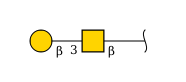
beta-D-galactopyranose-(1-3)-2-acetamido-2-deoxy-beta-D-galactopyranose
C, D
2N/A
Glycosylation Resources
GlyTouCan: G01534TU
GlyCosmos: G01534TU
GlyGen: G01534TU

Experimental Data & Validation

Experimental Data

  • Method: X-RAY DIFFRACTION
  • Resolution: 2.70 Å
  • R-Value Free:  0.253 (Depositor), 0.226 (DCC) 
  • R-Value Work:  0.190 (Depositor) 
  • R-Value Observed: 0.193 (Depositor) 
Space Group: P 21 21 21
Unit Cell:
Length ( Å )Angle ( ˚ )
a = 64.103α = 90
b = 144.061β = 90
c = 144.445γ = 90
Software Package:
Software NamePurpose
REFMACrefinement
HKL-2000data reduction
HKL-2000data scaling
PHENIXphasing

Structure Validation

View Full Validation Report


Entry History 

& Funding Information

Deposition Data


Funding OrganizationLocationGrant Number
Science and Technology Research Promotion Program for Agriculture, Forestry, Fisheries and Food IndustryJapan25010A
JSPSJapan16J09251

Revision History  (Full details and data files)

  • Version 1.0: 2017-04-19
    Type: Initial release
  • Version 1.1: 2017-05-03
    Changes: Database references
  • Version 1.2: 2017-10-18
    Changes: Structure summary
  • Version 2.0: 2020-07-29
    Type: Remediation
    Reason: Carbohydrate remediation
    Changes: Atomic model, Data collection, Derived calculations, Structure summary
  • Version 2.1: 2024-03-20
    Changes: Data collection, Database references, Derived calculations, Structure summary