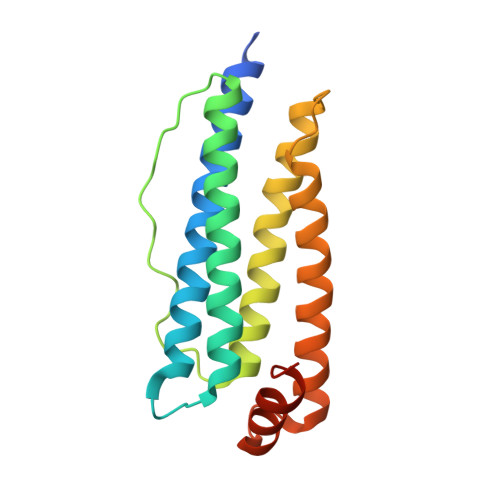
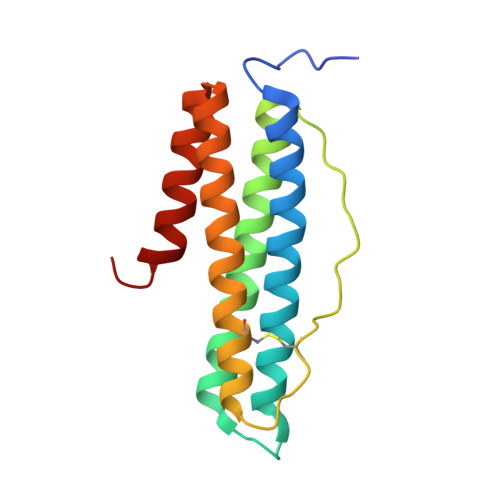
5GN8 | pdb_00005gn8

Structure of a 48-mer protein nanocage fabricated from its 24-mer analogue by subunit interface redesign


Experimental Data Snapshot

  • Method: X-RAY DIFFRACTION
  • Resolution: 2.81 Å
  • R-Value Free: 
    0.251 (Depositor), 0.253 (DCC) 
  • R-Value Work: 
    0.213 (Depositor), 0.223 (DCC) 
  • R-Value Observed: 
    0.215 (Depositor) 

Starting Model: experimental
View more details

wwPDB Validation 3D Report Full Report

Validation slider image for 5GN8

This is version 1.4 of the entry. See complete history

Literature

"Silent" Amino Acid Residues at Key Subunit Interfaces Regulate the Geometry of Protein Nanocages

Zhang, S.Zang, J.Zhang, X.Chen, H.Mikami, B.Zhao, G.

(2016) ACS Nano 10: 10382-10388

  • DOI: https://doi.org/10.1021/acsnano.6b06235
  • Primary Citation Related Structures: 
    5GN8

  • PubMed Abstract: 

    Rendering the geometry of protein-based assemblies controllable remains challenging. Protein shell-like nanocages represent particularly interesting targets for designed assembly. Here, we introduce an engineering strategy-key subunit interface redesign (KSIR)-that alters a natural subunit-subunit interface by selective deletion of a small number of "silent" amino acid residues (no participation in interfacial interactions) into one that triggers the generation of a non-native protein cage. We have applied KSIR to construct a non-native 48-mer nanocage from its native 24-mer recombinant human H-chain ferritin (rHuHF). This protein is a heteropolymer composed of equal numbers of two different subunits which are derived from one polypeptide. This strategy has allowed the study of conversion between protein nanocages with different geometries by re-engineering key subunit interfaces and the demonstration of the important role of the above-mentioned specific residues in providing geometric specificity for protein assembly.


  • Organizational Affiliation
    • Beijing Advanced Innovation Center for Food Nutrition and Human Health, College of Food Science and Nutritional Engineering, China Agricultural University , Key Laboratory of Functional Dairy, Ministry of Education, Beijing 100083, China.

Macromolecule Content 

  • Total Structure Weight: 37.71 kDa 
  • Atom Count: 2,525 
  • Modeled Residue Count: 305 
  • Deposited Residue Count: 322 
  • Unique protein chains: 2

Macromolecules

Find similar proteins by:|  3D Structure
Entity ID: 1
MoleculeChains  Sequence LengthOrganismDetailsImage
Ferritin heavy chain176Homo sapiensMutation(s): 0 
Gene Names: FTH1FTHFTHL6OK/SW-cl.84PIG15
EC: 1.16.3.1
UniProt & NIH Common Fund Data Resources
Find proteins for P02794 (Homo sapiens)
Explore P02794 
Go to UniProtKB:  P02794
PHAROS:  P02794
GTEx:  ENSG00000167996 
Entity Groups
Sequence Clusters30% Identity50% Identity70% Identity90% Identity95% Identity100% Identity
UniProt GroupP02794
Sequence Annotations
Expand
Reference Sequence
Find similar proteins by:|  3D Structure
Entity ID: 2
MoleculeChains  Sequence LengthOrganismDetailsImage
Ferritin heavy chain146Homo sapiensMutation(s): 0 
Gene Names: FTH1FTHFTHL6OK/SW-cl.84PIG15
EC: 1.16.3.1
UniProt & NIH Common Fund Data Resources
Find proteins for P02794 (Homo sapiens)
Explore P02794 
Go to UniProtKB:  P02794
PHAROS:  P02794
GTEx:  ENSG00000167996 
Entity Groups
Sequence Clusters30% Identity50% Identity70% Identity90% Identity95% Identity100% Identity
UniProt GroupP02794
Sequence Annotations
Expand
Reference Sequence

Experimental Data & Validation

Experimental Data

  • Method: X-RAY DIFFRACTION
  • Resolution: 2.81 Å
  • R-Value Free:  0.251 (Depositor), 0.253 (DCC) 
  • R-Value Work:  0.213 (Depositor), 0.223 (DCC) 
  • R-Value Observed: 0.215 (Depositor) 
Space Group: F 4 3 2
Unit Cell:
Length ( Å )Angle ( ˚ )
a = 236.12α = 90
b = 236.12β = 90
c = 236.12γ = 90
Software Package:
Software NamePurpose
PHENIXrefinement
HKL-3000data reduction
PHENIXphasing
HKL-3000data scaling

Structure Validation

View Full Validation Report


Entry History 

& Funding Information

Deposition Data


Funding OrganizationLocationGrant Number
China--

Revision History  (Full details and data files)

  • Version 1.0: 2016-12-14
    Type: Initial release
  • Version 1.1: 2017-01-25
    Changes: Database references
  • Version 1.2: 2019-07-24
    Changes: Data collection, Derived calculations
  • Version 1.3: 2023-11-08
    Changes: Data collection, Database references, Refinement description
  • Version 1.4: 2024-11-06
    Changes: Structure summary