5CPR | pdb_00005cpr

The novel SUV4-20 inhibitor A-196 verifies a role for epigenetics in genomic integrity


Experimental Data Snapshot

  • Method: X-RAY DIFFRACTION
  • Resolution: 2.22 Å
  • R-Value Free: 
    0.249 (Depositor), 0.249 (DCC) 
  • R-Value Work: 
    0.190 (Depositor), 0.192 (DCC) 
  • R-Value Observed: 
    0.193 (Depositor) 

Starting Model: experimental
View more details

wwPDB Validation 3D Report Full Report

Validation slider image for 5CPR

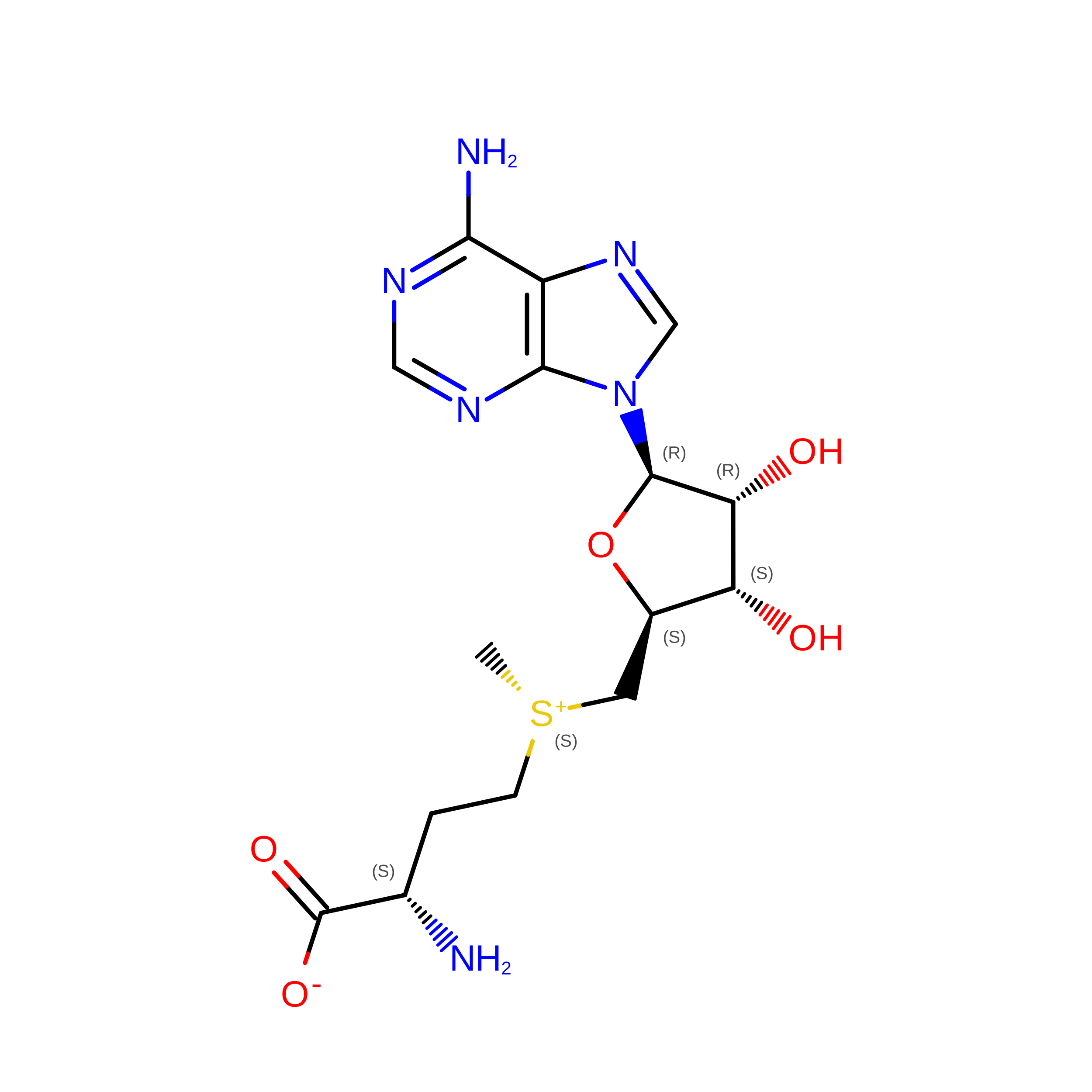
Ligand Structure Quality Assessment 


This is version 1.3 of the entry. See complete history

Literature

The SUV4-20 inhibitor A-196 verifies a role for epigenetics in genomic integrity.

Bromberg, K.D.Mitchell, T.R.Upadhyay, A.K.Jakob, C.G.Jhala, M.A.Comess, K.M.Lasko, L.M.Li, C.Tuzon, C.T.Dai, Y.Li, F.Eram, M.S.Nuber, A.Soni, N.B.Manaves, V.Algire, M.A.Sweis, R.F.Torrent, M.Schotta, G.Sun, C.Michaelides, M.R.Shoemaker, A.R.Arrowsmith, C.H.Brown, P.J.Santhakumar, V.Martin, A.Rice, J.C.Chiang, G.G.Vedadi, M.Barsyte-Lovejoy, D.Pappano, W.N.

(2017) Nat Chem Biol 13: 317-324

  • DOI: https://doi.org/10.1038/nchembio.2282
  • Primary Citation Related Structures: 
    5CPR

  • PubMed Abstract: 

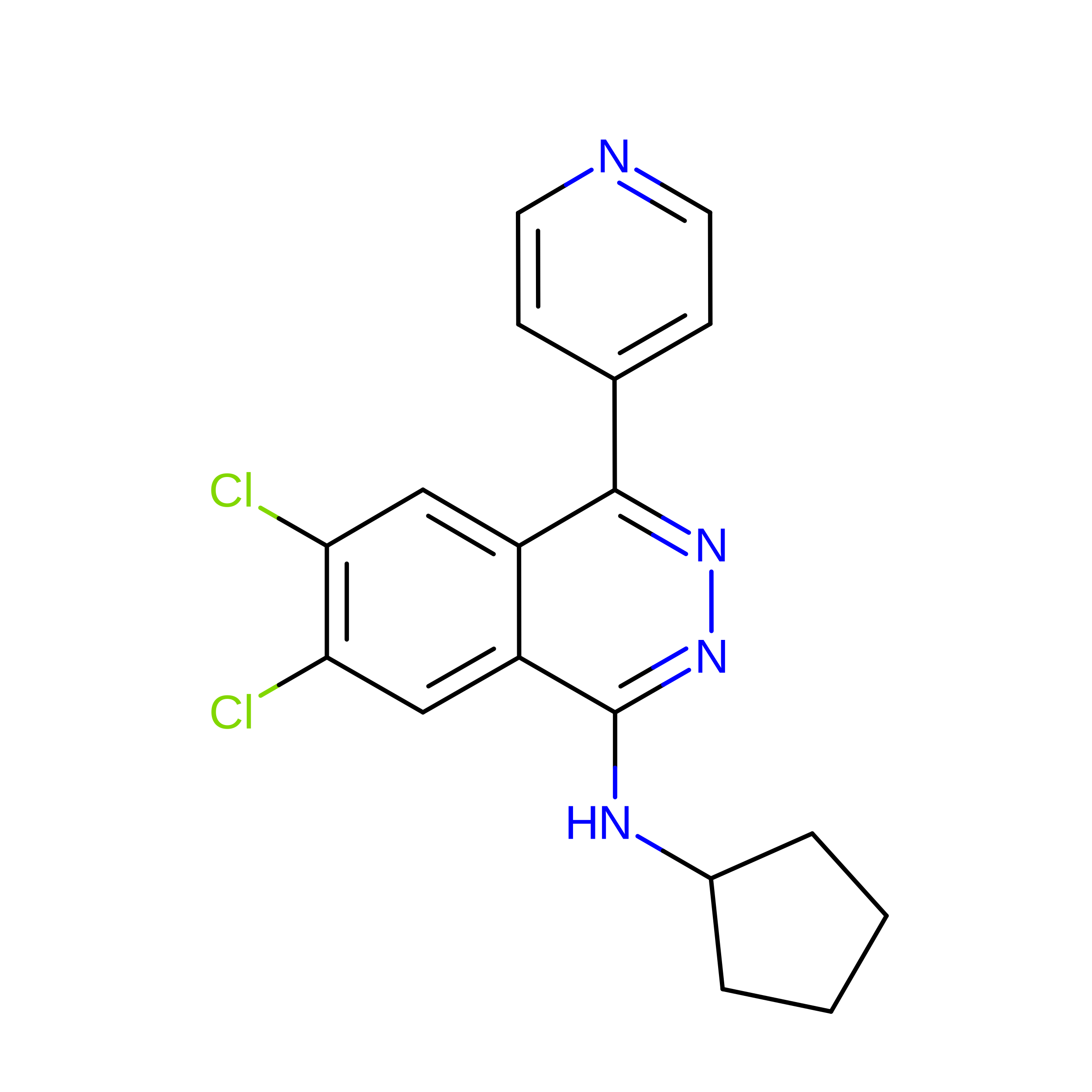
    Protein lysine methyltransferases (PKMTs) regulate diverse physiological processes including transcription and the maintenance of genomic integrity. Genetic studies suggest that the PKMTs SUV420H1 and SUV420H2 facilitate proficient nonhomologous end-joining (NHEJ)-directed DNA repair by catalyzing the di- and trimethylation (me2 and me3, respectively) of lysine 20 on histone 4 (H4K20). Here we report the identification of A-196, a potent and selective inhibitor of SUV420H1 and SUV420H2. Biochemical and co-crystallization analyses demonstrate that A-196 is a substrate-competitive inhibitor of both SUV4-20 enzymes. In cells, A-196 induced a global decrease in H4K20me2 and H4K20me3 and a concomitant increase in H4K20me1. A-196 inhibited 53BP1 foci formation upon ionizing radiation and reduced NHEJ-mediated DNA-break repair but did not affect homology-directed repair. These results demonstrate the role of SUV4-20 enzymatic activity in H4K20 methylation and DNA repair. A-196 represents a first-in-class chemical probe of SUV4-20 to investigate the role of histone methyltransferases in genomic integrity.


  • Organizational Affiliation
    • Discovery, Research and Development, AbbVie, North Chicago, Illinois, USA.

Macromolecule Content 

  • Total Structure Weight: 31.75 kDa 
  • Atom Count: 2,014 
  • Modeled Residue Count: 232 
  • Deposited Residue Count: 268 
  • Unique protein chains: 1

Macromolecules

Find similar proteins by:|  3D Structure
Entity ID: 1
MoleculeChains  Sequence LengthOrganismDetailsImage
Histone-lysine N-methyltransferase SUV420H1A [auth B]268Homo sapiensMutation(s): 0 
Gene Names: SUV420H1KMT5BCGI-85
EC: 2.1.1.43 (PDB Primary Data), 2.1.1.362 (UniProt), 2.1.1.361 (UniProt)
UniProt & NIH Common Fund Data Resources
Find proteins for Q4FZB7 (Homo sapiens)
Explore Q4FZB7 
Go to UniProtKB:  Q4FZB7
PHAROS:  Q4FZB7
GTEx:  ENSG00000110066 
Entity Groups
Sequence Clusters30% Identity50% Identity70% Identity90% Identity95% Identity100% Identity
UniProt GroupQ4FZB7
Sequence Annotations
Expand
Reference Sequence

Small Molecules

Experimental Data & Validation

Experimental Data

  • Method: X-RAY DIFFRACTION
  • Resolution: 2.22 Å
  • R-Value Free:  0.249 (Depositor), 0.249 (DCC) 
  • R-Value Work:  0.190 (Depositor), 0.192 (DCC) 
  • R-Value Observed: 0.193 (Depositor) 
Space Group: P 21 21 21
Unit Cell:
Length ( Å )Angle ( ˚ )
a = 42.209α = 90
b = 47.913β = 90
c = 129.072γ = 90
Software Package:
Software NamePurpose
BUSTERrefinement
XDSdata reduction
XDSdata scaling
PHASERphasing

Structure Validation

View Full Validation Report


Ligand Structure Quality Assessment 


Entry History 

Deposition Data

Revision History  (Full details and data files)

  • Version 1.0: 2017-01-25
    Type: Initial release
  • Version 1.1: 2017-02-08
    Changes: Database references
  • Version 1.2: 2017-02-22
    Changes: Database references
  • Version 1.3: 2023-09-27
    Changes: Data collection, Database references, Refinement description