4Z0J | pdb_00004z0j

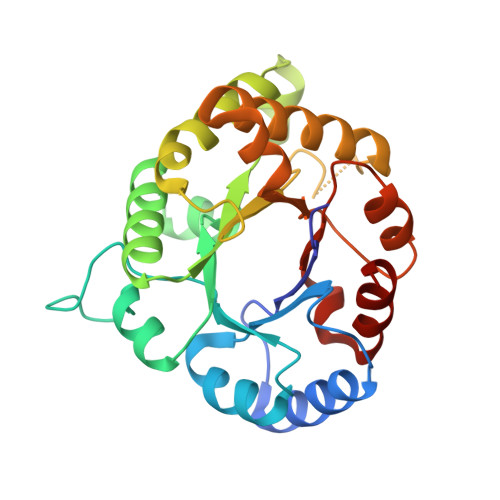
F96S/S73A Double mutant of Plasmodium Falciparum Triosephosphate Isomerase


Experimental Data Snapshot

  • Method: X-RAY DIFFRACTION
  • Resolution: 2.07 Å
  • R-Value Free: 
    0.260 (Depositor), 0.263 (DCC) 
  • R-Value Work: 
    0.216 (Depositor), 0.221 (DCC) 
  • R-Value Observed: 
    0.219 (Depositor) 

Starting Model: experimental
View more details

wwPDB Validation 3D Report Full Report

Validation slider image for 4Z0J

This is version 1.2 of the entry. See complete history

Literature

Connecting Active-Site Loop Conformations and Catalysis in Triosephosphate Isomerase: Insights from a Rare Variation at Residue 96 in the Plasmodial Enzyme

Pareek, V.Samanta, M.Joshi, N.V.Balaram, H.Murthy, M.R.N.Balaram, P.

(2016) Chembiochem 17: 620-629

  • DOI: https://doi.org/10.1002/cbic.201500532
  • Primary Citation Related Structures: 
    4X22, 4YMZ, 4YWI, 4YXG, 4Z0J, 4Z0S

  • PubMed Abstract: 

    Despite extensive research into triosephosphate isomerases (TIMs), there exists a gap in understanding of the remarkable conjunction between catalytic loop-6 (residues 166-176) movement and the conformational flip of Glu165 (catalytic base) upon substrate binding that primes the active site for efficient catalysis. The overwhelming occurrence of serine at position 96 (98% of the 6277 unique TIM sequences), spatially proximal to E165 and the loop-6 residues, raises questions about its role in catalysis. Notably, Plasmodium falciparum TIM has an extremely rare residue--phenylalanine--at this position whereas, curiously, the mutant F96S was catalytically defective. We have obtained insights into the influence of residue 96 on the loop-6 conformational flip and E165 positioning by combining kinetic and structural studies on the PfTIM F96 mutants F96Y, F96A, F96S/S73A, and F96S/L167V with sequence conservation analysis and comparative analysis of the available apo and holo structures of the enzyme from diverse organisms.


  • Organizational Affiliation
    • Molecular Biophysics Unit, Indian Institute of Science, Bangalore, 560012, India.

Macromolecule Content 

  • Total Structure Weight: 56.88 kDa 
  • Atom Count: 4,206 
  • Modeled Residue Count: 491 
  • Deposited Residue Count: 496 
  • Unique protein chains: 1

Macromolecules

Find similar proteins by:|  3D Structure
Entity ID: 1
MoleculeChains  Sequence LengthOrganismDetailsImage
Triosephosphate isomerase
A, B
248Plasmodium falciparumMutation(s): 3 
Gene Names: TPI
EC: 5.3.1.1
UniProt
Find proteins for Q07412 (Plasmodium falciparum)
Explore Q07412 
Go to UniProtKB:  Q07412
Entity Groups
Sequence Clusters30% Identity50% Identity70% Identity90% Identity95% Identity100% Identity
UniProt GroupQ07412
Sequence Annotations
Expand
Reference Sequence

Small Molecules

Ligands 2 Unique
IDChains Name / Formula / InChI Key2D Diagram3D Interactions
SO4

Query on SO4


Download:Ideal Coordinates CCD File
G [auth A],
H [auth A],
Q [auth B]
SULFATE ION
O4 S
QAOWNCQODCNURD-UHFFFAOYSA-L
EDO

Query on EDO


Download:Ideal Coordinates CCD File
C [auth A]
D [auth A]
E [auth A]
F [auth A]
I [auth B]
C [auth A],
D [auth A],
E [auth A],
F [auth A],
I [auth B],
J [auth B],
K [auth B],
L [auth B],
M [auth B],
N [auth B],
O [auth B],
P [auth B]
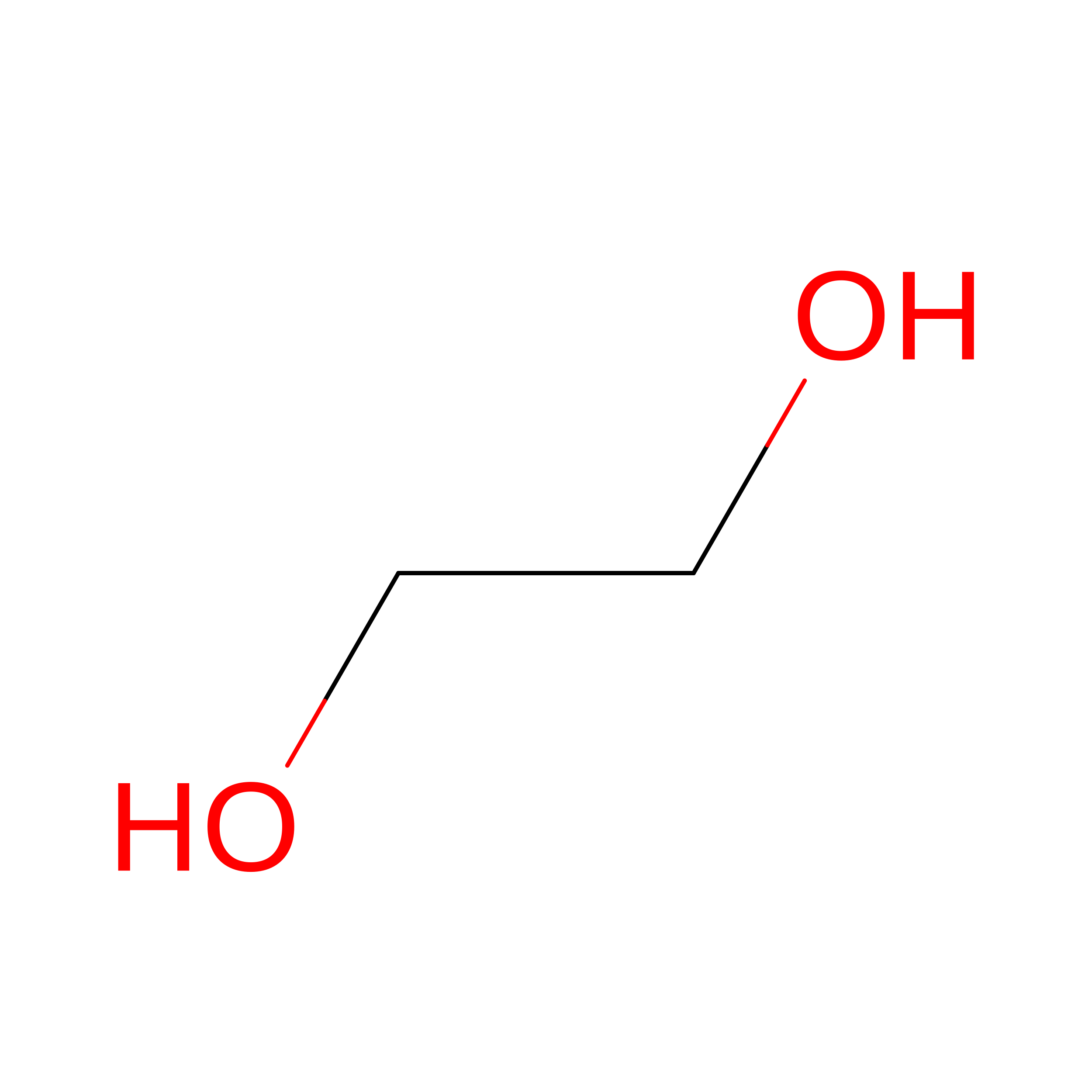
1,2-ETHANEDIOL
C2 H6 O2
LYCAIKOWRPUZTN-UHFFFAOYSA-N

Experimental Data & Validation

Experimental Data

  • Method: X-RAY DIFFRACTION
  • Resolution: 2.07 Å
  • R-Value Free:  0.260 (Depositor), 0.263 (DCC) 
  • R-Value Work:  0.216 (Depositor), 0.221 (DCC) 
  • R-Value Observed: 0.219 (Depositor) 
Space Group: P 1 21 1
Unit Cell:
Length ( Å )Angle ( ˚ )
a = 53.48α = 90
b = 50.84β = 91.74
c = 88.26γ = 90
Software Package:
Software NamePurpose
REFMACrefinement
iMOSFLMdata reduction
SCALAdata scaling
PHASERphasing

Structure Validation

View Full Validation Report


Entry History 

& Funding Information

Deposition Data


Funding OrganizationLocationGrant Number
DEPARTMENT OF SCIENCE AND TECHNOLOGYIndia--

Revision History  (Full details and data files)

  • Version 1.0: 2016-02-03
    Type: Initial release
  • Version 1.1: 2016-04-20
    Changes: Database references
  • Version 1.2: 2023-11-08
    Changes: Data collection, Database references, Derived calculations, Refinement description