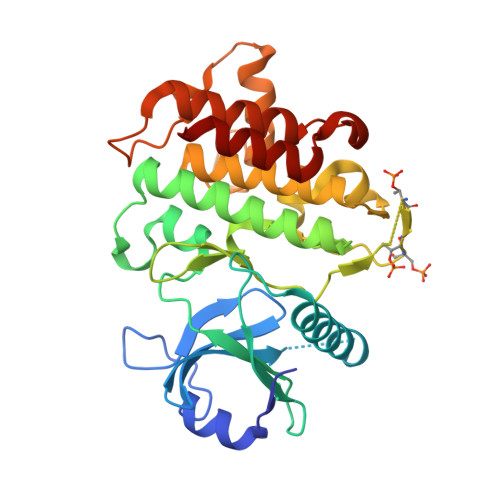
4YP8 | pdb_00004yp8

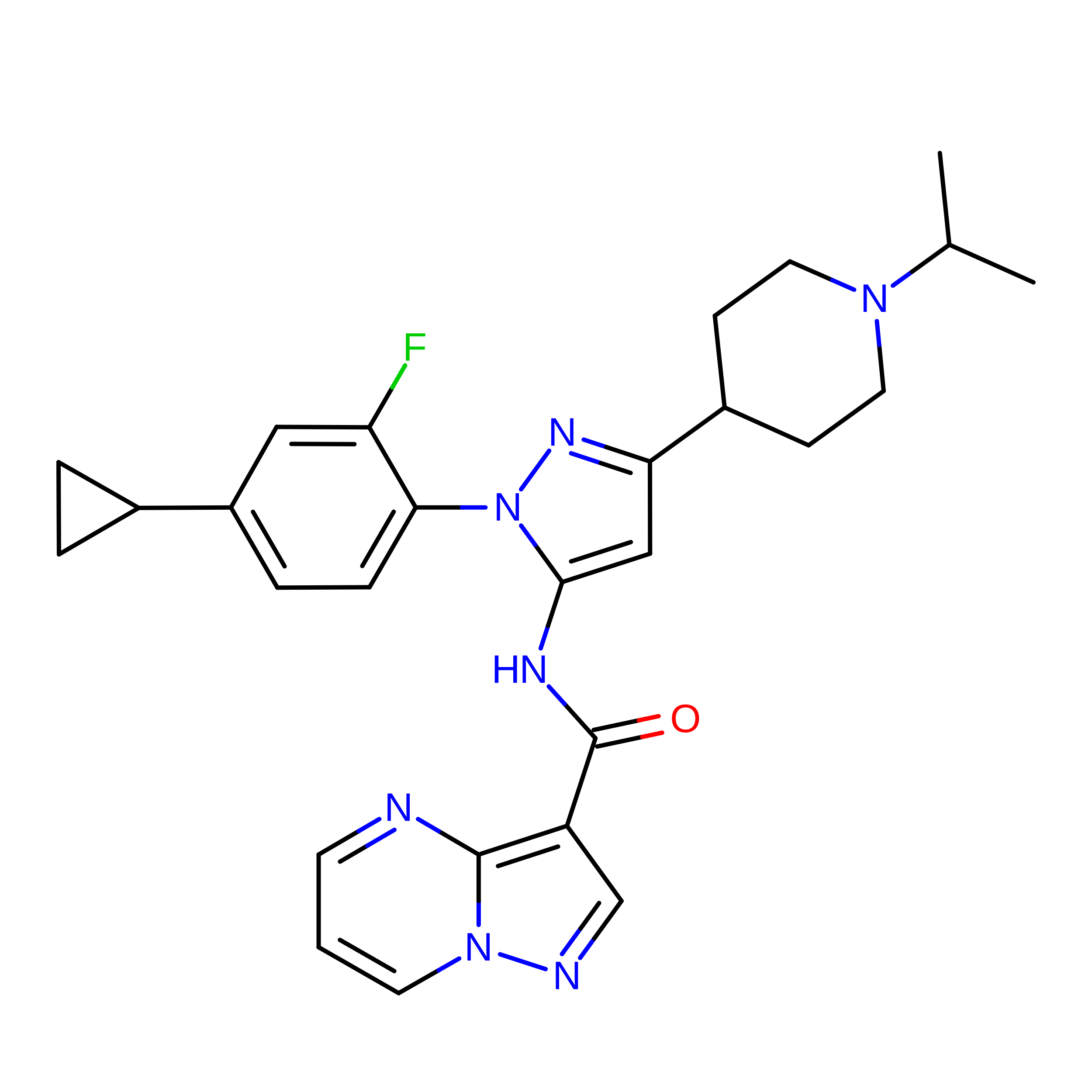
Irak4-inhibitor co-structure


Experimental Data Snapshot

  • Method: X-RAY DIFFRACTION
  • Resolution: 2.64 Å
  • R-Value Free: 
    0.219 (Depositor), 0.244 (DCC) 
  • R-Value Work: 
    0.192 (Depositor) 
  • R-Value Observed: 
    0.193 (Depositor) 

Starting Model: experimental
View more details

wwPDB Validation 3D Report Full Report

Validation slider image for 4YP8

Ligand Structure Quality Assessment 


This is version 1.3 of the entry. See complete history

Literature

Potent and Selective Amidopyrazole Inhibitors of IRAK4 That Are Efficacious in a Rodent Model of Inflammation.

McElroy, W.T.Tan, Z.Ho, G.Paliwal, S.Li, G.Seganish, W.M.Tulshian, D.Tata, J.Fischmann, T.O.Sondey, C.Bian, H.Bober, L.Jackson, J.Garlisi, C.G.Devito, K.Fossetta, J.Lundell, D.Niu, X.

(2015) ACS Med Chem Lett 6: 677-682

  • DOI: https://doi.org/10.1021/acsmedchemlett.5b00106
  • Primary Citation Related Structures: 
    4YO6, 4YP8

  • PubMed Abstract: 

    IRAK4 is a critical upstream kinase in the IL-1R/TLR signaling pathway. Inhibition of IRAK4 is hypothesized to be beneficial in the treatment of autoimmune related disorders. A screening campaign identified a pyrazole class of IRAK4 inhibitors that were determined by X-ray crystallography to exhibit an unusual binding mode. SAR efforts focused on the identification of a potent and selective inhibitor with good aqueous solubility and rodent pharmacokinetics. Pyrazole C-3 piperidines were well tolerated, with N-sulfonyl analogues generally having good rodent oral exposure but poor solubility. N-Alkyl piperidines exhibited excellent solubility and reduced exposure. Pyrazoles possessing N-1 pyridine and fluorophenyl substituents were among the most active. Piperazine 32 was a potent enzyme inhibitor with good cellular activity. Compound 32 reduced the in vivo production of proinflammatory cytokines and was orally efficacious in a mouse antibody induced arthritis disease model of inflammation.


  • Organizational Affiliation
    • Discovery Chemistry, Structural Chemistry, In Vitro Pharmacology, and Respiratory and Immunology, Merck Research Laboratories , 2015 Galloping Hill Road, Kenilworth, New Jersey 07033, United States.

Macromolecule Content 

  • Total Structure Weight: 137.78 kDa 
  • Atom Count: 9,177 
  • Modeled Residue Count: 1,146 
  • Deposited Residue Count: 1,204 
  • Unique protein chains: 1

Macromolecules

Find similar proteins by:|  3D Structure
Entity ID: 1
MoleculeChains  Sequence LengthOrganismDetailsImage
Interleukin-1 receptor-associated kinase 4
A, B, C, D
301Homo sapiensMutation(s): 0 
Gene Names: IRAK4
EC: 2.7.11.1
UniProt & NIH Common Fund Data Resources
Find proteins for Q9NWZ3 (Homo sapiens)
Explore Q9NWZ3 
Go to UniProtKB:  Q9NWZ3
PHAROS:  Q9NWZ3
GTEx:  ENSG00000198001 
Entity Groups
Sequence Clusters30% Identity50% Identity70% Identity90% Identity95% Identity100% Identity
UniProt GroupQ9NWZ3
Sequence Annotations
Expand
Reference Sequence

Small Molecules

Modified Residues  2 Unique
IDChains TypeFormula2D DiagramParent
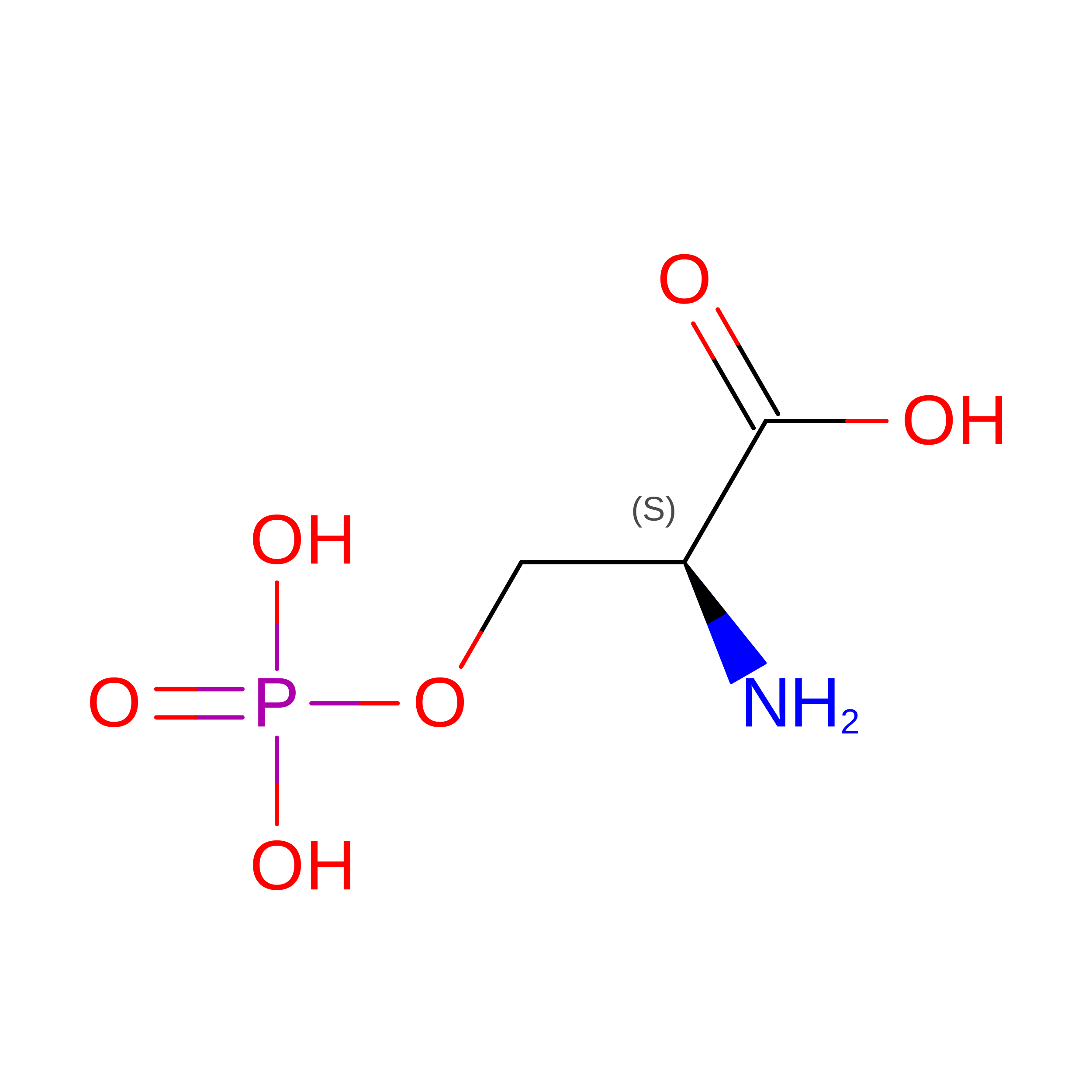
SEP
Query on SEP
A, B, C, D
L-PEPTIDE LINKINGC3 H8 N O6 PSER
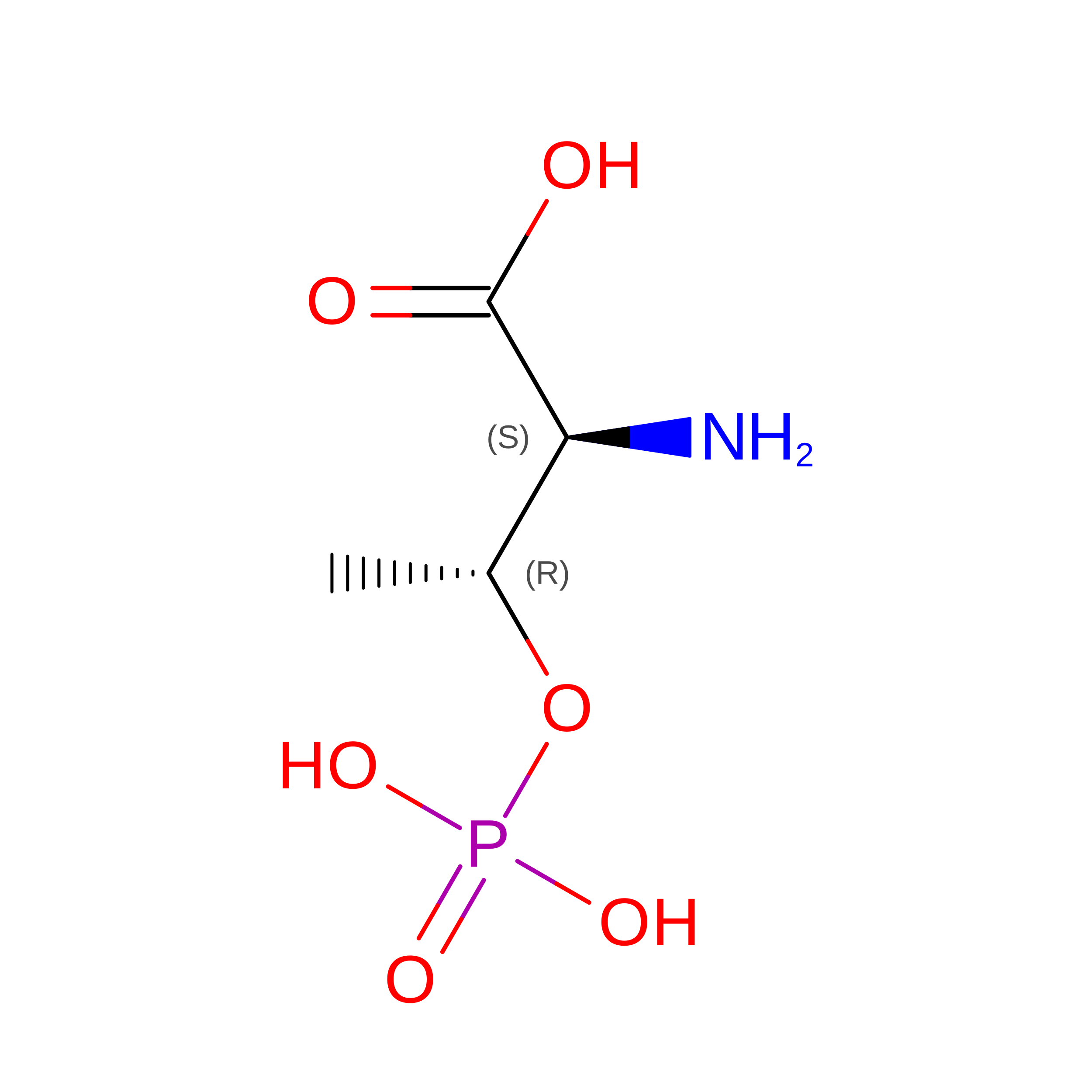
TPO
Query on TPO
A, B, C, D
L-PEPTIDE LINKINGC4 H10 N O6 PTHR

Experimental Data & Validation

Experimental Data

  • Method: X-RAY DIFFRACTION
  • Resolution: 2.64 Å
  • R-Value Free:  0.219 (Depositor), 0.244 (DCC) 
  • R-Value Work:  0.192 (Depositor) 
  • R-Value Observed: 0.193 (Depositor) 
Space Group: C 1 2 1
Unit Cell:
Length ( Å )Angle ( ˚ )
a = 144.01α = 90
b = 138.19β = 124.72
c = 88.08γ = 90
Software Package:
Software NamePurpose
SCALAdata scaling
BUSTERrefinement
PDB_EXTRACTdata extraction
XDSdata reduction

Structure Validation

View Full Validation Report


Ligand Structure Quality Assessment 


Entry History 

Deposition Data

Revision History  (Full details and data files)

  • Version 1.0: 2015-05-20
    Type: Initial release
  • Version 1.1: 2015-07-08
    Changes: Database references
  • Version 1.2: 2023-09-27
    Changes: Data collection, Database references, Derived calculations, Refinement description, Source and taxonomy
  • Version 1.3: 2024-10-09
    Changes: Structure summary