4WZ6 | pdb_00004wz6

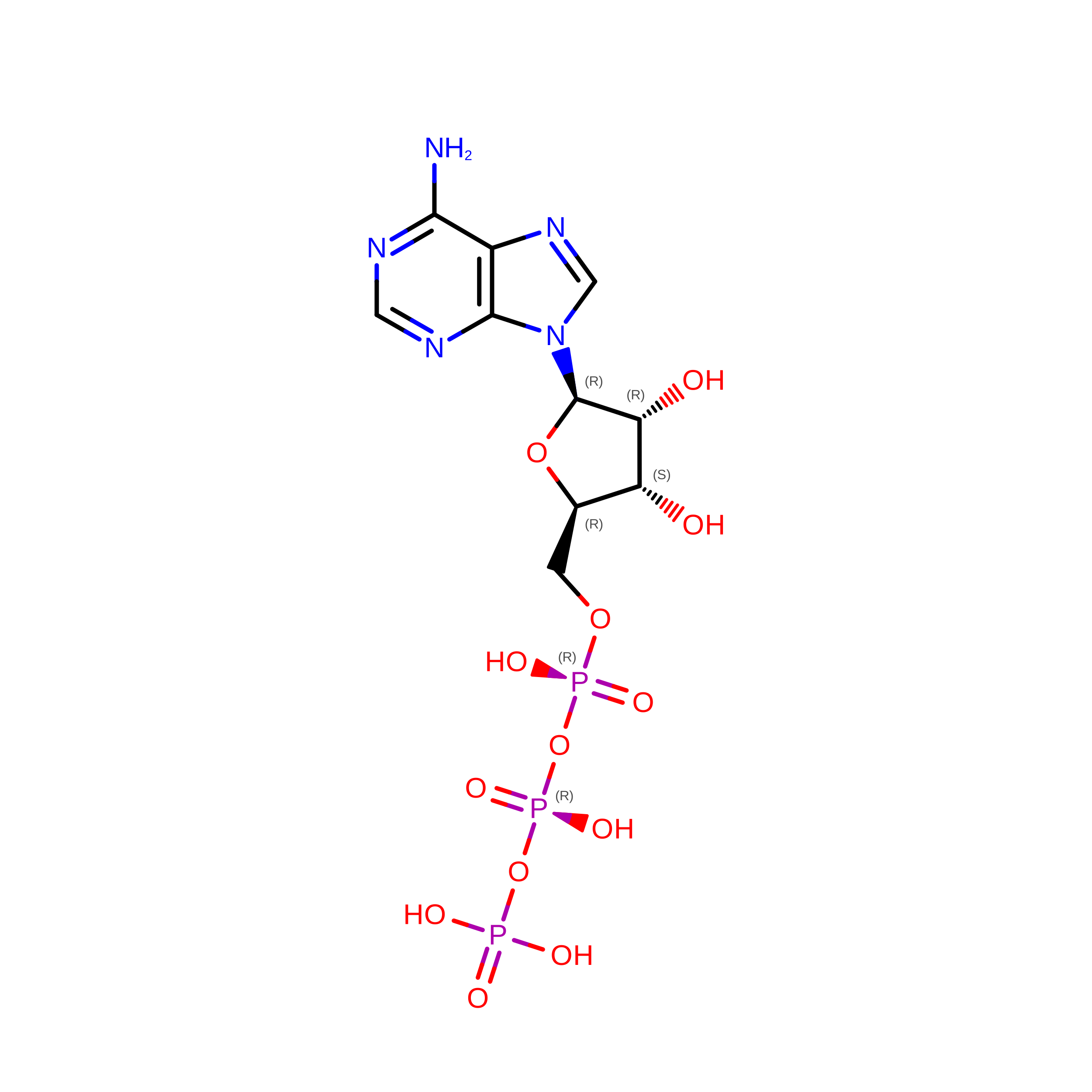
Human CFTR aa389-678 (NBD1), deltaF508 with three solubilizing mutations, bound ATP


Experimental Data Snapshot

  • Method: X-RAY DIFFRACTION
  • Resolution: 2.05 Å
  • R-Value Free: 
    0.239 (Depositor), 0.247 (DCC) 
  • R-Value Work: 
    0.195 (Depositor), 0.202 (DCC) 
  • R-Value Observed: 
    0.197 (Depositor) 

Starting Model: experimental
View more details

wwPDB Validation 3D Report Full Report

Validation slider image for 4WZ6

Ligand Structure Quality Assessment 


This is version 1.3 of the entry. See complete history

Literature

Binding screen for cystic fibrosis transmembrane conductance regulator correctors finds new chemical matter and yields insights into cystic fibrosis therapeutic strategy.

Hall, J.D.Wang, H.Byrnes, L.J.Shanker, S.Wang, K.Efremov, I.V.Chong, P.A.Forman-Kay, J.D.Aulabaugh, A.E.

(2016) Protein Sci 25: 360-373

  • DOI: https://doi.org/10.1002/pro.2821
  • Primary Citation Related Structures: 
    4WZ6

  • PubMed Abstract: 

    The most common mutation in cystic fibrosis (CF) patients is deletion of F508 (ΔF508) in the first nucleotide binding domain (NBD1) of the CF transmembrane conductance regulator (CFTR). ΔF508 causes a decrease in the trafficking of CFTR to the cell surface and reduces the thermal stability of isolated NBD1; it is well established that both of these effects can be rescued by additional revertant mutations in NBD1. The current paradigm in CF small molecule drug discovery is that, like revertant mutations, a path may exist to ΔF508 CFTR correction through a small molecule chaperone binding to NBD1. We, therefore, set out to find small molecule binders of NBD1 and test whether it is possible to develop these molecules into potent binders that increase CFTR trafficking in CF-patient-derived human bronchial epithelial cells. Several fragments were identified that bind NBD1 at either the CFFT-001 site or the BIA site. However, repeated attempts to improve the affinity of these fragments resulted in only modest gains. Although these results cannot prove that there is no possibility of finding a high-affinity small molecule binder of NBD1, they are discouraging and lead us to hypothesize that the nature of these two binding sites, and isolated NBD1 itself, may not contain the features needed to build high-affinity interactions. Future work in this area may, therefore, require constructs including other domains of CFTR in addition to NBD1, if high-affinity small molecule binding is to be achieved.


  • Organizational Affiliation
    • Structural Biology and Biophysics Group, Pfizer, Groton, Connecticut, 06340.

Macromolecule Content 

  • Total Structure Weight: 32.92 kDa 
  • Atom Count: 2,106 
  • Modeled Residue Count: 258 
  • Deposited Residue Count: 290 
  • Unique protein chains: 1

Macromolecules

Find similar proteins by:|  3D Structure
Entity ID: 1
MoleculeChains  Sequence LengthOrganismDetailsImage
Cystic fibrosis transmembrane conductance regulator290Homo sapiensMutation(s): 4 
Gene Names: CFTRABCC7
EC: 3.6.3.49 (PDB Primary Data), 5.6.1.6 (UniProt)
UniProt & NIH Common Fund Data Resources
Find proteins for P13569 (Homo sapiens)
Explore P13569 
Go to UniProtKB:  P13569
PHAROS:  P13569
GTEx:  ENSG00000001626 
Entity Groups
Sequence Clusters30% Identity50% Identity70% Identity90% Identity95% Identity100% Identity
UniProt GroupP13569
Sequence Annotations
Expand
Reference Sequence

Small Molecules

Experimental Data & Validation

Experimental Data

  • Method: X-RAY DIFFRACTION
  • Resolution: 2.05 Å
  • R-Value Free:  0.239 (Depositor), 0.247 (DCC) 
  • R-Value Work:  0.195 (Depositor), 0.202 (DCC) 
  • R-Value Observed: 0.197 (Depositor) 
Space Group: P 43 21 2
Unit Cell:
Length ( Å )Angle ( ˚ )
a = 101.456α = 90
b = 101.456β = 90
c = 58.335γ = 90
Software Package:
Software NamePurpose
Aimlessdata scaling
REFMACrefinement
PDB_EXTRACTdata extraction
PHASERphasing

Structure Validation

View Full Validation Report


Ligand Structure Quality Assessment 


Entry History 

Deposition Data

Revision History  (Full details and data files)

  • Version 1.0: 2015-11-11
    Type: Initial release
  • Version 1.1: 2016-02-10
    Changes: Database references
  • Version 1.2: 2017-11-22
    Changes: Database references, Derived calculations, Refinement description
  • Version 1.3: 2023-09-27
    Changes: Data collection, Database references, Derived calculations, Refinement description