4WN4 | pdb_00004wn4

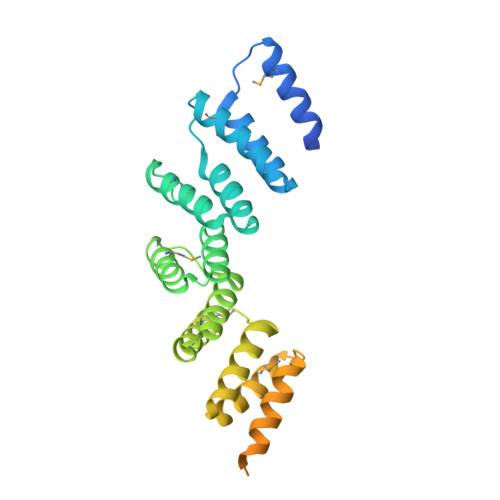
Crystal structure of designed cPPR-polyA protein


Experimental Data Snapshot

  • Method: X-RAY DIFFRACTION
  • Resolution: 3.85 Å
  • R-Value Free: 
    0.230 (Depositor), 0.240 (DCC) 
  • R-Value Work: 
    0.179 (Depositor), 0.188 (DCC) 
  • R-Value Observed: 
    0.184 (Depositor) 

Starting Model: experimental
View more details

wwPDB Validation 3D Report Full Report

Validation slider image for 4WN4

This is version 1.4 of the entry. See complete history

Literature

An artificial PPR scaffold for programmable RNA recognition.

Coquille, S.Filipovska, A.Chia, T.Rajappa, L.Lingford, J.P.Razif, M.F.Thore, S.Rackham, O.

(2014) Nat Commun 5: 5729-5729

  • DOI: https://doi.org/10.1038/ncomms6729
  • Primary Citation Related Structures: 
    4PJQ, 4PJR, 4PJS, 4WN4, 4WSL

  • PubMed Abstract: 

    Pentatricopeptide repeat (PPR) proteins control diverse aspects of RNA metabolism in eukaryotic cells. Although recent computational and structural studies have provided insights into RNA recognition by PPR proteins, their highly insoluble nature and inconsistencies between predicted and observed modes of RNA binding have restricted our understanding of their biological functions and their use as tools. Here we use a consensus design strategy to create artificial PPR domains that are structurally robust and can be programmed for sequence-specific RNA binding. The atomic structures of these artificial PPR domains elucidate the structural basis for their stability and modelling of RNA-protein interactions provides mechanistic insights into the importance of RNA-binding residues and suggests modes of PPR-RNA association. The modular mode of RNA binding by PPR proteins holds great promise for the engineering of new tools to target RNA and to understand the mechanisms of gene regulation by natural PPR proteins.


  • Organizational Affiliation
    • Department of Molecular Biology, University of Geneva, Science III, 30, Quai Ernest-Ansermet, Geneva 4 1211, Switzerland.

Macromolecule Content 

  • Total Structure Weight: 66.45 kDa 
  • Atom Count: 3,216 
  • Modeled Residue Count: 420 
  • Deposited Residue Count: 606 
  • Unique protein chains: 1

Macromolecules

Find similar proteins by:|  3D Structure
Entity ID: 1
MoleculeChains  Sequence LengthOrganismDetailsImage
Pentatricopeptide repeat protein
A, B
303synthetic constructMutation(s): 0 

Small Molecules

Modified Residues  1 Unique
IDChains TypeFormula2D DiagramParent
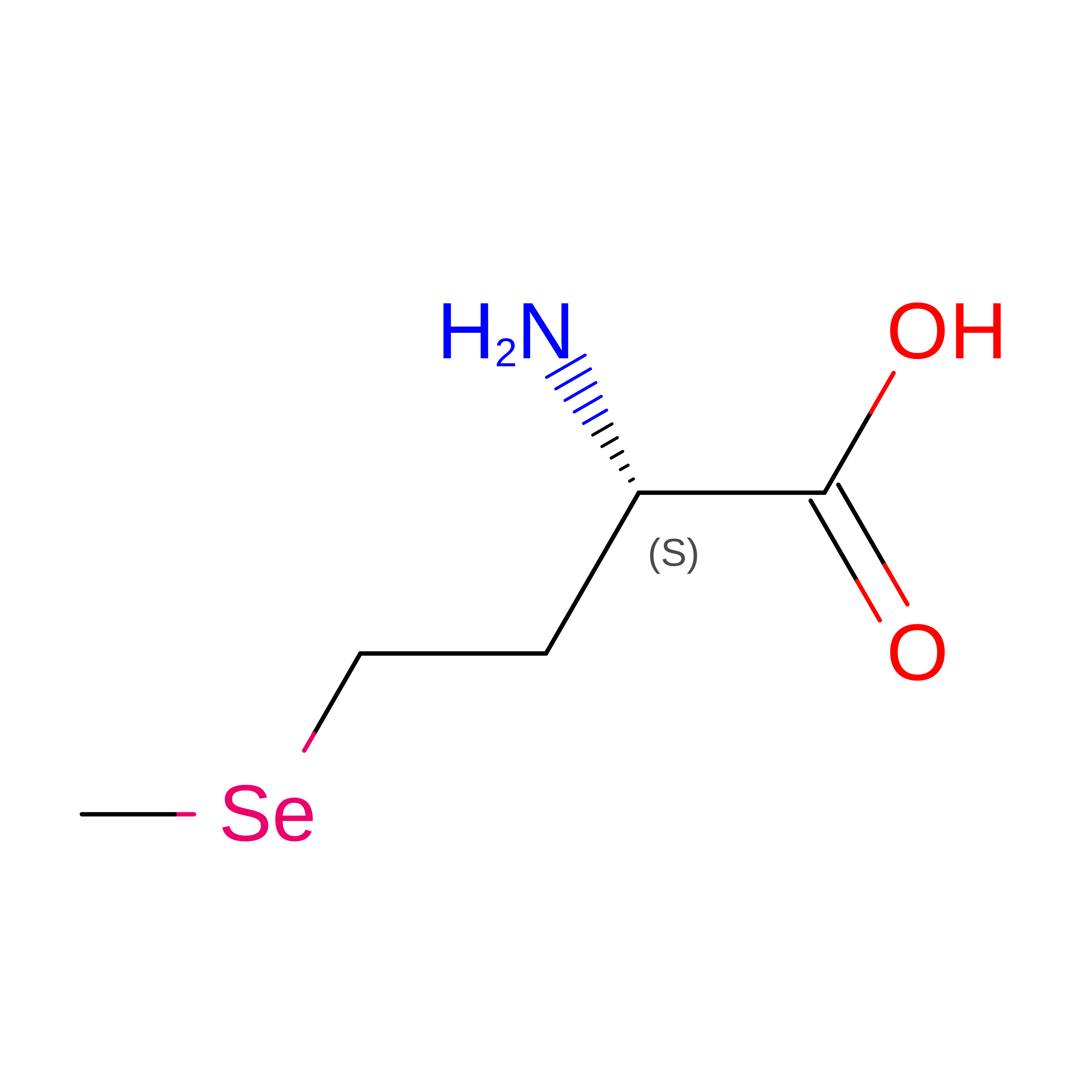
MSE
Query on MSE
A, B
L-PEPTIDE LINKINGC5 H11 N O2 SeMET

Experimental Data & Validation

Experimental Data

  • Method: X-RAY DIFFRACTION
  • Resolution: 3.85 Å
  • R-Value Free:  0.230 (Depositor), 0.240 (DCC) 
  • R-Value Work:  0.179 (Depositor), 0.188 (DCC) 
  • R-Value Observed: 0.184 (Depositor) 
Space Group: F 2 3
Unit Cell:
Length ( Å )Angle ( ˚ )
a = 204.72α = 90
b = 204.72β = 90
c = 204.72γ = 90
Software Package:
Software NamePurpose
XDSdata reduction
XSCALEdata scaling
Cootmodel building
PHASERphasing
PHENIXrefinement

Structure Validation

View Full Validation Report


Entry History 

& Funding Information

Deposition Data


Funding OrganizationLocationGrant Number
Swiss National Science FoundationSwitzerland316030-128787
Swiss National Science FoundationSwitzerland31003A_140924
Swiss National Science FoundationSwitzerland31003A_124909
Novartis Foundation for medical-biological researchSwitzerland09A07
Australian Research CouncilAustraliaFT0991008
Australian Research CouncilAustraliaFT0991113
Australian Research CouncilAustraliaDP140104111
National Health and Medical Research CouncilAustraliaAPP1058442
National Health and Medical Research CouncilAustraliaAPP1045677

Revision History  (Full details and data files)

  • Version 1.0: 2014-12-24
    Type: Initial release
  • Version 1.1: 2016-07-20
    Changes: Database references
  • Version 1.2: 2018-03-07
    Changes: Source and taxonomy, Structure summary
  • Version 1.3: 2024-01-10
    Changes: Data collection, Database references, Refinement description
  • Version 1.4: 2024-10-16
    Changes: Structure summary