4UQG | pdb_00004uqg

A new bio-isosteric base pair based on reversible bonding


Experimental Data Snapshot

  • Method: X-RAY DIFFRACTION
  • Resolution: 2.00 Å
  • R-Value Free: 
    0.211 (Depositor), 0.219 (DCC) 
  • R-Value Work: 
    0.178 (Depositor), 0.190 (DCC) 
  • R-Value Observed: 
    0.180 (Depositor) 

Starting Model: experimental
View more details

wwPDB Validation 3D Report Full Report

Validation slider image for 4UQG

This is version 2.1 of the entry. See complete history

Literature

"Post-it" type connected DNA created with a reversible covalent cross-link.

Tomas-Gamasa, M.Serdjukow, S.Su, M.Muller, M.Carell, T.

(2015) Angew Chem Int Ed Engl 54: 796-800

  • DOI: https://doi.org/10.1002/anie.201407854
  • Primary Citation Related Structures: 
    4UQG

  • PubMed Abstract: 

    We report the development of a new heterobase that is held together through reversible bonding. The so-formed cross-link adds strong stabilization to the DNA duplex. Despite this, the cross-link opens and closes through reversible imine bonding. Moreover, even enzymatic incorporation of the cross-link is possible. The new principle can be used to stabilize DNA duplexes and nanostructures that otherwise require high salt concentrations, which may hinder biological applications.


  • Organizational Affiliation
    • Department of Chemistry and Pharmacy, Ludwig-Maximilians-Universität München, Butenandtstrasse 5-13, 81377 München (Germany) http://www.carellgroup.de.

Macromolecule Content 

  • Total Structure Weight: 73.02 kDa 
  • Atom Count: 5,208 
  • Modeled Residue Count: 599 
  • Deposited Residue Count: 599 
  • Unique protein chains: 1
  • Unique nucleic acid chains: 2

Macromolecules


Find similar proteins by:|  3D Structure
Entity ID: 1
MoleculeChains  Sequence LengthOrganismDetailsImage
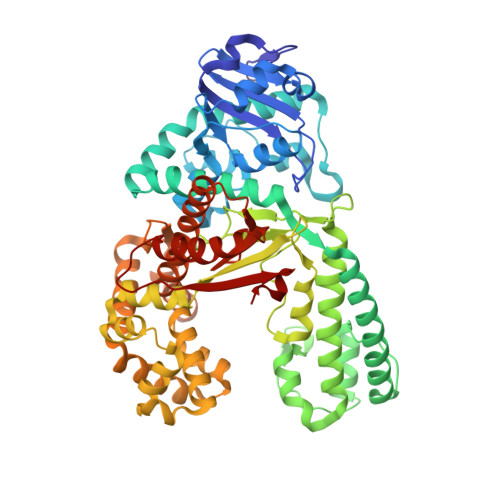
DNA POLYMERASE579Geobacillus stearothermophilusMutation(s): 0 
EC: 2.7.7.7
UniProt
Find proteins for E1C9K5 (Geobacillus stearothermophilus)
Explore E1C9K5 
Go to UniProtKB:  E1C9K5
Entity Groups
Sequence Clusters30% Identity50% Identity70% Identity90% Identity95% Identity100% Identity
UniProt GroupE1C9K5
Sequence Annotations
Expand
Reference Sequence
Find similar nucleic acids by:  Sequence
Entity ID: 2
MoleculeChains LengthOrganismImage
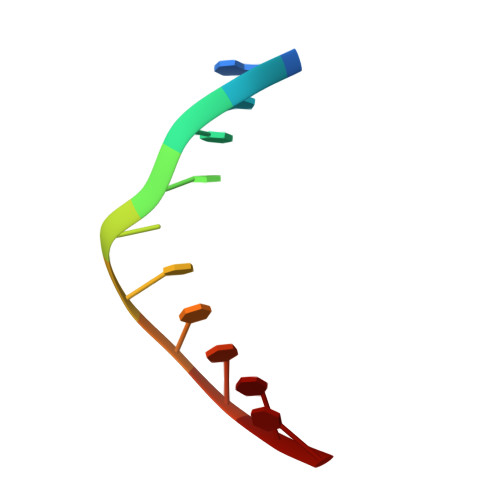
5'-D(*GP*AP*CP*C T0TP*TP*CP*CP*CP*TP)-3'10synthetic construct
Sequence Annotations
Expand
Reference Sequence
Find similar nucleic acids by:  Sequence
Entity ID: 3
MoleculeChains LengthOrganismImage
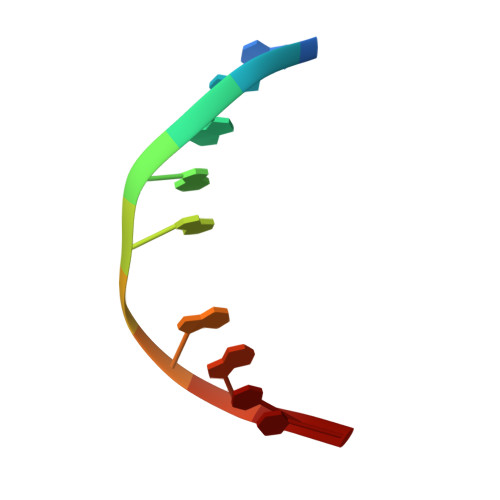
5'-D(*AP*GP*GP*GP*A SAYP*GP*GP*TP*CP)-3'10synthetic construct
Sequence Annotations
Expand
Reference Sequence

Oligosaccharides

Help  
Entity ID: 4
MoleculeChains Length2D Diagram GlycosylationD Interactions
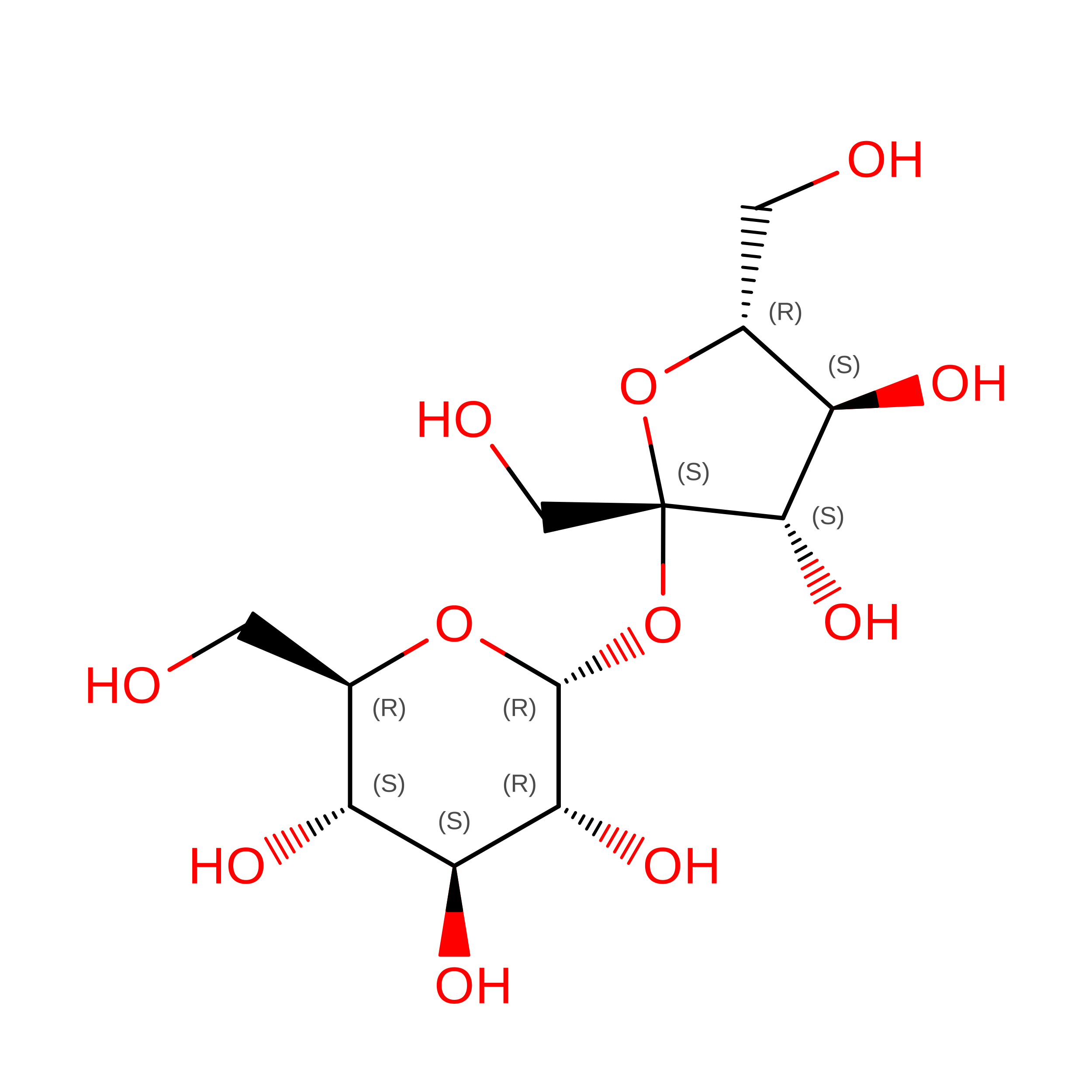
beta-D-fructofuranose-(2-1)-alpha-D-glucopyranose
D
2N/A
Glycosylation Resources
GlyTouCan: G05551OP
GlyCosmos: G05551OP

Biologically Interesting Molecules (External Reference) 

1 Unique

Experimental Data & Validation

Experimental Data

  • Method: X-RAY DIFFRACTION
  • Resolution: 2.00 Å
  • R-Value Free:  0.211 (Depositor), 0.219 (DCC) 
  • R-Value Work:  0.178 (Depositor), 0.190 (DCC) 
  • R-Value Observed: 0.180 (Depositor) 
Space Group: P 21 21 21
Unit Cell:
Length ( Å )Angle ( ˚ )
a = 87.442α = 90
b = 93.996β = 90
c = 105.416γ = 90
Software Package:
Software NamePurpose
REFMACrefinement
XDSdata reduction
PHASERphasing

Structure Validation

View Full Validation Report


Entry History 

Deposition Data

Revision History  (Full details and data files)

  • Version 1.0: 2014-12-03
    Type: Initial release
  • Version 1.1: 2014-12-10
    Changes: Database references, Other, Refinement description
  • Version 1.2: 2015-01-28
    Changes: Database references
  • Version 1.3: 2017-08-23
    Changes: Advisory, Data collection
  • Version 1.4: 2019-02-20
    Changes: Data collection, Database references, Derived calculations, Source and taxonomy
  • Version 2.0: 2020-07-29
    Type: Remediation
    Reason: Carbohydrate remediation
    Changes: Atomic model, Data collection, Derived calculations, Non-polymer description, Other, Structure summary
  • Version 2.1: 2024-01-10
    Changes: Data collection, Database references, Refinement description, Structure summary